
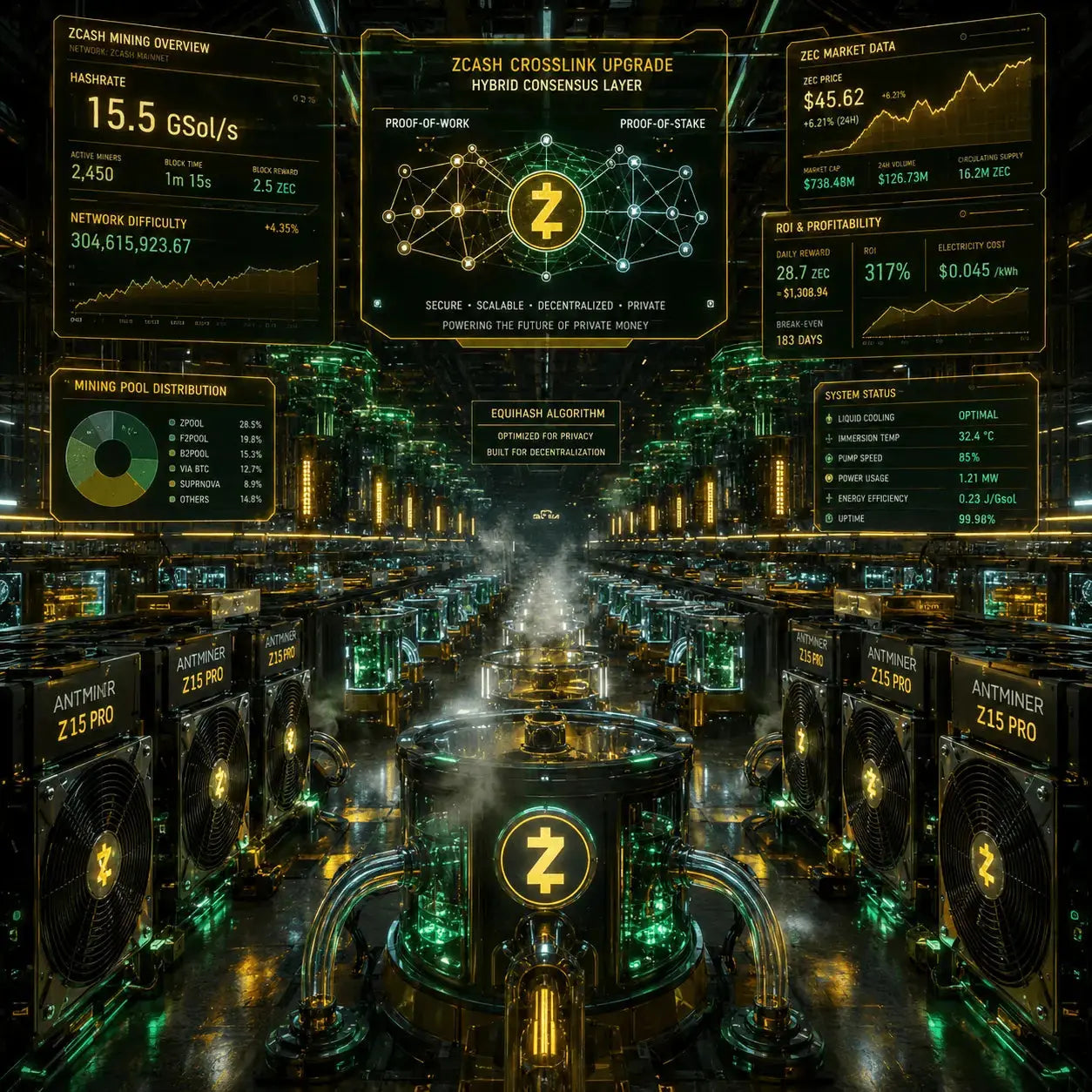
A medida que el mercado mundial de criptomonedas entra en un nuevo ciclo estructural, los activos digitales centrados en la privacidad están atrayendo una vez más capital institucional y la atención de los inversores a largo plazo. Entre todas las redes de prueba de trabajo orientadas a la privacidad, Zcash (ZEC) sigue siendo uno de los ecosistemas más maduros técnicamente y económicamente más importantes.
Sin embargo, la minería de Zcash en 2026 es fundamentalmente diferente del entorno de alto margen que experimentaron los mineros hace varios años. Tras el evento de reducción a la mitad de 2024, las recompensas en bloque se redujeron a 1,5625 ZEC, mientras que solo el 80% de esa recompensa se asigna a los mineros. Al mismo tiempo, la dificultad de la red sigue siendo elevada, la competencia de los ASIC se ha intensificado y importantes cambios regulatorios y de gobernanza están comenzando a remodelar el ecosistema.
Para los mineros modernos, la rentabilidad ya no se determina simplemente comprando hardware y conectándolo a un grupo de minería. El éxito ahora depende de una combinación de:
- Costos de electricidad ultrabajos
- Infraestructura ASIC de alta eficiencia
- Sistemas de refrigeración avanzados
- Estrategias sofisticadas de tesorería y cobertura
- Adaptabilidad a cambios a nivel de protocolo
Esta guía proporciona una descripción general completa del panorama minero de Zcash 2026, que cubre los fundamentos de la red, la competencia de hardware ASIC, los modelos de rentabilidad, la centralización del grupo de minería, las estrategias de optimización operativa y las implicaciones a largo plazo de la próxima actualización del consenso híbrido Crosslink.
¿Por qué la minería Zcash seguirá siendo importante en 2026?
Conclusión principal: A pesar de la presión posterior a la reducción a la mitad y la turbulencia de la gobernanza, la creciente demanda de privacidad financiera y el renovado interés institucional continúan fortaleciendo la tesis de inversión a largo plazo de Zcash.
La reducción a la mitad de 2024 marcó un importante punto de inflexión para el ecosistema de Zcash. Las recompensas por bloque cayeron a 1,5625 ZEC por bloque, y los mineros recibieron solo el 80% de la emisión, mientras que el 20% restante se asigna a fondos de desarrollo del ecosistema.
Esto comprimió drásticamente los ingresos de los mineros por unidad de hashpower.
Sin embargo, la red no colapsó.
En cambio, en 2025-2026 se produjo un resurgimiento más amplio de las criptonarrativas centradas en la privacidad. A medida que las herramientas de análisis de blockchain basadas en IA se volvieron cada vez más sofisticadas, la privacidad financiera resurgió como una preocupación crítica para las instituciones, empresas y usuarios de alto patrimonio neto.
Varios acontecimientos institucionales aceleraron aún más la confianza del mercado:
- Iniciativas de inversión en privacidad respaldadas por Winklevoss
- Acumulación estratégica por Digital Currency Group (DCG)
- El impulso de Grayscale hacia una estructura ETF de Zcash
- Expansión de la infraestructura minera que cumple con las normas de América del Norte
Estos catalizadores ayudaron a impulsar los precios de ZEC al rango de más de $ 600 durante las condiciones máximas del mercado en 2026.
Incluso la gran crisis de liderazgo en Electric Coin Company (ECC) a principios de 2026, incluida la salida de ejecutivos e investigadores clave, no logró desestabilizar fundamentalmente la red. En cambio, la Fundación Zcash reforzó rápidamente la continuidad de la gobernanza, demostrando que el modelo de seguridad de Zcash no depende de una sola organización.
Para la primavera de 2026:
- La tasa de hash de la red se estabilizó entre 13 y 15,5 GSol/s
- La dificultad se mantuvo en el rango 136M-142M
- La participación de las mineras se mantuvo resistente a pesar de la economía posterior a la mitad
Estas métricas sugieren que la confianza en la viabilidad a largo plazo de la red sigue siendo fuerte.
¿Por qué el Antminer Z15 Pro ¿Sigues dominando la minería Zcash?
Conclusión principal: Bitmain continúa manteniendo un dominio casi total sobre el sector Equihash ASIC, y el Antminer Z15 Pro sigue siendo la plataforma minera más viable comercialmente en 2026.
Zcash utiliza el algoritmo Equihash 200/9, que por diseño tiene mucha memoria. Esto aumenta significativamente la complejidad del desarrollo de ASIC porque el rendimiento depende no sólo de la potencia informática bruta, sino también de la arquitectura de memoria de gran ancho de banda.
Como resultado, el mercado de Equihash ASIC sigue estando muy concentrado.
El estándar indiscutible de la industria en 2026 seguirá siendo:
Bitmain Antminer Z15 Pro
Especificaciones clave
- Tasa de hash: 840–860 KSol/s
- Consumo de energía: 2780W
- Eficiencia: 3,15–3,31 J/KSol
- Precio del mercado secundario: $1500–$2000
El dominio del Z15 Pro no se trata simplemente de hashrate. Su verdadera ventaja radica en:
- Estabilidad probada a largo plazo
- Ecosistema de firmware maduro
- Comportamiento térmico confiable
- Fuerte soporte posventa
- Alta previsibilidad operativa
Durante 2025-2026, Bitmain dio prioridad a la capacidad de semiconductores avanzada para los mineros SHA-256 y RandomX, dejando al sector Equihash sin un verdadero sucesor de próxima generación.
Aunque circularon por todo el mercado rumores sobre los mineros de clase Z17 y Z19, no ha surgido ningún reemplazo masivo.
Como resultado, el Z15 Pro sigue siendo el estándar de facto para la minería Equihash a escala industrial.
¿Por qué las nuevas marcas como Pinecone no han cambiado el mercado?
Conclusión principal: la mayoría de las marcas de ASIC de “nueva generación” en realidad no compiten en el ecosistema de Equihash.
Algunos mineros inicialmente creyeron que INIBOX Pro de Pinecone se convertiría en un importante competidor de Bitmain.
En realidad, la serie INIBOX apunta principalmente al algoritmo VersaHash en lugar de Equihash 200/9.
Por lo tanto, no compite materialmente con la infraestructura minera de Zcash.
A partir de 2026, Bitmain sigue siendo la fuerza dominante en la industria de Equihash ASIC sin ningún rival significativo.
¿Siguen siendo viables los mineros más antiguos como el Z15 y el Z11?
Conclusión principal: fuera de las regiones con electricidad ultrabaja, los ASIC Equihash más antiguos se están volviendo obsoletos rápidamente.
Antminero Z15
- Tasa de hash: 420 KSol/s
- Consumo de energía: 1510W
- Eficiencia: ~3,6 J/KSol
El Z15 aún conserva una viabilidad limitada en entornos energéticos de coste excepcionalmente bajo.
Sin embargo, su perfil de retorno de la inversión es cada vez más inferior al del Z15 Pro.
Antminero Z11
El Z11 está ahora prácticamente a punto de jubilarse.
Su eficiencia supera los 10 J/KSol, lo que hace que una operación rentable sea casi imposible en las difíciles condiciones modernas.
A menos que los mineros tengan acceso a fuentes de energía abandonadas o casi gratuitas, el despliegue continuo rara vez tiene sentido financiero.
¿Por qué el coste de la electricidad será la variable más importante en 2026?
Conclusión principal: En la era posterior al halving, el costo de la electricidad se ha convertido en el determinante más importante de la supervivencia de la minería.
Para los mineros de Zcash, el panorama competitivo se ha alejado de la acumulación de hardware y se ha orientado hacia la optimización energética.
Un solo Z15 Pro consume aproximadamente:
- 2780W
- ~66,72 kWh por día
En:
0,04 $/kWh
El costo diario de electricidad es aproximadamente:
- $2.67
En condiciones de precios fuertes de la ZEC, esto deja un margen operativo sustancial.
Sin embargo, en:
0,08$/kWh
Los costos diarios de energía aumentan a:
- $5.34
Durante las crisis del mercado, esto puede borrar por completo la rentabilidad.
En términos prácticos:
La minería moderna de Zcash se ha convertido en un negocio de arbitraje energético.
Sólo los operadores capaces de mantener costos de electricidad por debajo de $0,05/kWh probablemente seguirán siendo consistentemente rentables a lo largo de múltiples ciclos de mercado.
¿Por qué el panorama de los pools mineros está cambiando tan rápidamente?
Conclusión principal: El capital institucional y el cumplimiento normativo están remodelando rápidamente la infraestructura minera de Zcash.
Históricamente, ViaBTC controlaba más del 60% del hashrate de la red Zcash.
Este nivel de concentración generó preocupaciones persistentes sobre una posible vulnerabilidad de ataque del 51%.
En 2026, Foundry Digital, propiedad de DCG, ingresó agresivamente al ecosistema Zcash.
En unos meses:
- Foundry capturó más del 27% del hashrate de la red
- La participación de ViaBTC disminuyó significativamente
A diferencia de los pools tradicionales, la ventaja competitiva de Foundry es la infraestructura de cumplimiento.
La piscina requiere:
- KYC obligatorio
- Solo direcciones transparentes
- Sin pagos de direcciones blindadas
Esto representa un cambio filosófico importante.
La infraestructura minera institucional está empujando efectivamente a Zcash hacia un marco de "privacidad regulada".
Para muchos miembros antiguos de la comunidad, esto crea un grave conflicto ideológico:
Si las monedas de privacidad pierden protecciones de privacidad funcionales, su propuesta de valor central puede debilitarse.
¿Por qué se están volviendo estándar los sistemas de inmersión y refrigeración por agua?
Conclusión principal: La ingeniería térmica se ha convertido en un impulsor directo de la rentabilidad minera.
En condiciones de alta temperatura, el Z15 Pro es propenso a sufrir estrangulamiento térmico.
Esto reduce la tasa de hash efectiva y acelera la degradación del hardware.
Como resultado, las granjas mineras a gran escala dependen cada vez más de:
- Refrigeración por agua
- Enfriamiento por inmersión
- Sistemas de recuperación de calor de circuito cerrado.
Los beneficios son sustanciales:
Estabilidad mejorada
Las temperaturas más bajas de los puntos calientes reducen la degradación del chip y mantienen un rendimiento constante.
Ruido reducido
La salida de ruido puede caer de 75 dB a menos de 50 dB.
Reutilización de energía
La energía térmica recuperada se puede reutilizar para:
- Calefacción de invernadero
- Secado industrial
- Construyendo sistemas climáticos
Algunas operaciones industriales reducen los costos operativos efectivos de energía entre un 10% y un 15% mediante la reutilización térmica.
¿Por qué la optimización del firmware se está convirtiendo en una ventaja competitiva?
Conclusión principal: la optimización a nivel de software es ahora una fuente importante de ventaja operativa.
Los mineros profesionales en 2026 rara vez utilizan configuraciones de firmware estándar.
En cambio, los operadores avanzados implementan firmware personalizado para:
- Sintonización de voltaje
- Escalado de frecuencia dinámico
- overclocking automatizado
- Optimización de la gestión de energía
Modo ecológico
Reduce el consumo de energía del Z15 Pro a aproximadamente 2100W.
Esto mejora significativamente la eficiencia durante los períodos de debilidad del mercado.
Modo de impulso
Cuando se combina con refrigeración líquida, los mineros pueden impulsar temporalmente el rendimiento más allá de 1 MSol/s durante condiciones de mercado altamente rentables.
Esto refleja un cambio más amplio en la industria:
La minería ya no es puramente un negocio de hardware: se ha convertido en una industria de optimización de hardware y software.
¿Por qué la actualización Crosslink podría remodelar completamente la minería Zcash?
Conclusión principal: La próxima transición de consenso híbrido puede convertirse en el mayor riesgo sistémico que enfrentan los mineros de ASIC.
Shielded Labs está desarrollando actualmente:
Enlace cruzado
Una arquitectura de consenso híbrida que introduce una capa de finalidad de prueba de participación además del sistema PoW existente de Zcash.
La implicación más crítica es económica:
La asignación de recompensas de los mineros de PoW puede disminuir del 80% al 40%.
Esto efectivamente reduciría los ingresos de los mineros a la mitad.
Según la hoja de ruta actual:
- Lanzamiento de redes de prueba incentivadas en el tercer trimestre de 2026
- La implementación de candidatos a actualización comienza en el primer trimestre de 2027
- La activación total puede ocurrir durante 2027
Esto cambia drásticamente los supuestos de inversión de ASIC.
Para los mineros que compren unidades Z15 Pro en 2026, la “ventana de alto rendimiento” realista puede durar solo de 8 a 10 meses antes de que el riesgo de transición del protocolo se vuelva dominante.
Cualquier modelo serio de retorno de la inversión debe incorporar este escenario.
¿Cuál es la mejor estrategia minera para 2026?
Conclusión principal: La rentabilidad sostenible ahora requiere energía de bajo costo, eficiencia operativa y una gestión de riesgos sofisticada.
Si los costos de electricidad son inferiores a $0,05/kWh
Estrategia recomendada:
- Implementar agresivamente la infraestructura Z15 Pro
- Implementar sistemas de refrigeración líquida.
- Acelerar la recuperación de CAPEX
- Utilice estrategias de cobertura de futuros
- Prepárese para una posible migración a cadenas compatibles con Equihash como Horizen (ZEN) o Komodo (KMD)
Este es actualmente el modelo operativo más competitivo.
Si los costos de electricidad exceden $0,07/kWh
Generalmente no se recomienda la inversión en ASIC a gran escala.
A precios de electricidad más altos:
- Los márgenes operativos colapsan rápidamente
- El riesgo de transición de reticulación se vuelve grave
- La depreciación del hardware se acelera
Para estos inversores, la exposición directa a ZEC a través de acumulación al contado o productos fiduciarios puede representar una estrategia más eficiente y de menor riesgo.



Deja un comentario
Este sitio está protegido por hCaptcha y se aplican la Política de privacidad de hCaptcha y los Términos del servicio.