
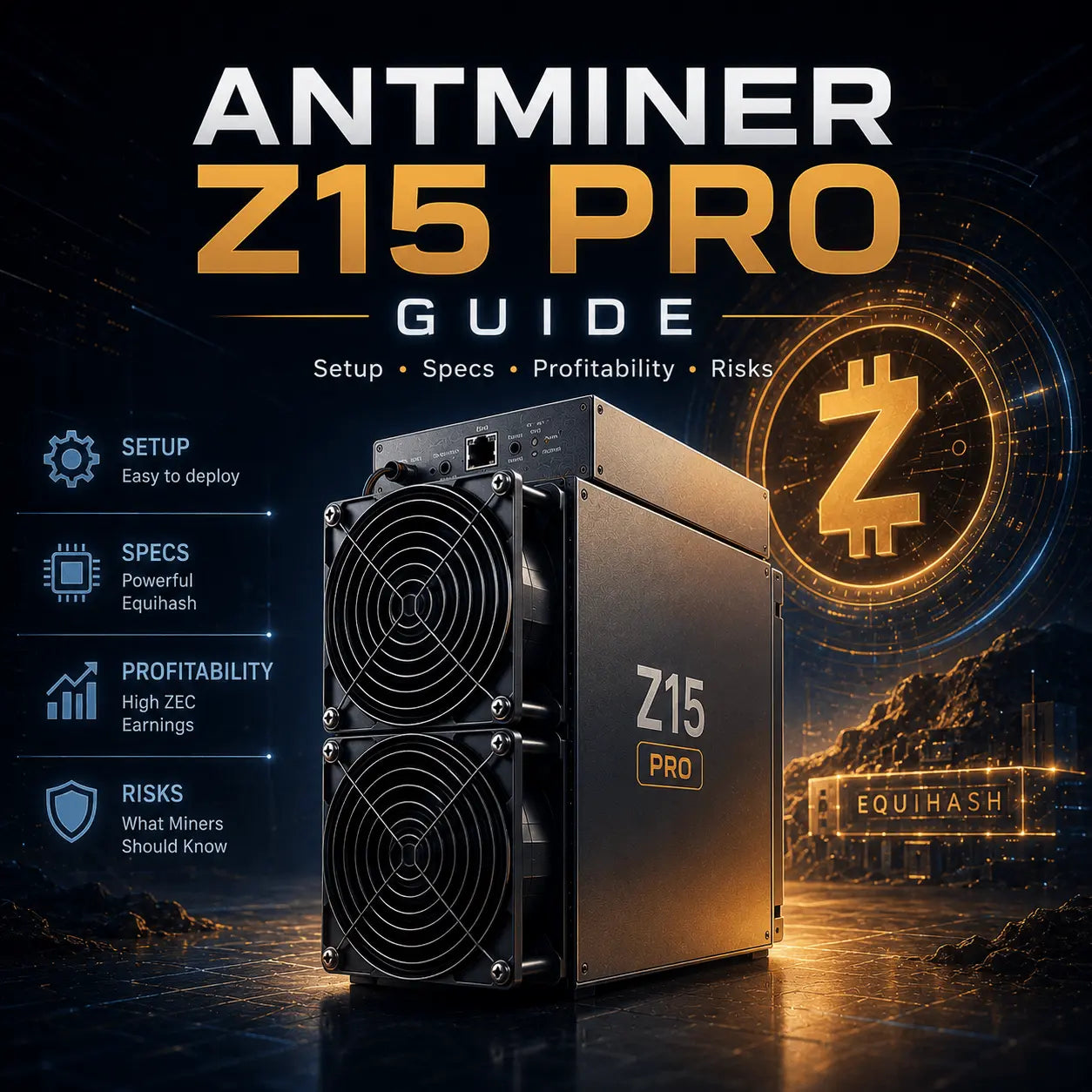
Guía completa de Antminer Z15 Pro
Especificaciones, configuración, costos y ajuste del comprador
Minería Equihash de 840 KSol/s · Consumo de energía de 2780 W · Eficiencia de 3,31 J/KSol · Compatibilidad ZEC y ZEN
En esta página
1Veredicto rápido
El Bitmain Antminer Z15 Pro es un ASIC Equihash de alto rendimiento diseñado para operadores que desean un hashrate concentrado de Zcash u Horizen en un chasis convencional refrigerado por aire. Bitmain enumera una tasa de hash típica de 840 KSol/s, 2780 vatios en la pared y una eficiencia de 3,31 J/KSol a 25°C. Esas cifras lo convierten en un paso importante por encima del Z15 estándar, pero no lo hacen automáticamente rentable.
La máquina debe estar en una sala de minería, un almacén o un sitio de alojamiento profesional exclusivo. Requiere una entrada de 200-240 VCA, consume una corriente sustancial, produce ruido industrial continuo y agota casi toda la electricidad consumida en forma de calor. Por lo tanto, los compradores deben evaluar el circuito eléctrico, el flujo de aire, el acceso a la piscina, la capacidad del servicio y el costo total de adquisición antes de comparar los resultados de la calculadora.
El Z15 Pro es una sólida plataforma Equihash para sitios administrados profesionalmente y de bajo costo. No es una buena opción para un espacio habitable, un tomacorriente estándar de 120 V o cualquier comprador que dependa de una única captura de pantalla optimista de ingresos.
2Especificaciones oficiales y lo que significan
Las cifras del fabricante son el punto de partida correcto porque las páginas de los revendedores a menudo mezclan revisiones o repiten valores obsoletos. Bitmain afirma que la tasa de hash puede fluctuar en un ±3%, mientras que la potencia y la eficiencia de la pared pueden fluctuar en un ±5%. Un presupuesto de producción debería utilizar esas tolerancias en lugar de asumir que cada unidad mantendrá el número típico de forma continua.
| Especificación | Valor oficial | Impacto de la planificación |
|---|---|---|
| Algoritmo / monedas | Equihash / ZEC, ZEN | Los ingresos están ligados a un mercado de algoritmos estrecho |
| tasa de hash típica | 840 ksol/s | Permitir una variación unitaria de ±3% |
| Toma de pared a 25°C | 2.780W | Aproximadamente 66,72 kWh al día |
| Eficiencia a 25°C | 3,31 J/KSol | Métrica clave para comparar los ASIC de Equihash |
| entrada de CA | 200-240 V, 50-60 Hz | Se debe confirmar la compatibilidad eléctrica. |
| Tamaño y peso | 428 × 195 × 290 mm; 16,9 kilogramos | Planificar la carga de los estantes y la autorización de servicio. |
| Ruido | 75 dBA máximo a 25°C | No apto para habitaciones ocupadas normalmente |
| Medio ambiente | 0-40°C; 10-90% HR, sin condensación | Las condiciones de ingesta afectan directamente la estabilidad. |
La potencia nominal de 2780 W no es una carga doméstica menor. Bitmain especifica dos entradas de CA a 10 A por cable y advierte que un voltaje de entrada incorrecto puede dañar el servidor. Un electricista calificado debe revisar el tamaño del circuito, la clasificación de los conductores, los disyuntores, los receptáculos y el cumplimiento de los códigos locales. No trate un adaptador económico como un diseño eléctrico.
3Qué confirmar antes de comprar
Comience con la unidad exacta, no solo con el nombre del producto. Solicite un número de serie, lote de producción, informe de condición, imagen actual del tablero, estado del tablero hash, lecturas del ventilador y un video que muestre el funcionamiento estable. Para equipos usados, pregunte si la unidad ha sido reparada, expuesta a la corrosión, operada en aire inusualmente polvoriento o operada con firmware de terceros.
A continuación, calcule el costo de destino. El precio del hardware es solo una línea. Incluya envío, seguro, aduanas, impuestos, tarifas de pago, trabajos eléctricos, espacio en rack, equipo de red, ventiladores de repuesto, tarifas de piscina y depósitos de alojamiento. La cobertura de la garantía también tiene valor práctico sólo cuando se puede acceder al vendedor, al fabricante y a la ruta de reparación desde su ubicación.
4Guía de configuración paso a paso
1. Prepare el sitio. Coloque el minero en una rejilla estable y no inflamable con vías de entrada y salida sin obstrucciones. Separe el escape caliente del aire de entrada para que la máquina no recicle su propio calor. Confirme que la temperatura y la humedad permanezcan dentro del rango oficial.
2. Inspeccione antes de energizar. Revise el chasis, los ventiladores, el tablero de control, los cables, los conectores y los tableros hash para detectar daños durante el envío o piezas sueltas. Conecte ambas entradas de CA requeridas y Ethernet solo después de que se haya verificado el circuito derivado.
3. Encuentra al minero en la red. Encienda la unidad, permita que se inicialice y luego identifique su dirección DHCP a través del enrutador o el flujo de trabajo oficial de IP Reporter de Bitmain. Abra esa dirección desde una computadora en la misma red local confiable.
4. Asegure la interfaz. Cambie las credenciales predeterminadas inmediatamente. Mantenga la interfaz de administración fuera de la Internet pública, restrinja el acceso al enrutador o a la VLAN de administración y obtenga el firmware únicamente a través del canal de soporte del fabricante.
5. Configurar grupos. Ingrese el punto final del estrato principal, la identidad del trabajador y la contraseña, luego agregue los puntos finales secundarios y terciarios. Guarde la configuración y confirme que el panel informe todos los tableros hash, la velocidad normal del ventilador, la temperatura aceptable y una tasa de hash promedio estable.
6. Verificar externamente. Consulte el panel del grupo para conocer las acciones aceptadas, la tasa de acciones rechazadas, el estado del trabajador y la dirección de pago. Un panel local puede verse en buen estado incluso cuando la URL de un grupo, el nombre del trabajador o la regla de red son incorrectos. Supervise las primeras horas antes de considerar completa la puesta en servicio.
5Economía minera sin falsa precisión
Los ingresos del Z15 Pro cambian según el precio de la moneda, la dificultad de la red, la recompensa del bloque, el método del grupo, las tarifas, la suerte y el tiempo de actividad. Una cifra fija de ingresos diarios se vuelve obsoleta rápidamente, por lo que el cálculo duradero comienza con el costo de energía e inserta los ingresos brutos activos el día de la evaluación.
El minero consume aproximadamente 66,72 kWh por día a su potencia nominal típica de 2780 W. Por tanto, el coste directo diario de la electricidad es 66,72 × tu tarifa por kWh. Esto excluye ventilación, transformadores, redes y otros gastos generales del sitio.
| Tarifa de Electricidad | Costo de energía diario | Costo de energía de 30 días |
|---|---|---|
| $0.05/kWh | $3.34 | $100.08 |
| 0,08$/kWh | $5.34 | $160.13 |
| $0,10/kWh | $6.67 | $200.16 |
| 0,15$/kWh | $10.01 | $300.24 |
Para realizar una prueba de desventajas útil, reduzca los ingresos brutos en vivo en un 20 %, aumente los supuestos de dificultad, aplique tarifas de alojamiento y pool realistas e incluya un tiempo de actividad del 95-98 % en lugar del 100 %. Luego, calcule la recuperación a partir del costo total de descarga, no del precio minero anunciado. Una compra es más resistente cuando sigue siendo aceptable bajo supuestos conservadores y no requiere un precio de moneda sin cambios.
Una calculadora de rentabilidad es una instantánea en vivo, no un contrato. Registre su fecha, precio de la moneda, dificultad, supuestos de recompensa y tarifas para que el resultado pueda reproducirse y cuestionarse más adelante.
6Estrategia de fondos y pagos
Para un Z15 Pro, la minería conjunta generalmente ofrece un flujo de caja más fluido que la minería en solitario. Compare los grupos por proximidad del servidor, tarifa, método de pago, pago mínimo, historial operativo, transparencia y soporte. Los métodos de estilo PPS pueden hacer que los ingresos sean más predecibles, mientras que los métodos PPLNS exponen al operador a una mayor variación a corto plazo y pueden recompensar la participación constante de manera diferente.
No seleccione un grupo únicamente porque aparece primero en una lista. Pruebe la latencia de la instalación real, confirme que el grupo admita la moneda Equihash y el tipo de dirección deseados, lea sus reglas de pago y verifique el formato de estrato correcto. Configure puntos finales de conmutación por error operados en regiones adecuadas. Compare periódicamente el hashrate informado por el grupo con el promedio local del minero; las brechas persistentes pueden indicar latencia, recursos compartidos rechazados, errores de configuración o hardware inestable.
7Z15 Pro frente a hardware Equihash anterior
El Antminer Z15 estándar tiene una potencia nominal de alrededor de 420 KSol/s y 1.510W, o aproximadamente 3,6 J/KSol. Según esas cifras, un Z15 Pro proporciona aproximadamente el doble de hashrate y utiliza menos energía que dos unidades Z15 estándar. También reduce la cantidad de puertos de red, estantes y máquinas que los técnicos deben administrar para un objetivo de hashrate determinado.
Eso no significa que todos los mineros mayores deban ser reemplazados. Un Z15 totalmente depreciado comprado a bajo precio puede seguir siendo útil con tarifas eléctricas bajas, mientras que un nuevo Z15 Pro debe recuperar el coste de adquisición. Los mineros Equihash más antiguos y de bajo rendimiento pueden ofrecer un precio de entrada más bajo, pero generalmente traen una eficiencia más débil, una menor densidad de rack, componentes envejecidos y una demanda de reventa limitada. Compare el costo por KSol/s, los julios por KSol, la vida útil restante y el costo operativo total juntos.
- Elige Z15 Pro cuando la eficiencia, la densidad y la producción a escala profesional son lo más importante.
- Considere un Z15 usado cuando el costo de adquisición es inusualmente bajo y la energía sigue siendo barata.
- Evite unidades heredadas cuando el riesgo de reparación y el costo de la electricidad borran su precio de compra más bajo.
8Operaciones a Largo Plazo y Control de Riesgos
Mantenga limpio el lado de entrada, controle el polvo a nivel de la habitación e inspeccione el comportamiento y las temperaturas del ventilador con regularidad. La frecuencia de limpieza depende del entorno; Utilice los procedimientos de apagado y seguridad electrostática recomendados por el fabricante o un técnico calificado. Nunca fuerce la entrada de desechos a mayor profundidad en la máquina ni trabaje en equipos energizados.
Realice un seguimiento del hashrate promedio, las acciones rechazadas, las temperaturas de la placa, la velocidad del ventilador, los eventos de energía y el tiempo de actividad del grupo. Las alertas deben activarse cuando un trabajador desaparece o el desempeño se desvía materialmente de su línea de base. Mantenga copias de seguridad de la configuración, etiquete circuitos y puertos de red, y mantenga un pequeño stock de piezas de servicio adecuadas cuando el tiempo de inactividad sea costoso.
El mayor riesgo comercial es la concentración. El Z15 Pro no puede cambiar a SHA-256 u otro algoritmo no relacionado, por lo que su valor está estrechamente vinculado a las redes Equihash compatibles y al mercado de hardware Equihash. Otros riesgos incluyen el aumento de la dificultad, la caída del precio de las monedas, los cambios en el grupo, las vulnerabilidades del firmware, las restricciones de importación, la fricción de la garantía y la compresión de la reventa. Dimensione la compra de modo que un cambio adverso no amenace toda la operación.
9Preguntas frecuentes sobre Antminer Z15 Pro
¿Qué monedas puede extraer el Antminer Z15 Pro?
Bitmain incluye Equihash con ZEC y ZEN en las especificaciones oficiales del producto. Se debe comprobar el soporte del pool y la economía de la red antes de la implementación.
¿Puede el Z15 Pro funcionar con un tomacorriente estándar de 120 V?
No. Bitmain especifica una entrada de CA de 200-240 V. El circuito y las conexiones deben ser planificados por un electricista calificado según las normas locales aplicables.
¿Cuánta energía usa cada día?
Con una potencia nominal típica de 2780 W, utiliza aproximadamente 66,72 kWh en 24 horas antes de la ventilación y otros gastos generales de la instalación.
¿El Z15 Pro es adecuado para la minería doméstica?
Generalmente no. Su requisito de voltaje, su figura de ruido máxima de aproximadamente 75 dBA, su producción de calor y su carga continua hacen que una instalación dedicada o un anfitrión profesional sea la opción más segura.
¿Cómo se debe calcular el ROI?
Utilice los ingresos brutos reales, reste los costos de electricidad, piscina, alojamiento, mantenimiento y tiempo de inactividad, luego divida el costo total de descarga por el flujo de efectivo neto mensual conservador. Pruebe los casos negativos antes de comprar.
10Referencias y fuentes de datos
Estas fuentes se seleccionaron según la autoridad del fabricante, información del protocolo oficial o datos institucionales de electricidad. Los enlaces se abren en una nueva pestaña y están marcados como nofollow.
- Bitmain: Especificaciones del Z15 ProFuente principal de hashrate, potencia, eficiencia, voltaje, tamaño, ruido y límites ambientales.
- Documentación oficial de Zcash: Guía de mineríaDocumentación de protocolo que cubre minería Equihash, variables de recompensa, hardware ASIC, alojamiento, grupos y billeteras.
- Documentación oficial del protocolo ZcashContexto técnico del protocolo Zcash y su proceso de actualización de red.
- Administración de Información Energética de EE. UU.: Precios de la electricidadReferencia institucional para entender cómo varían las tarifas eléctricas según clase de cliente y ubicación.
Veredicto final
El Antminer Z15 Pro sigue siendo una máquina Equihash importante porque combina una salida típica de 840 KSol/s con una eficiencia típica de 3,31 J/KSol en un formato familiar refrigerado por aire. Su comprador más fuerte ya cuenta con energía de 200-240 V compatible, flujo de aire controlado, electricidad competitiva, acceso confiable a la piscina y un plan de servicio.
Cómprelo como un sistema operativo con costos mensurables, no como una caja con una fecha de recuperación prometida. Cuando el modelo conservador funciona después de las tarifas, el tiempo de inactividad y el estrés del mercado, el Z15 Pro puede ser un activo central capaz para una operación dedicada de Equihash.


Deja un comentario
Este sitio está protegido por hCaptcha y se aplican la Política de privacidad de hCaptcha y los Términos del servicio.