

Top 10 Crypto to Mine in 2025
What Still Deserves Review in 2026
Algorithm fit · Hardware type · Electricity cost · Difficulty risk · Liquidity and exit planning
On This Page
1Quick Answer
The best cryptocurrency to mine is not a permanent winner. It is the network that matches hardware you can operate efficiently, a reliable pool or solo-mining plan, acceptable liquidity, and an electricity rate that still works after difficulty, fees, cooling, downtime, and hardware depreciation are included.
This article keeps the original 2025 search question but was reviewed in October 2026. The list below is therefore a research shortlist, not a live profitability leaderboard. Bitcoin, Litecoin and Dogecoin, Kaspa, Zcash, Alephium, Siacoin, Nervos CKB, Ethereum Classic, Monero, and Ravencoin represent different algorithm and hardware choices. Their order can change as price, network difficulty, rewards, pool conditions, and available machines change.
A calculator result is a time-stamped estimate. Verify the exact model, wall power, pool payout method, network difficulty, coin liquidity, local electricity tariff, cooling overhead, and a conservative resale value before committing capital.
2What Does "Best Crypto to Mine" Actually Mean?
A coin can show high gross revenue and still be a poor mining choice. The operator may need expensive electrical work, the algorithm may have shallow hardware resale demand, the coin may have thin exchange liquidity, or difficulty may rise soon after a new ASIC batch ships. A useful comparison separates five questions:
For this reason, "most profitable" should mean best risk-adjusted fit for your site and time horizon, not the highest number displayed today. The full revenue model is explained in the crypto mining profit calculation guide, while electricity planning is covered separately in the mining electricity cost guide.
32026 Algorithm and Hardware Matrix
| Network or Pair | Algorithm | Practical Hardware | Main Reason to Evaluate | Primary Risk |
|---|---|---|---|---|
| Bitcoin (BTC) | SHA-256d | Modern SHA-256 ASIC | Deepest mining and liquidity ecosystem | High difficulty and capital intensity |
| Litecoin + Dogecoin | Scrypt | Scrypt ASIC | Merged-mining revenue from compatible chains | High power draw and ASIC competition |
| Kaspa (KAS) | kHeavyHash | kHeavyHash ASIC | High-throughput PoW ecosystem | Rapid hardware and difficulty change |
| Zcash (ZEC) | Equihash | Equihash ASIC | Established privacy-focused PoW network | Narrower hardware resale market |
| Alephium (ALPH) | Blake3-based PoLW | Compatible ALPH ASIC | ASIC-friendly sharded PoW design | Smaller market and changing emissions |
| Siacoin (SC) | Blake2b-Sia | Compatible Sia ASIC | Utility tied to decentralized storage | Algorithm-specific hardware and liquidity |
| Nervos CKB | Eaglesong | Eaglesong ASIC | Established specialized-ASIC network | Hardware concentration and resale depth |
| Ethereum Classic | ETCHash | GPU or compatible ASIC | Flexible GPU path plus ASIC support | DAG, efficiency, and network economics |
| Monero (XMR) | RandomX | CPU | Accessible, ASIC-resistant mining design | Low scale efficiency and software security |
| Ravencoin (RVN) | KAWPOW | Consumer GPU | GPU-accessible PoW option | Power cost and price volatility |
An ASIC is normally tied to one algorithm family. A SHA-256 miner cannot switch to Scrypt, Equihash, kHeavyHash, Eaglesong, or RandomX. Even miners marketed with similar algorithm names may require different protocols, firmware, or network-specific parameters.
4Ten Crypto Mining Options to Evaluate
1. Bitcoin: the benchmark ASIC market
Bitcoin remains the reference point for industrial proof-of-work mining. Modern operation is dominated by SHA-256 ASICs, and most smaller miners use pools to reduce payout variance. Its advantages are market depth, a large pool ecosystem, and comparatively strong hardware resale demand. The disadvantages are intense difficulty competition, several kilowatts of continuous power per current-generation machine, and narrow margins at expensive electricity rates.
Do not compare Bitcoin miners by hashrate alone. Compare J/TH, delivered price, voltage, repair access, firmware support, and expected uptime. See the Bitcoin mining guide for the complete workflow.
2. Litecoin and Dogecoin: one Scrypt hardware decision
Dogecoin's official documentation explains that it has supported merged mining with other Scrypt networks since 2014. In practice, many pools let Scrypt ASIC operators contribute the same work to Litecoin and Dogecoin and receive pool payouts associated with multiple compatible chains. This makes the pair more useful to evaluate together than as two unrelated hardware purchases.
Merged mining does not remove risk. Revenue allocation depends on the pool, both networks have changing difficulty and prices, and Scrypt ASICs still create substantial noise, heat, and continuous load. Review the Dogecoin mining guide before choosing hardware or a pool.
3. Kaspa: fast hardware cycles require conservative assumptions
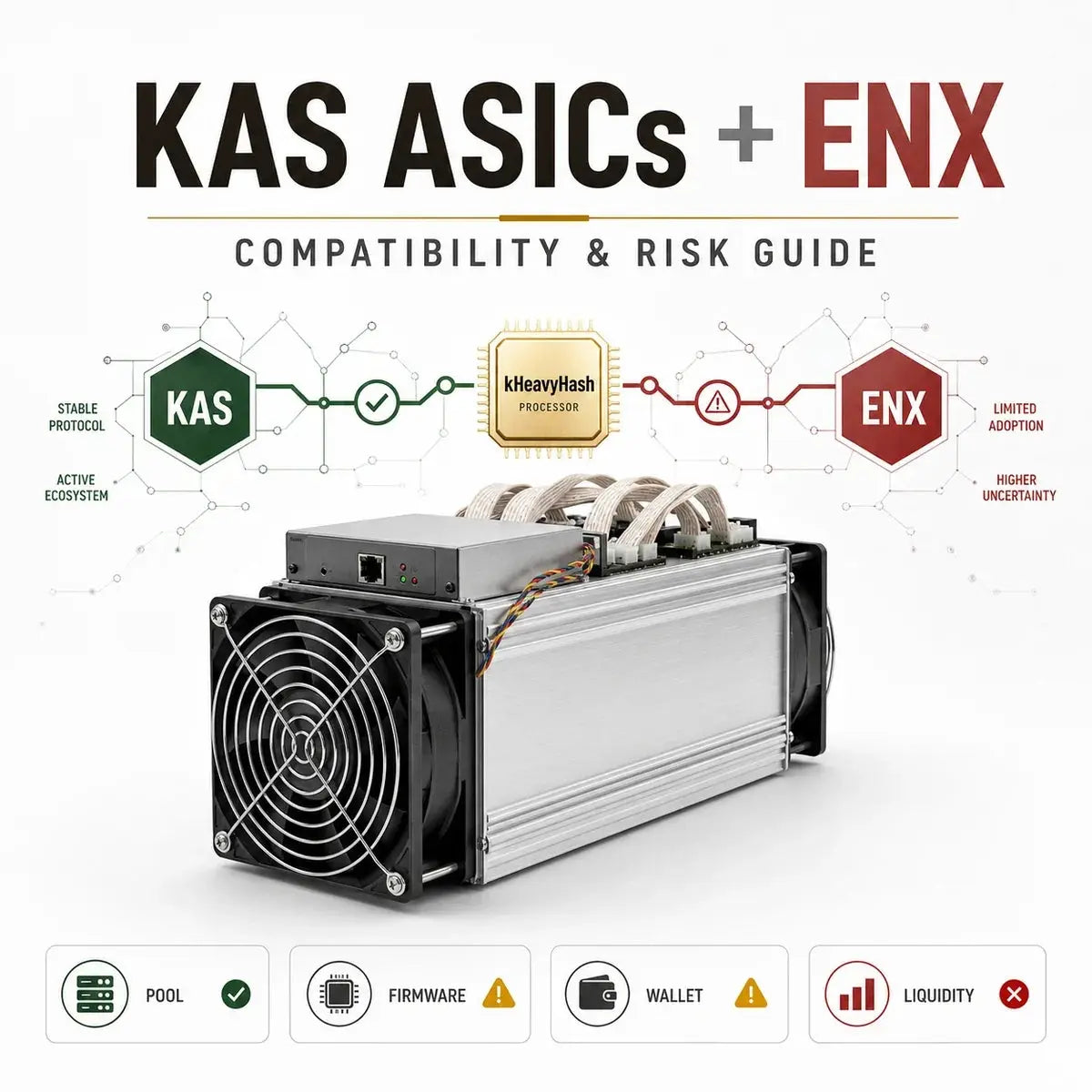
Kaspa uses kHeavyHash proof of work. Specialized ASIC competition has made efficiency and purchase timing central to the decision. A new unit can look attractive at launch, then face lower revenue as additional batches raise network hashrate. Model difficulty growth and a lower resale value instead of extrapolating the launch-day result.
The Kaspa mining guide covers setup, while the Kaspa ASIC comparison separates current machine classes.
4. Zcash: established Equihash ASIC mining
Zcash uses Equihash and its official mining guide states that current network difficulty requires ASIC hardware for practical mining. The main strengths are an established proof-of-work history and a defined pool workflow. The main constraints are algorithm-specific hardware, a smaller resale audience than SHA-256 or Scrypt, and sensitivity to ZEC price, reward changes, network difficulty, and pool support.
Use the Zcash mining profitability guide for a dedicated scenario model rather than importing a Bitcoin payback assumption.
5. Alephium: ASIC-friendly proof of work with a different reward model
Alephium's documentation describes solo and pooled mining across a sharded network and documents a Blake3-based block-hashing process. The project is ASIC-friendly, but its emissions are not a simple Bitcoin-style halving schedule. Buyers should verify current rewards, pool compatibility, miner firmware, exchange liquidity, and the effect of new hardware on network difficulty.
The Alephium mining guide contains the network-specific setup and risk checks.
6. Siacoin: mining tied to a storage network
Siacoin supports activity on the Sia decentralized storage network. Sia's documentation explains that miners verify blocks containing transactions and storage-contract activity, and that the block reward reached a floor rather than declining toward zero. For operators, the practical question is whether a compatible Blake2b-Sia ASIC, pool, wallet, and market are available at an acceptable all-in cost.
Do not assume that every product described as "BLAKE2b" is automatically compatible with every BLAKE2b-based chain. Check network-specific firmware and pool instructions. The Siacoin miner comparison provides model-level context.
7. Nervos CKB: a specialized Eaglesong ASIC market
Nervos documents that CKB uses Eaglesong and that practical mining has shifted from GPU and FPGA hardware to specialized ASICs. That makes efficiency, pool availability, replacement parts, and resale demand more important than theoretical algorithm flexibility. Verify the miner's exact voltage, wall power, supported firmware, and pool endpoints before purchase.
8. Ethereum Classic: GPU flexibility with ASIC competition
Ethereum Classic uses ETCHash. Its official documentation lists both GPUs and compatible ASICs, which gives operators more hardware choices than a single-purpose ASIC-only network. However, flexibility is not the same as profitability. Memory requirements, GPU efficiency, ASIC competition, network rewards, fees, and electricity cost all affect the result.
9. Monero: CPU mining by design
Monero uses RandomX, an algorithm designed to reduce the advantage of specialized ASIC hardware. The official project states that CPUs are more efficient than GPUs for Monero and supports solo, pool, and P2Pool approaches. This makes XMR accessible for learning or spare-capacity experiments, but a general-purpose computer is not automatically profitable after electricity, cooling, software fees, and security risk.
10. Ravencoin: a consumer-GPU path
Ravencoin uses KAWPOW, which is designed around consumer GPU memory and compute capabilities. It can be evaluated by miners who value flexible hardware and do not want an algorithm-specific ASIC. The trade-off is typically lower energy efficiency than specialized hardware and strong exposure to coin price, network hashrate, and electricity cost.
5ASIC vs GPU vs CPU: Choose Hardware First
| Hardware | Strength | Weakness | Best Use |
|---|---|---|---|
| ASIC | Highest efficiency on its target algorithm | Low flexibility and algorithm-specific resale risk | Operators with low power cost and a defined network plan |
| GPU | Can switch among supported workloads | Usually lower mining efficiency than a mature ASIC | Flexible testing, KAWPOW or ETCHash exposure, and resale optionality |
| CPU | Low entry barrier using general-purpose hardware | Limited scale and possible competition with other computer workloads | RandomX learning, P2Pool participation, or spare-capacity use |
Choose the algorithm and operating site before the model. A machine that cannot use the available voltage, cannot be cooled, or creates unacceptable noise is not a good purchase even if its calculator revenue looks high. Older hardware can still be useful at unusually cheap power, but acquisition price must be weighed against efficiency and remaining service life.
6Calculate Mining Profit Without a False Promise
Use realized revenue where possible and keep the time stamp. A practical daily model is:
Realized pool revenue - electricity - pool and hosting fees - cooling overhead - maintenance reserve - depreciation reserve. Taxes and financing may need separate treatment.
Daily electricity use is watts ÷ 1,000 × 24. A 3,200W miner uses 76.8 kWh per day before facility overhead. At $0.08/kWh that is $6.14 per day; at $0.16/kWh it is $12.29. This example demonstrates cost sensitivity only and is not a revenue estimate.
| Scenario Input | Base Case | Stress Case |
|---|---|---|
| Gross mining revenue | Current multi-day average | 25% lower |
| Network difficulty | Current level | 20% higher |
| Uptime | 97% | 90% |
| Electricity | Contract rate | Rate plus 15% |
| Resale value | Conservative estimate | Zero |
Do not add merged-mining revenue twice, mix gross and net pool figures, or use the manufacturer's rated power without checking the mode and wall measurement. Recalculate after a difficulty adjustment, major price move, reward change, firmware change, or new ASIC shipment.
7Risk Screens Before You Mine
- Electricity: use the full delivered tariff, not only the energy component.
- Difficulty: stress-test lower coin output as competing hashrate grows.
- Liquidity: confirm pool payout, exchange support, deposit status, withdrawal cost, and realistic market depth.
- Hardware: check efficiency, voltage, noise, cooling, warranty, repair parts, and second-hand demand.
- Firmware: use trusted sources, change default credentials, isolate management access, and avoid exposed dashboards.
- Pool: compare payout method, minimum threshold, fee, latency, rejected shares, and counterparty history.
- Regulation and tax: document payouts and expenses, and verify local electrical, noise, customs, and tax rules.
- Concentration: avoid committing the entire budget to one coin, one pool, one hosting site, or one hardware batch.
Mining risk is not only coin-price risk. The ASIC depreciation and exit-strategy guide explains why resale timing matters, and the multi-algorithm mining playbook compares concentration across networks.
8A Repeatable Mining Decision Workflow
- Measure the site: confirm voltage, continuous circuit capacity, delivered electricity cost, airflow, temperature, noise limits, and network reliability.
- Select an algorithm: choose the network exposure before choosing a machine.
- Verify the exact miner: confirm hashrate, wall power, efficiency, operating mode, firmware, condition, and included PSU.
- Check live network data: review difficulty, hashrate, rewards, fees, pool status, payout history, and liquidity on the same date.
- Build three cases: base, downside, and severe downside. Include downtime, repair reserve, and depreciation.
- Plan the exit: define the minimum acceptable margin and the conditions for selling, relocating, or shutting down the miner.
- Start small: validate wall power, temperatures, rejected shares, pool payouts, and operational workload before scaling.
9Crypto Mining FAQ
What is the most profitable crypto to mine?
There is no permanent winner. Profit depends on the exact hardware, electricity rate, difficulty, rewards, fees, uptime, and coin liquidity at the time of operation.
Can I mine Bitcoin with a GPU?
Modern Bitcoin mining is dominated by SHA-256 ASICs. A GPU is not competitive for practical Bitcoin mining, although GPUs can support other algorithms such as KAWPOW or ETCHash.
Can Litecoin and Dogecoin be mined together?
Yes. Dogecoin supports merged mining with compatible Scrypt networks. Pool terms determine how rewards are credited, so verify the payout method before connecting an ASIC.
Which coin is best for home mining?
The best home option depends on circuit capacity, noise tolerance, ventilation, electricity price, and whether the operator prefers ASIC, GPU, or CPU hardware. Quiet does not automatically mean profitable.
How often should mining profitability be recalculated?
Recalculate at least weekly for an active operation and whenever price, difficulty, rewards, pool performance, electricity rates, firmware, or hardware availability changes materially.
Is older mining hardware worth buying?
Sometimes, but only when the lower purchase price compensates for weaker efficiency, repair risk, shorter useful life, and lower resale value under a conservative revenue scenario.
10Official References
These sources establish algorithm, mining, and network mechanics. They do not provide a permanent profitability ranking.
- Bitcoin Developer Guide: MiningProtocol-level explanation of ASIC mining, solo mining, pooled mining, shares, block rewards, and transaction fees.
- Dogecoin: Mining DogecoinOfficial explanation of Scrypt ASIC mining and merged mining with Litecoin and other compatible networks.
- Kaspa: Network and kHeavyHash OverviewOfficial Kaspa material describing its proof-of-work design and kHeavyHash algorithm.
- Zcash Documentation: Mining GuideOfficial Equihash mining, ASIC, pool, wallet, cost, and reward-planning guidance.
- Alephium Documentation: MiningOfficial mining protocol, block-hash calculation, pools, and network-specific implementation details.
- Sia Documentation: About Mining on SiaOfficial proof-of-work, storage-contract, block-reward, and ASIC-mining background.
- Nervos CKB: Mining GuideOfficial Eaglesong algorithm and specialized ASIC mining guidance.
- Ethereum Classic: Miner FAQOfficial ETCHash, hardware, rewards, fees, and profitability-factor explanation.
- Monero: MiningOfficial RandomX, CPU, solo, pool, and P2Pool guidance.
- Ravencoin: About KAWPOWOfficial explanation of KAWPOW and its consumer-GPU design goal.
Final Verdict
The strongest mining choice is the one that survives a downside model at your actual site. Bitcoin offers the deepest ASIC ecosystem; Scrypt merged mining changes how Litecoin and Dogecoin revenue is evaluated; Kaspa, Zcash, Alephium, Siacoin, and Nervos provide specialized ASIC paths; Ethereum Classic and Ravencoin preserve GPU options; Monero keeps CPU mining relevant.
Choose the algorithm first, verify hardware and pool compatibility, measure electricity at the wall, stress-test difficulty and price, and define an exit plan before scaling. A live calculation can support a decision, but it cannot guarantee the result.



Leave a comment
This site is protected by hCaptcha and the hCaptcha Privacy Policy and Terms of Service apply.