
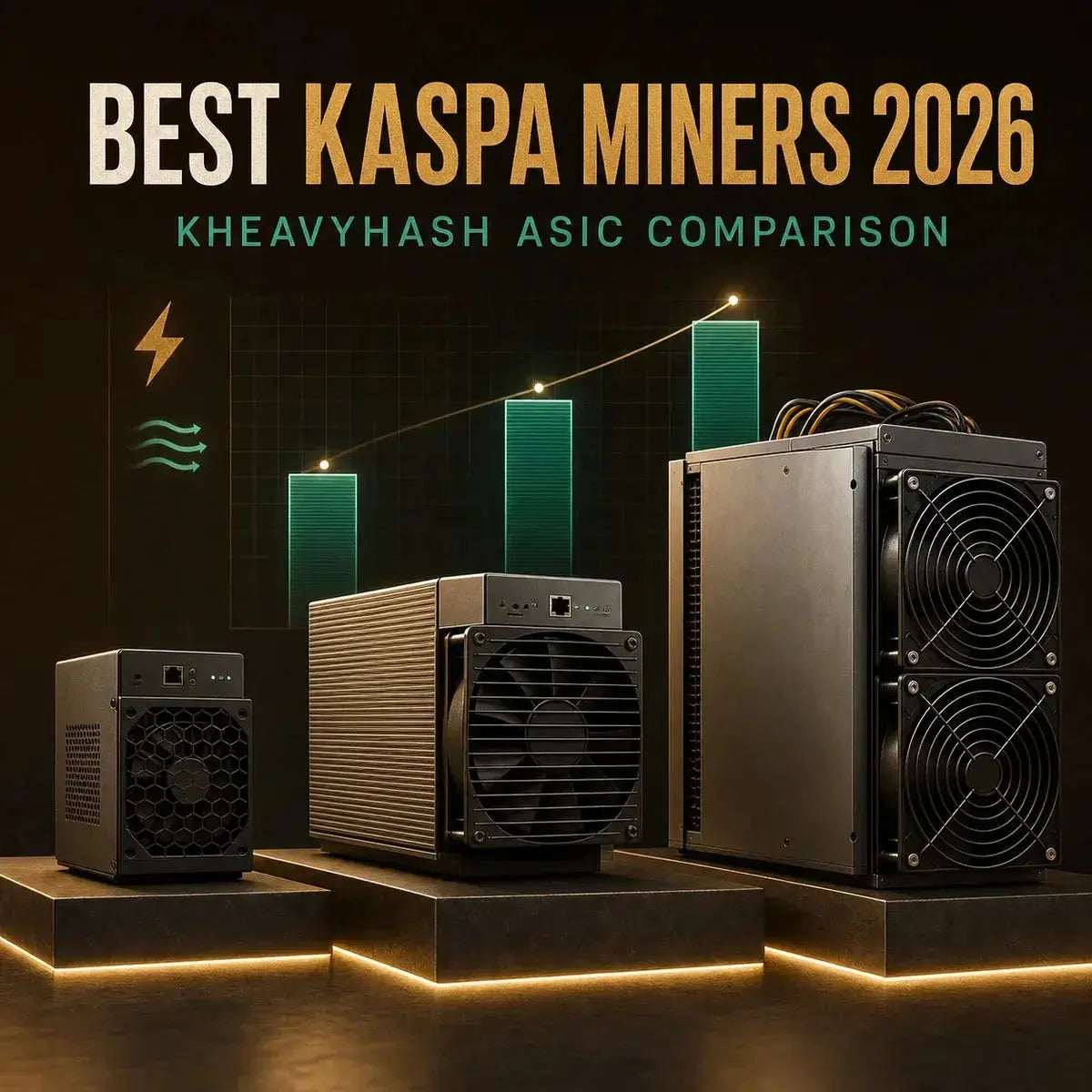
Best Kaspa Miners in 2026
Top KHeavyHash ASICs Compared
Verified KHeavyHash specifications · Home and farm fit · Noise and voltage · Electricity break-even discipline
On This Page
1What a Kaspa Miner Does
A Kaspa miner is an ASIC built to calculate the KHeavyHash proof-of-work algorithm used by the Kaspa network. Unlike a GPU rig, a Kaspa ASIC is not designed to switch freely across many algorithms. Its value comes from specialization: it produces far more KHeavyHash output per watt than general-purpose hardware can manage.
Kaspa uses a BlockDAG rather than Bitcoin's single-chain structure. This explains its fast block production, but it does not remove electricity, difficulty, or hardware-depreciation risk.
The Antminer KS7 is the strongest efficiency and output pick in this comparison for a properly powered mining room. The ICERIVER KS7 Lite is the more practical low-power entry, while the Goldshell KA Box Pro is the quietest verified option here. The right Kaspa ASIC depends on electricity cost, circuit voltage, heat exhaust, noise tolerance, and purchase price rather than hashrate alone.
2Kaspa ASIC Miner Comparison
The models below cover three real buyer categories in 2026: maximum-output farm hardware, lower-power home entries, and quieter integrated systems. Specifications are manufacturer-listed values or clearly identified product modes; actual wall draw and sound can vary with batch, ambient temperature, fan speed, and firmware.
| Miner | Hashrate | Power | Efficiency | Noise / Input | Best Fit |
|---|---|---|---|---|---|
| Bitmain Antminer KS7 | 40 TH/s | 3,080 W | 77 J/TH | 75-76 dB / 220-277V | Efficiency-led farm or hosted deployment |
| ICERIVER KS7 | 30 TH/s (±5%) | 3,500 W (±10%) | 116.7 J/TH nominal | Industrial / 200-250V | High-output dedicated mining room |
| ICERIVER KS7 Lite | 4.2 TH/s (±5%) | 500 W (±10%) | 119 J/TH nominal | Verify dB / 100-240V | Low-power beginner or home test setup |
| Goldshell KA Box Pro | 1.6 TH/s (±5%) | 600 W (±5%) | 375 J/TH | ≤35 dB / 12V DC PSU | Quiet hobby and learning use |
| Goldshell E-KA1M | 5.5 TH/s / 3.8 TH/s low-power | 1,800 W / 1,100 W | 327 / 289 J/TH | ≤45 dB / 110-240V | Flexible garage, basement, or workshop |
The efficiency gap is decisive. At 77 J/TH, the 40 TH/s KS7 uses less energy per terahash than every smaller model here. The KA Box Pro is easier to place at 35 dB or below, but its 375 J/TH rating trades profitability resilience for quiet operation.
3Best Picks by Use Case
Best efficiency and maximum output: Bitmain Antminer KS7. Its 40 TH/s and 77 J/TH lead this set. Confirm 220-277V power, continuous-load capacity, 75-76 dB isolation, and heat exhaust before buying.
Best low-power entry: ICERIVER KS7 Lite. Its 4.2 TH/s, 500 W draw, and 100-240V input create a practical middle point between desktop micro-miners and farm hardware. Verify acoustic behavior before placing it near occupied rooms.
Best quiet home experiment: Goldshell KA Box Pro. Goldshell lists 35 dB or below, but 375 J/TH is the weakest efficiency here. Treat it as a learning and low-noise machine first.
Best mode flexibility: Goldshell E-KA1M. Low-power mode improves listed efficiency from 327 to 289 J/TH while reducing draw to 1,100 W. It favors controllability over maximum terahash efficiency.
Alternative industrial option: ICERIVER KS7. Its 30 TH/s, 3,500 W draw, and 200-250V input make purchase price, warranty route, and hosting terms especially important.
4Kaspa Miner Electricity Cost and Break-Even
Kaspa miner profitability changes with KAS price, network hashrate, pool luck, pool fees, block rewards, and electricity cost. Any daily profit figure is only a snapshot. Instead of trusting an earnings screenshot, build a reusable formula and update it on the day you buy. For the broader method, use the ASIC miner efficiency and electricity-rate guide.
Daily profit = daily KAS revenue in USD - [(watts / 1,000) x 24 x electricity rate] - pool, hosting, and maintenance costs.
For example, a 500 W unit uses 12 kWh per day. At $0.07/kWh, direct electricity cost is $0.84 per day. A 3,500 W unit uses 84 kWh per day, costing $5.88 per day at the same rate. That is why a high-hashrate miner can still disappoint when power cost and energy efficiency do not line up.
| Miner / Mode | Daily kWh | Cost at $0.07/kWh | Cost at $0.12/kWh |
|---|---|---|---|
| KS7 Lite, 500 W | 12.0 kWh | $0.84/day | $1.44/day |
| KA Box Pro, 600 W | 14.4 kWh | $1.01/day | $1.73/day |
| E-KA1M low-power, 1,100 W | 26.4 kWh | $1.85/day | $3.17/day |
| Antminer KS7, 3,080 W | 73.92 kWh | $5.17/day | $8.87/day |
| ICERIVER KS7, 3,500 W | 84.0 kWh | $5.88/day | $10.08/day |
The electricity break-even rate equals gross daily revenue divided by daily kWh. If a miner earns $6.00 gross and uses 73.92 kWh, its power-only ceiling is about $0.081/kWh. The practical ceiling is lower after pool fees, cooling, downtime, and maintenance.
Calculate at current revenue, then repeat at 25% and 40% lower gross revenue. Reject a purchase that works only at today's best-case rate or only before cooling and pool costs.
Full payback also includes hardware price, shipping, duties, warranty, downtime, rejected shares, and resale value. Positive daily margin does not guarantee a sensible payback period.
5Match the Kaspa Miner to the Site
Kaspa ASICs are easier to start than GPU rigs, but they are still electrical and thermal equipment. A full-size KS7-class unit can sound like a loud appliance running continuously and may require a circuit that ordinary household rooms were not built to support. Heat is also constant: nearly all consumed electricity becomes heat inside the room.
If a miner will run near people, noise may matter more than theoretical profit. If it will run in a mining room, efficiency and uptime usually matter more than footprint. The right choice follows the room, not the other way around. Industrial KS7-class units also deserve a qualified electrician's review before installation; their voltage and continuous load are outside ordinary plug-and-play expectations.
6Kaspa Pool Selection and First 48 Hours
Most Kaspa ASIC setup follows a simple path: place the miner in a ventilated area, connect power and Ethernet, find its IP address, open the web interface, enter pool URL, worker name, and Kaspa wallet address, then save and reboot. The first 48 hours should be treated as a burn-in test.
- Use wired Ethernet: Wi-Fi instability can cause rejected shares and lost mining time.
- Check pool region: lower latency can improve share submission consistency.
- Verify wallet address: a wrong address can send payouts somewhere unrecoverable.
- Watch temperatures: early thermal problems often reveal poor placement or blocked exhaust.
- Record baseline hashrate: compare pool-side hashrate with local miner readings.
Solo mining is usually unrealistic for small operators because reward variance is high. Pools smooth payouts by combining many miners' hashrate and distributing rewards according to contributed work. When comparing Kaspa mining pools, check the payout method, fee, minimum payout, server region, recent uptime, hashrate reporting, and whether the pool supports your preferred wallet workflow. The largest pool is not automatically the best if its closest server produces unstable latency.
Use the complete Kaspa mining guide for the broader wallet, setup, and network workflow. This comparison stays focused on choosing hardware rather than duplicating that full tutorial.
7Risks New Kaspa Miners Should Check
The biggest mistake is treating a Kaspa ASIC like a small consumer device. Even compact miners run continuously, create heat, and depend on network connectivity. Full-size models add high noise, higher voltage, and more serious airflow requirements.
Market risk also matters. KAS revenue can change quickly if price moves or network hashrate rises. ASIC resale value can fall when newer batches arrive. Warranty windows are limited, and international shipping can make repair slow. A conservative buyer assumes some downtime, higher future difficulty, and lower resale value instead of modeling only the best case.
Do not buy a 75 dB, multi-kilowatt miner for a shared living space unless power, noise, heat, and ventilation have already been solved.
8Kaspa ASIC Buying Checklist
Before purchasing, confirm the exact model, hashrate mode, power draw, voltage, plug type, PSU inclusion, warranty policy, shipping cost, customs responsibility, seller reputation, and return process. For used machines, ask for pool screenshots, serial numbers, operating hours if available, and a short live test video.
Then run three profitability cases: current conditions, 25% lower KAS revenue, and your electricity rate plus cooling overhead. If the miner only works in the optimistic case, it is not a reliable plan. If it still works in the downside case, the hardware has a stronger margin of safety.
| Priority | Question to Answer | Why It Matters |
|---|---|---|
| Power | Can the circuit support continuous load? | Prevents trips, overheating, and unsafe wiring |
| Noise | Can the room tolerate the dB rating? | Protects daily usability and neighbor comfort |
| Efficiency | What is the real J/TH after setup? | Determines survival at higher electricity rates |
| Liquidity | How long is payback under conservative assumptions? | Reduces exposure to rapid ASIC depreciation |
9Kaspa Miner FAQ
What algorithm do Kaspa miners use?
Kaspa miners use KHeavyHash, the proof-of-work algorithm associated with the Kaspa network.
Can a Kaspa ASIC mine Bitcoin?
No. Bitcoin uses SHA-256, while Kaspa uses KHeavyHash. ASICs are usually designed for one algorithm class.
Which Kaspa miner is best for home use?
The KS7 Lite is the strongest low-power entry in this comparison, while the KA Box Pro is the quietest verified option at 35 dB or below. Neither changes the need to plan heat, network access, and electrical load.
Is hashrate more important than efficiency?
No. Hashrate drives revenue potential, but efficiency controls power cost. Compare both before buying.
What is the best Kaspa mining pool?
There is no permanent best pool. Compare fees, payout method, minimum payout, server location, uptime, and pool-side hashrate stability, then test at least two regional endpoints before deciding.
10References and Data Sources
These sources were selected for official network information, protocol context, or manufacturer-level product reference. They open in a new tab and are marked nofollow.
- Kaspa Official WebsiteOfficial source for Kaspa's network positioning, BlockDAG messaging, ecosystem links, and community resources.
- Kaspa Rust Node RepositoryProtocol-level open-source repository for Kaspa node software and technical development context.
- Goldshell KA Box Pro Product PageManufacturer product reference for a compact KHeavyHash/Kaspa-oriented home miner class.
- Goldshell E-KA1M Product PageManufacturer specifications for standard and low-power modes, noise, voltage, dimensions, and operating range.
- ICERIVER Official KAS Miner CatalogManufacturer catalog for current KHeavyHash models and listed hashrate and power values.
- ICERIVER KS7 Lite Product PageManufacturer reference for hashrate, power, voltage, dimensions, network connection, and operating range.
- BITMAIN Mining CalculatorManufacturer calculator listing the KAS Miner KS7 and illustrating why live network and revenue inputs must be refreshed.
Final Verdict
Choose the Antminer KS7 when efficiency and maximum output are the priority and the site is already prepared for industrial power, heat, and noise. Choose the KS7 Lite for a lower-power entry, the KA Box Pro for verified quiet operation, or the E-KA1M when controllable modes matter more than best-in-class J/TH.
The winning purchase is the one that fits your circuit, acoustic limit, cooling plan, electricity break-even rate, and downside revenue model. Verify the exact batch and recalculate live revenue before paying; static profitability tables are temporary snapshots, not promises.




Leave a comment
This site is protected by hCaptcha and the hCaptcha Privacy Policy and Terms of Service apply.