
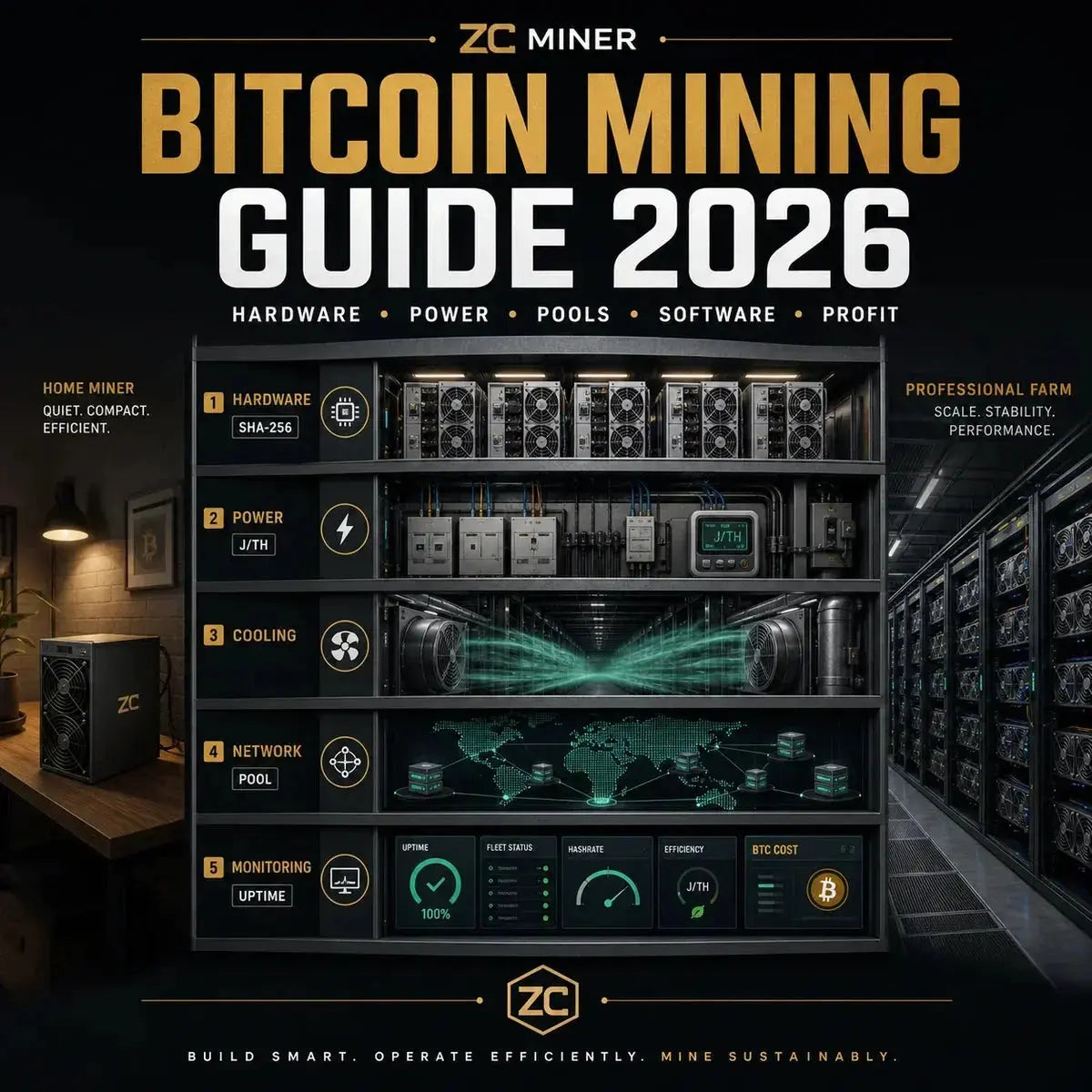
Bitcoin Mining Guide 2026:
Miners, Calculators, and Software
SHA-256 process · ASIC hardware · electricity · pools · software · profitability · risk
On This Page
1What Do You Need to Mine Bitcoin in 2026?
Competitive Bitcoin mining in 2026 requires SHA-256 ASIC hardware, suitable electrical capacity, cooling or heat removal, a Bitcoin payout address, a mining pool or solo-mining stack, stable network access, monitoring, and a cost model that can survive changing difficulty and revenue. A desktop CPU or gaming GPU can demonstrate proof-of-work concepts, but it is not economically competitive with modern ASICs on the Bitcoin network.
This page is a topic hub. It explains how hardware, power, pools, software, calculators, and risk connect. Detailed software configuration belongs in our dedicated software guide, and current pool fees belong in the pool comparison. That separation keeps this guide useful without turning it into a long list that becomes obsolete whenever one model, firmware release, or fee changes.
Choose the miner that produces the lowest sustainable cost per bitcoin at your site, not the machine with the highest advertised hashrate.
2How Bitcoin Mining Works
Miners repeatedly hash candidate block headers using SHA-256. A valid block hash must be below the network target. The protocol adjusts difficulty so blocks continue to arrive near the intended interval even as total network hashrate changes. When a block is accepted, its miner receives the current block subsidy plus transaction fees.
Since the April 2024 halving, the subsidy is 3.125 BTC per block until the next scheduled halving, expected around 2028. A miner's expected share of rewards is approximately its effective hashrate divided by network hashrate, adjusted for uptime, rejected work, pool method, fees, and variance. Actual short-term results can differ sharply from the estimate.
Pool miners submit easier proofs called shares. Shares let the pool measure contributed work and distribute income under its payout rules. Solo miners keep a full successful block reward but may wait an extremely long and unpredictable time. For a deeper foundation, read what cryptocurrency mining is.
3How to Choose a Bitcoin Miner
Bitcoin ASIC selection begins with five linked measurements: hashrate in TH/s, wall power in watts, efficiency in J/TH, purchase and installation cost, and expected uptime. Efficiency is power divided by hashrate. Lower J/TH generally means less electricity per unit of work, but efficiency alone does not guarantee the best total return if the machine is expensive, unreliable, difficult to cool, or incompatible with the site.
| Hardware Class | Best Fit | Main Advantage | Main Constraint |
|---|---|---|---|
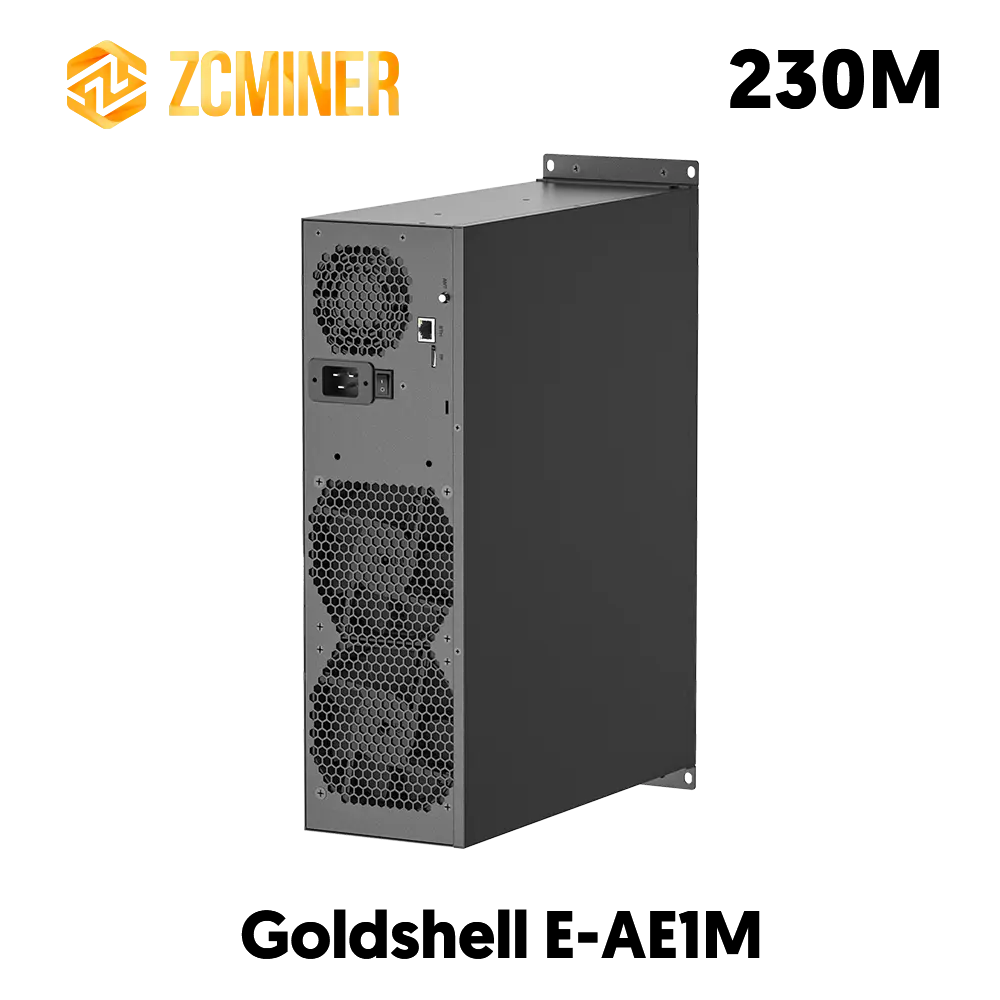
| Current air-cooled ASIC | Prepared home rooms, workshops, and farms | Simpler deployment and broad service knowledge | High noise and large hot-air volume |
| Hydro-cooled ASIC | Professionally engineered facilities | Dense heat transfer and stable chip temperature | Water loop, controls, plumbing, and site complexity |
| Immersion deployment | Operators building a complete thermal system | Noise control and potential thermal stability | Tank, dielectric fluid, pumps, heat rejection, and maintenance |
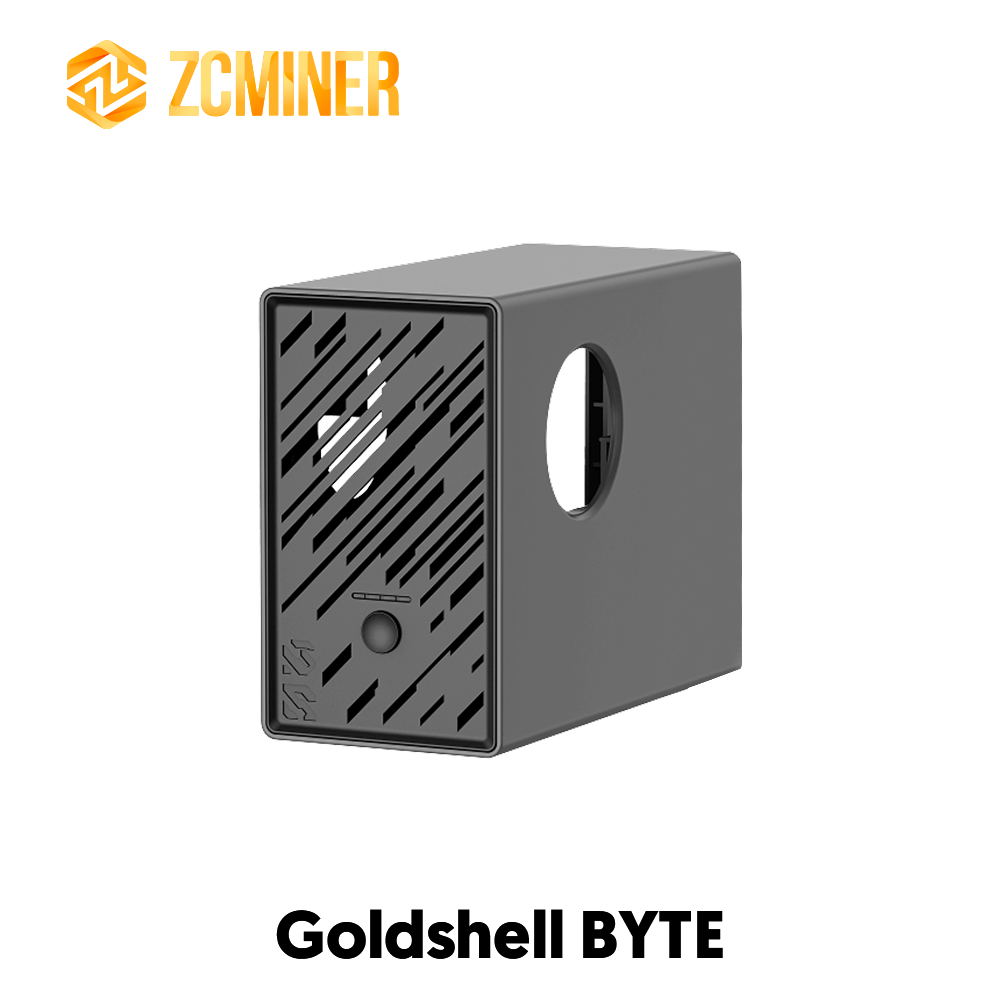
| Compact or open-source miner | Learning, hobby, and solo-lottery experiments | Low absolute power and educational value | Very small network share and no predictable reward |
| Used older ASIC | Very low electricity rates and repair-capable buyers | Lower purchase price | Higher J/TH, uncertain history, and shorter economic life |
For current model-level planning, compare the Antminer S21 series for home and farm use. Buyers with smaller budgets should use the Bitcoin miners under $1,000 guide. Both pages serve narrower purchase intent; this hub focuses on the overall system.
4Electricity, Circuits, Cooling, and Noise
Electricity is usually the largest controllable operating cost. Daily energy use equals power in kW multiplied by 24. A 3.5 kW miner consumes 84 kWh per day before cooling and supporting equipment. At $0.08/kWh, that is $6.72 per day; at $0.15/kWh, it is $12.60. The same hardware can therefore be viable at one site and structurally unprofitable at another.
Use measured wall power, not only the nominal specification. Confirm voltage, plug, breaker, PDU, cable rating, grounding, and continuous-load headroom with a qualified electrician. Do not treat a household extension lead or simple surge strip as a mining power plan. The Bitcoin mining electricity cost guide covers watts, kWh, tariffs, cooling overhead, and break-even electricity rates.
Every watt becomes heat. Air-cooled machines need a defined intake and exhaust path; hydro and immersion systems still need final heat rejection. Measure noise at the location where people will actually hear it, including fan ramps and multiple-unit effects. Our home ASIC cooling and noise guide covers containment, ventilation, and monitoring.
5Mining Pools, Payouts, and Wallets
Most operators use a pool to convert a small share of global hashrate into more frequent payouts. Compare payout method, fee, minimum payout, transaction-fee treatment, server region, Stratum support, uptime history, security controls, and support quality. FPPS, PPS+, PPLNS, and other methods distribute fee and variance exposure differently; the headline pool fee is not the entire economic result.
Copy Stratum endpoints from the pool's official documentation and verify the account, worker, region, and payout address. Use a Bitcoin address you control or fully understand. A pool needs a payout address, not your wallet seed phrase or private key. See the dedicated Bitcoin mining pool comparison for current provider details and the solo versus pool mining guide for reward variance.
6Bitcoin Mining Software and Firmware
Modern ASICs usually include firmware and a browser-based management interface. The basic workflow is to discover the miner on the local network, sign in, change credentials, enter one or more pool endpoints, set the worker and payout configuration, and monitor temperatures, fans, power mode, hashrate, rejected shares, and hardware errors.
Bitcoin Core, CGMiner, CKPool, manufacturer firmware, pool software, and fleet-management platforms solve different problems. They should not be presented as interchangeable "best mining software." Our Bitcoin mining software guide maps each layer without competing for the broad Bitcoin mining guide query.
Install firmware only from a verified source, confirm exact model support, preserve a rollback image, and test one device before a fleet rollout. The ASIC firmware security checklist covers signatures, network isolation, credentials, remote access, and recovery.
7Bitcoin Mining Calculators and Profitability Math
A calculator is a snapshot, not a forecast. Enter hashrate, measured power, electricity rate, pool fee, expected uptime, and purchase cost. Then add installation, cooling, maintenance, financing, taxes, duties, and repair reserves. Revenue changes with Bitcoin price, network difficulty, block fees, and pool performance.
Build a low case with lower BTC revenue, higher difficulty, and reduced uptime; a base case using current measured data; and a high case that is treated as upside, not the purchase justification.
Useful outputs include daily electricity cost, gross revenue, operating margin, break-even electricity rate, cost per BTC, and payback under each scenario. Do not assume difficulty stays flat for the full payback period. WhatToMine and pool calculators can provide current inputs, while your own spreadsheet should hold the complete ownership model. For formulas and examples, use the crypto mining profitability guide.
8Bitcoin Miner Setup Workflow
- Survey the site: document voltage, circuit capacity, electricity rate, ambient temperature, intake, exhaust, noise limits, and network availability.
- Select the hardware class: match air, hydro, immersion, compact, new, or used equipment to the site and operating skill.
- Build the model: calculate low, base, and high scenarios before paying for hardware.
- Verify the purchase: confirm condition, PSU, plug, warranty, shipping, duties, firmware, repair access, and seller terms.
- Prepare payout and pool: create a secure Bitcoin address and copy official Stratum settings.
- Secure the miner: isolate the network, change default credentials, restrict remote management, and record firmware.
- Commission one unit: compare wall power, local hashrate, pool-side accepted work, rejects, temperature, and stability for 24 to 72 hours.
- Operate from records: track uptime, kWh, payouts, fees, maintenance, errors, and actual cost per BTC before scaling.
9Main Bitcoin Mining Risks
Difficulty and Revenue Risk
Network competition can rise while BTC price or transaction fees fall, compressing margin even when the miner performs correctly.
Efficiency and Failure Risk
Newer J/TH levels can reduce the value of older equipment. Fans, PSUs, hashboards, pumps, and controllers can fail.
Power, Heat, and Downtime
Electrical trips, overheating, network loss, dust, water-loop problems, and poor airflow reduce accepted work.
Seller, Pool, and Firmware Risk
Misrepresented hardware, weak warranty, pool outages, payout changes, and compromised firmware can create losses.
There is also regulatory, tax, insurance, import, noise, and utility-contract risk. Rules differ by jurisdiction and can change. No miner, pool, calculator, or firmware can guarantee profit.
10Bitcoin Mining FAQ
Can I mine Bitcoin with a PC or GPU in 2026?
A PC can demonstrate mining concepts but is not competitive with SHA-256 ASICs on Bitcoin. Modern network mining is dominated by specialized hardware.
What is the most important Bitcoin miner specification?
No single number is enough. Evaluate TH/s, wall watts, J/TH, purchase and installation cost, site compatibility, reliability, and expected uptime together.
How much electricity does a Bitcoin miner use?
Multiply rated kilowatts by operating hours. A 3.5 kW miner running for 24 hours uses about 84 kWh before cooling and support loads.
Is pool mining better than solo mining?
Pools usually reduce payout variance, while solo mining preserves the full reward from a rare successful block. The right choice depends on hashrate, risk tolerance, fees, and operational goals.
Can a Bitcoin mining calculator predict ROI?
No. It estimates from current or assumed inputs. Difficulty, BTC price, fees, uptime, repairs, and electricity can change throughout the payback period.
11References
These primary and established sources were reviewed before inclusion. External links open in a new tab and are marked nofollow.
- Bitcoin Developer Guide: MiningTechnical explanation of solo mining, pooled mining, shares, block templates, and Stratum.
- Bitcoin Core RepositoryPrimary source code and release repository for the reference Bitcoin node implementation.
- Braiins AcademyCurrent operational documentation for Bitcoin pool setup, payouts, firmware, and farm management.
- WhatToMine Bitcoin CalculatorCurrent SHA-256 mining inputs and modeled revenue for scenario building.
- Cambridge Bitcoin Electricity Consumption IndexUniversity research resource for Bitcoin network electricity and mining context.
- CGMiner Official RepositoryPrimary repository for the established open-source mining program referenced in the software section.
Final Recommendation
Bitcoin mining is an infrastructure business expressed through cost per unit of accepted SHA-256 work. Hardware matters, but power price, electrical design, heat removal, pool rules, firmware integrity, monitoring, and uptime determine whether advertised hashrate becomes useful production.
Use this page as the map, then move into the linked hardware, electricity, pool, software, calculator, cooling, and security guides for implementation. Start with one measured unit and scale only after the real operating data supports the model.


Leave a comment
This site is protected by hCaptcha and the hCaptcha Privacy Policy and Terms of Service apply.