
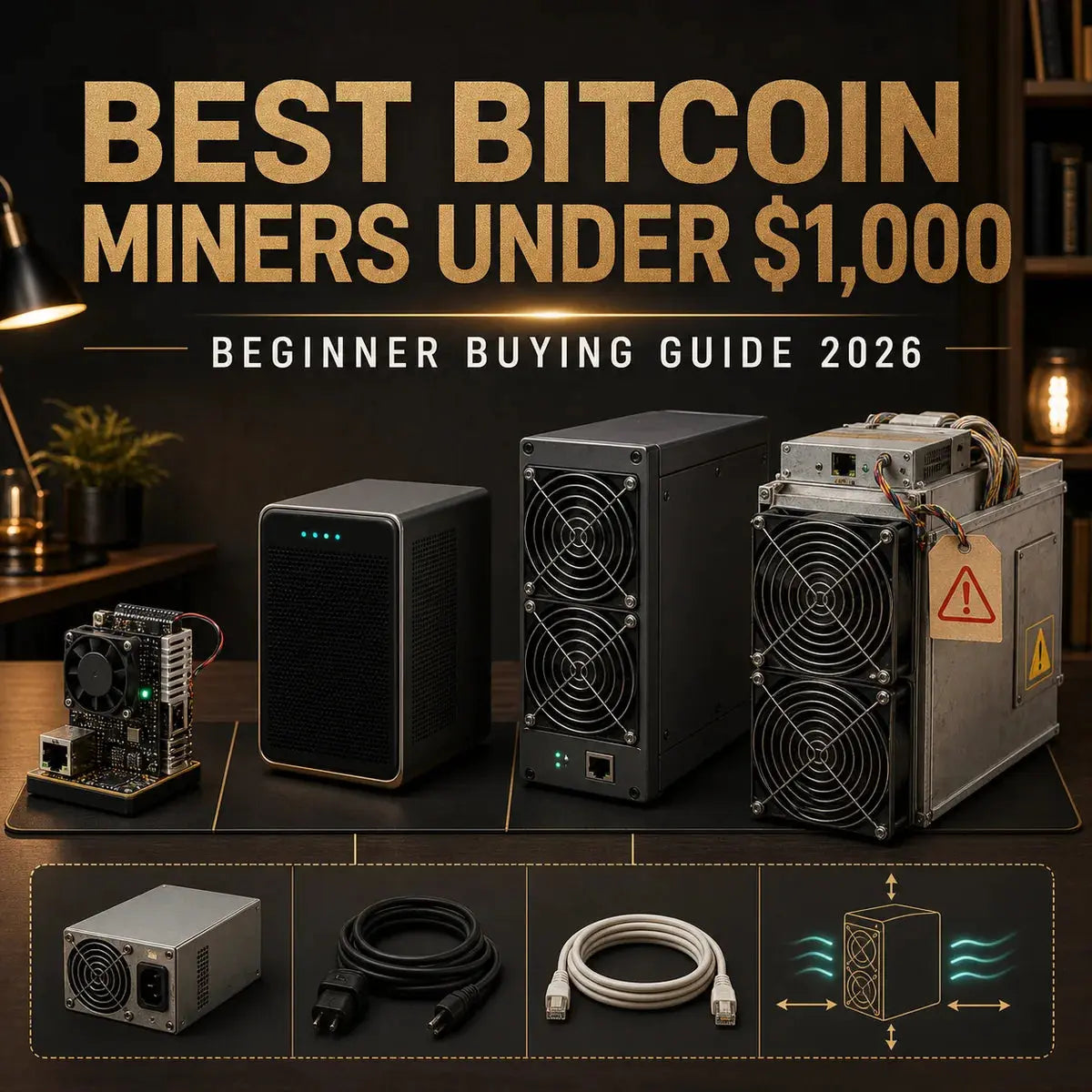
Best Bitcoin Miners Under $1,000
for Beginners
Low-power SHA-256 miners · quiet home setup · pool mining expectations · electricity planning
On This Page
1Beginner Overview
The best Bitcoin miners under $1,000 for beginners are not miniature versions of industrial mining farms. They are compact SHA-256 devices built for learning, experimentation, pool participation, and low-stress home operation. That difference matters. A beginner miner should not require a dedicated 240 V circuit, a sound-treated room, or a complicated ventilation plan just to understand how mining works.
In this price range, the goal is usually education first and earnings second. These miners let you connect a real ASIC to a pool, watch hashrate move, understand accepted shares, learn how heat and airflow affect stability, and decide whether larger hardware makes sense later. If your first miner is too loud, too hot, or too expensive to run, the learning curve becomes frustrating quickly.
Under $1,000, choose for comfort, reliability, and learning value. Do not choose only by the highest hashrate number.
2Best Bitcoin Miners Under $1,000
The table below retains the original shortlist and uses commonly listed baseline specifications. Prices, included accessories, firmware profiles, and stock can change by batch and seller, so treat every price as a reference rather than a guaranteed offer.
| Miner | Hashrate | Power | Approx. Price | Best For |
|---|---|---|---|---|
| NerdQaxe++ Rev 6.1 | About 6 TH/s | About 100 W | About $349 | Best overall starter balance |
| NerdOCTAxe 9.6Th | About 9.6 TH/s | About 160 W | About $589 | Best higher-output beginner unit |
| Magicminer BG02 | About 7 TH/s | About 150 W | About $359 | Air-cooled mini ASIC users |
| Bitaxe Supra Hex 701 | About 4.2 TH/s | About 90 W | About $229 | Low-budget SHA-256 learning |
| NerdQaxe++ 4.8Th | Up to 4.8 TH/s | About 75 W | Verify live listing | Efficiency-focused beginners |
| Bitaxe Gamma 601 | About 1.2 TH/s | About 17 W | About $109 | Pure education and tinkering |
| Avalon Nano 3S | Up to 6 TH/s | About 140 W | About $278 observed | Brand-backed compact mining |
3How to Choose the Right Miner
A beginner should start with the room, not the product page. Where will the miner sit? Can the space handle 24-hour fan noise? Is there enough airflow? Is the power supply safe and matched to the unit? Will Ethernet be available, or does the miner need Wi-Fi? These practical questions matter more than a small difference in hashrate.
For pure learning, the Bitaxe Gamma 601 is the lowest-commitment option because its power draw is tiny. For a more serious first device, the NerdQaxe++ Rev 6.1 and Avalon Nano 3S are better balanced. If you want the strongest pool participation in this list, the NerdOCTAxe 9.6Th leads on hashrate, but it also uses more power and has a larger thermal footprint. Buyers with a tighter ceiling should first compare the dedicated Bitcoin miners under $500 guide.
4Total Budget, PSU, and Used ASIC Options
The miner price is not always the complete setup price. Before comparing two listings, confirm whether the package includes the correct power supply, AC cable, controller, fan, Wi-Fi antenna, stand, and any required adapter. Add shipping, import charges, pool fees, a safe surge-protection plan, and basic ventilation to the budget. A $700 miner that needs a separate PSU and electrical work may exceed the $1,000 ceiling, while a $500 complete kit may remain comfortably inside it.
A used full-size ASIC can sometimes appear below $1,000 and deliver far more hashrate than a mini miner. It is a different purchase path, not an automatic bargain. Older industrial units can draw several kilowatts, require a suitable 200–240 V circuit, and create enough heat and noise to make home use impractical. Ask for a recent dashboard video, serial number, hashboard status, temperature and error logs, repair history, firmware source, PSU condition, and return terms. Calculate the site cost before comparing hashrate.
Choose a used industrial ASIC only when your electrical circuit, ventilation, noise plan, and seller verification are already solved. For most first-time home miners, a complete low-power kit is the safer learning purchase.
For model-level comparisons within the open-source compact category, see the Bitaxe miner buying guide. For room planning beyond this budget comparison, use the home mining guide for beginners.
5What Beginners Should Expect in 2026
Bitcoin mining in 2026 is highly competitive. The block subsidy is 3.125 BTC, and network hashrate is measured in hundreds of exahashes per second. A few terahashes at home can participate, but it should not be treated like a major income stream.
Do not rely on a fixed daily-dollar estimate in a buying guide. Recalculate with current pool or network data on the day you buy: estimate your share of network hashrate, apply the current block subsidy and recent fee environment, then subtract pool fees and electricity. For a small miner, short-term pool results can vary, so compare a longer average rather than one lucky or unlucky day.
That does not make these devices useless. It means their value is different: education, hands-on practice, low-cost experimentation, and a better understanding of whether you want to scale into larger ASIC hardware later.
Small miners can teach you real mining mechanics, but they are not a shortcut to fast Bitcoin income. Treat revenue as a bonus, not the primary reason to buy.
6Electricity Cost for Small Miners
The good news is that electricity cost is usually manageable at this scale. A 100 W miner running 24 hours per day uses about 72 kWh per month. At $0.10/kWh, that is about $7.20 per month before any cooling overhead. This is far easier to manage than a full-size industrial ASIC drawing thousands of watts.
| Power Draw | Daily kWh | Monthly kWh | Cost @ $0.07 | Cost @ $0.10 |
|---|---|---|---|---|
| 17 W | 0.41 | 12.2 | $0.85/mo | $1.22/mo |
| 75 W | 1.80 | 54.0 | $3.78/mo | $5.40/mo |
| 100 W | 2.40 | 72.0 | $5.04/mo | $7.20/mo |
| 150 W | 3.60 | 108.0 | $7.56/mo | $10.80/mo |
| 160 W | 3.84 | 115.2 | $8.06/mo | $11.52/mo |
7Model Notes by Use Case
NerdQaxe++ Rev 6.1 is the best all-around starter if you want one device that balances hashrate, noise, power draw, and price. It is strong enough for pool participation without feeling like a large machine.
NerdOCTAxe 9.6Th is the performance pick in this group. It suits buyers who already know they want more hashrate and are comfortable with a higher price and power draw.
Magicminer BG02 sits in the middle. It is a practical option for someone who wants more output than the smallest devices without moving to the most expensive beginner model.
Bitaxe Supra Hex 701 is attractive for budget-minded learners. Its lower cost and compact footprint make it an easy first step into SHA-256 mining.
NerdQaxe++ 4.8Th is for efficiency-focused users who want low heat and modest power draw. Bitaxe Gamma 601 is best treated as an educational device. Avalon Nano 3S appeals to beginners who prefer a compact miner from a more established ASIC manufacturer.
8Beginner Setup Checklist
Before buying, make sure you understand the basics of setup. You will need a compatible power supply, stable internet, a Bitcoin wallet, a mining pool account, and a location with enough airflow. Once the miner arrives, configure one pool first, confirm accepted shares, then monitor temperature and uptime for the first day.
- Confirm voltage, power supply, and connector requirements before powering on.
- Confirm exactly what is included and calculate the delivered setup cost.
- Use Ethernet when available; use Wi-Fi only when the model supports it reliably.
- Keep intake and exhaust clear, even on very small miners.
- Choose an established pool with clear payout rules and regional servers.
- Track accepted shares, rejected shares, temperature, and uptime.
- Do not scale to multiple units until one miner runs reliably for several days.
9FAQ
Can a Bitcoin miner under $1,000 be profitable?
It can produce small pool payouts, but most beginner units are better viewed as learning hardware. Profit depends on BTC price, network hashrate, pool fees, uptime, and electricity cost.
Which beginner miner is best overall?
The NerdQaxe++ Rev 6.1 is a strong all-around choice because it balances hashrate, power draw, price, and home usability. The best choice still depends on your space and goals.
Should beginners solo mine?
Solo mining is useful for experimentation, but it is extremely unlikely to deliver regular rewards at this hashrate level. Pool mining is the practical path for steady participation.
Do these miners need special electrical work?
Most devices in this guide are low-power compared with industrial ASICs, but you should still use a safe power supply, avoid overloaded strips, and follow the seller's electrical requirements.
Should I buy a used industrial ASIC for under $1,000?
Only when you can verify its condition and already have suitable power, ventilation, and noise control. A used full-size ASIC may offer more hashrate, but its site requirements and failure risk are much higher than a compact beginner miner.
10References and Data Sources
- Mempool Mining DashboardUsed for current Bitcoin network hashrate, mining context, and recent block reward observations.
- Bitcoin Developer Reference: getmininginfoTechnical reference for mining concepts such as hashrate, difficulty, blocks, and network mining data.
- Bitaxe Open-Source Project on GitHubOpen-source reference point for Bitaxe-style small SHA-256 miner hardware and firmware context.
- Canaan: Avalon Nano 3SOfficial manufacturer reference for the compact Avalon Nano product line and current product information.
- U.S. Energy Information Administration Electricity Data BrowserReference point for checking electricity price assumptions when estimating mining power costs.
Final Verdict
The best Bitcoin miner under $1,000 is the one that fits your room, your patience, and your learning goal. The NerdQaxe++ Rev 6.1 is the most balanced starter, the NerdOCTAxe is the higher-output choice, the Bitaxe Gamma 601 is the cheapest learning path, and the Avalon Nano 3S is the name-brand compact option.
Start small, learn pool mining, watch real hashrate and power behavior, then decide whether larger ASIC mining makes sense for you.



Leave a comment
This site is protected by hCaptcha and the hCaptcha Privacy Policy and Terms of Service apply.