
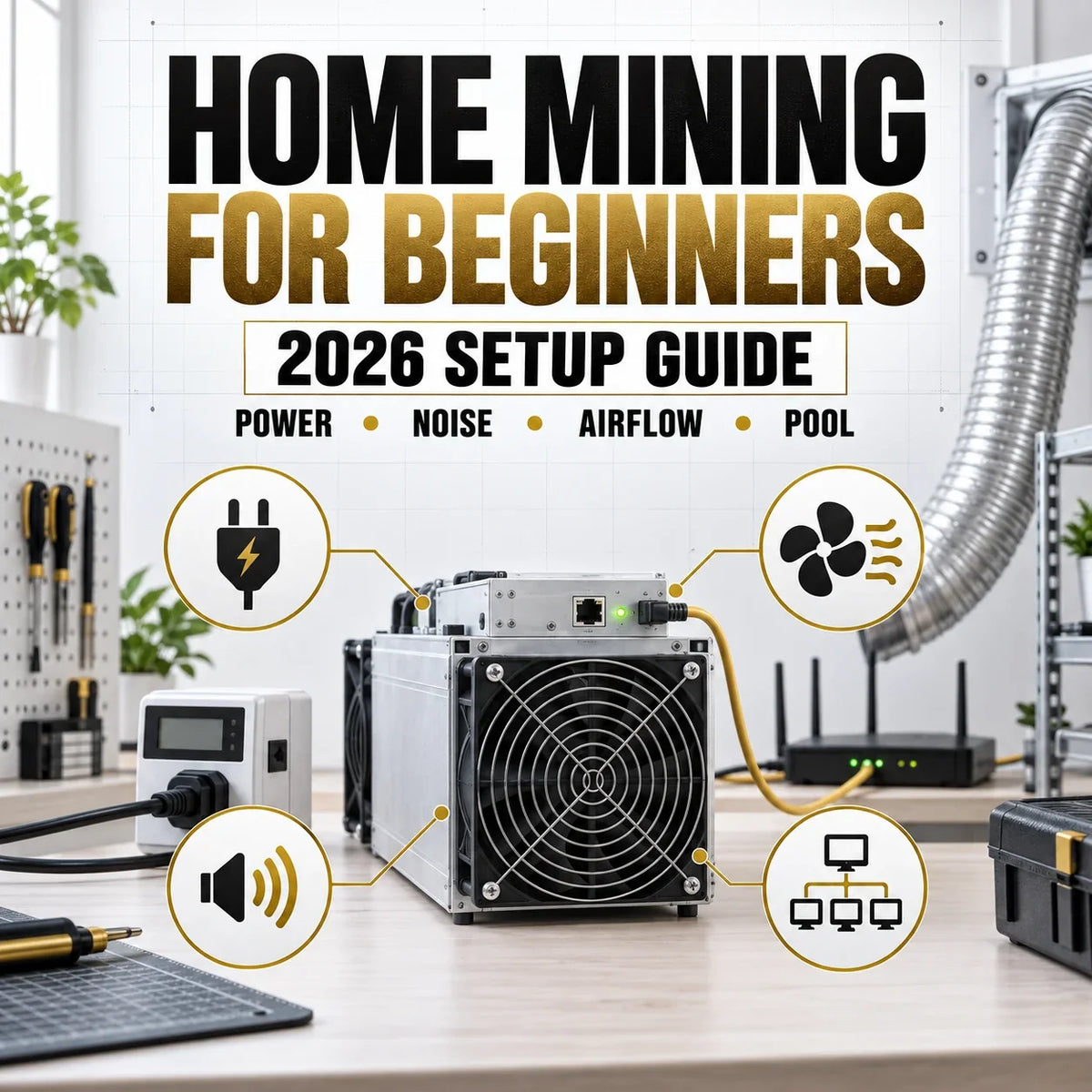
Home Mining for Beginners in 2026
A practical guide to compact miners, full-size ASICs, algorithms, pool and solo strategies, household power, airflow, costs, security, and responsible scaling.
1Quick Answer
Home mining is still possible in 2026, but the right setup depends on what you want to learn, which algorithm you want to run, how much continuous power and heat your home can safely handle, and whether you are comfortable with uncertain mining revenue. A small desktop miner can be a controlled technical experiment. A full-size Bitcoin ASIC is closer to operating a dedicated high-load appliance and may require a separate circuit, ventilation, and noise planning.
Practical verdict: beginners should start with one device whose power, noise, algorithm, pool support, and operating cost they can verify. For Bitcoin, pooled mining normally reduces payout variance; compact solo miners are better treated as educational or lottery-style devices. Profit is never guaranteed.
- Choose the coin and algorithm before choosing the hardware.
- Use wall power, not only advertised hashrate, to estimate daily operating cost.
- Plan exhaust heat and noise before the miner arrives.
- Use trusted firmware, unique passwords, and a payout wallet you control.
- Run one unit long enough to understand uptime and maintenance before scaling.
2What Is a Home Miner?
A home miner is not a separate blockchain protocol or formal hardware category. It is a mining device selected and operated for a residential environment. Compared with industrial ASIC deployments, home-oriented machines usually emphasize compact size, lower wall power, lower acoustic output, simpler setup, and easier monitoring.
The term covers more than one kind of device. Some units are purpose-built compact miners. Others are standard ASICs that can work at home only when the electrical circuit, airflow path, ambient temperature, and noise isolation are suitable. A machine is not automatically home-friendly merely because it fits on a shelf.
Important distinction: low hashrate does not automatically mean high efficiency, and high hashrate does not automatically mean better profitability. Compare the correct algorithm unit, wall watts, efficiency, purchase cost, and operating environment together.
3Why Home Mining Can Work for Beginners
The strongest reason to begin at home is not a promise of quick income. It is the ability to learn the complete operating cycle with limited scale: connect hardware, find the miner on the local network, configure a pool or solo endpoint, monitor accepted shares, understand thermal behavior, and see how electricity cost affects the result.
Hands-on experience
Operate real hardware and learn algorithms, pool shares, worker names, payout thresholds, firmware, temperatures, fan behavior, and uptime.
Low-cost validation
One manageable device lets you test whether mining fits your budget, room, schedule, and technical interest before committing to a larger deployment.
Predictable inputs
Hardware price, measured wall power, electricity rate, pool fee, and uptime can be tracked even when coin price and network difficulty change.
Independent operation
Running your own device builds practical understanding of proof of work. The decentralization benefit depends on the network, pool choice, and whether the miner controls its infrastructure.
4Choose the Right Home Bitcoin Mining Route
This section incorporates the useful decision framework from the former home Bitcoin mining article. It separates four routes that are often incorrectly presented as if they were the same activity.
Compact solo or lottery miner
Best for education, open-source experimentation, and low-power participation. It performs real SHA-256 work, but the probability of finding a Bitcoin block alone is extremely low. Treat the power spend as a hobby or education budget.
Full ASIC connected to a pool
A pool measures contributed work and reduces payout variance compared with solo mining. It does not guarantee profit; power, fees, downtime, difficulty, Bitcoin price, and hardware efficiency still control the outcome.
Full ASIC operated solo
The operator receives the block subsidy and fees only after finding a valid block. Long periods without a payout are normal, while node, software, monitoring, and uptime responsibilities remain.
Hosted or cloud hashrate
This is not local home hardware mining. The buyer may not control the equipment, power contract, firmware, pool account, or withdrawals. Review ownership, fees, termination terms, and proof of operation.
| Route | Hardware at home | Payout pattern | Power and heat | Main risk |
|---|---|---|---|---|
| Compact solo miner | Yes | Rare, high-variance block event | Usually easiest to manage | Mistaking education for predictable income |
| Full ASIC with pool | Yes | Smaller payouts with lower variance | Continuous load and substantial exhaust heat | Power cost, downtime, and changing economics |
| Full ASIC solo | Yes | Full reward only after finding a block | Same site demands as pooled ASIC mining | Long periods without revenue |
| Hosted or cloud hashrate | No or remote | Contract-dependent | Managed by provider | Fees, custody, contract, and provider failure |
For a deeper comparison, read Solo Mining vs Mining Pools in 2026 and the guide to lottery miner odds, costs, and risks.
5Choose the Algorithm Before the Miner
An ASIC is built for a specific proof-of-work algorithm. It cannot normally switch to an unrelated algorithm through a simple software setting. This is why the coin or network decision comes before the model decision.
| Algorithm | Example networks | Typical home use | What to verify |
|---|---|---|---|
| Scrypt | Litecoin and Dogecoin merged mining | Compact and mid-power home miners | Pool supports merged mining, payout rules, wall power, and noise |
| SHA-256 | Bitcoin | Compact solo experiments or full ASIC pool mining | Solo versus pool goal, circuit capacity, heat, efficiency, and network difficulty |
| SHA3x | Tari (XTM) | Compact emerging-network devices | Firmware, pool availability, exchange liquidity, and current network support |
| zkSNARK-oriented ASIC | Aleo | Compact or mid-power specialist miners | Current protocol compatibility, pool status, firmware, and power mode |
| Card-based platform | Depends on installed mining card | Algorithm experimentation | Exact card, supported algorithm, hashrate, power, and software version |
Do not buy by coin name alone. Confirm the exact algorithm and current network compatibility on the manufacturer or product page. A miner for one proof-of-work algorithm cannot be assumed to mine another coin with a similar marketing description.
6Home Miner Models and Use Cases
The following models preserve the useful product coverage from the existing article. Figures are typical listed modes rather than guaranteed wall measurements. Product revisions, firmware, ambient temperature, voltage, and operating mode can change real performance, so confirm the current product page before purchase.
| Model | Algorithm or network | Typical listed output | Typical listed power | Best fit |
|---|---|---|---|---|
| ElphaPex DG HOME 1 | Scrypt / LTC + DOGE | About 2.1 GH/s | About 630 W | Beginner Scrypt mining with moderate household load |
| Goldshell Mini Doge III | Scrypt / LTC + DOGE | About 700 MH/s | About 400 W in default mode | Compact Scrypt entry point |
| VolcMiner D1 Mini | Scrypt / LTC + DOGE | About 2.2 GH/s | About 500 W | More Scrypt output while remaining compact |
| Fluminer L1 Pro | Scrypt / LTC + DOGE | About 6 GH/s | About 1,400 W | Higher-output home use after circuit and noise checks |
| Goldshell XT BOX | SHA3x / XTM | About 580 GH/s | About 400 W | Compact Tari ecosystem exploration |
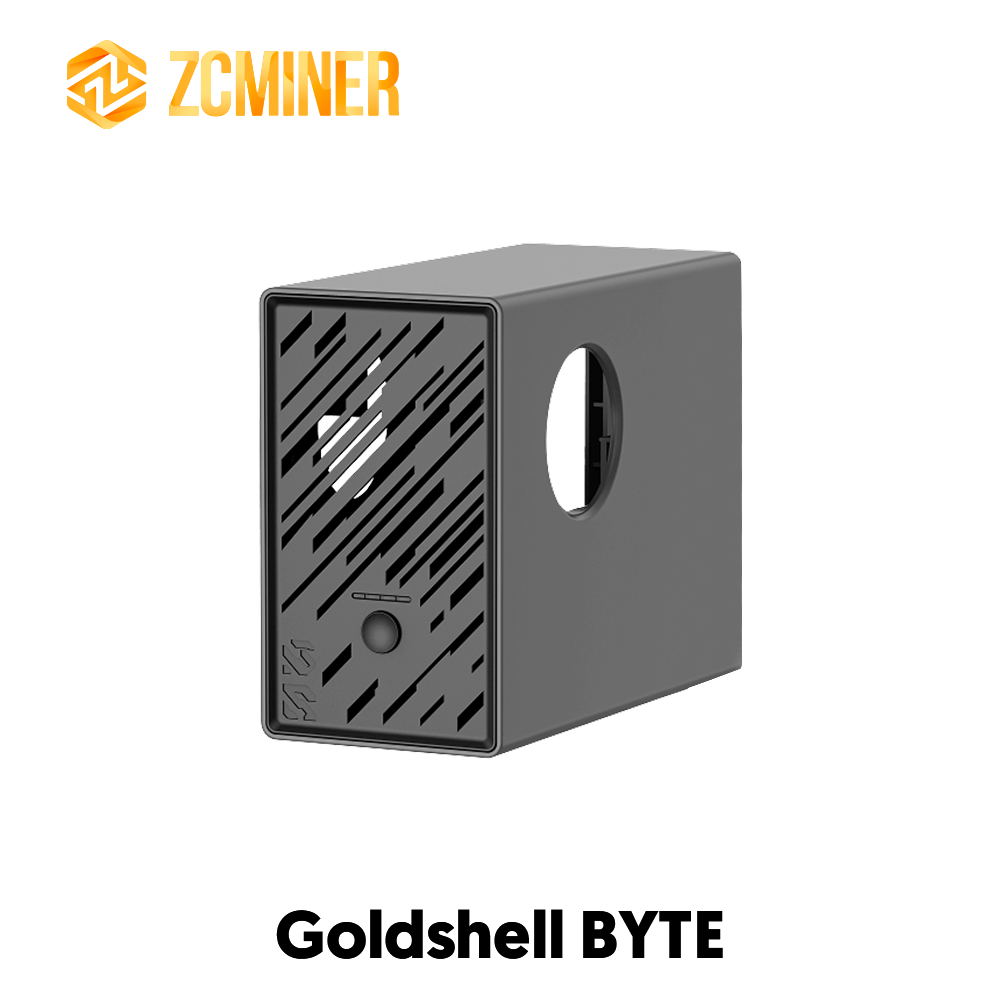
| Goldshell BYTE | Depends on installed card | Card-dependent | Mode and card-dependent | Low-power multi-algorithm experimentation |
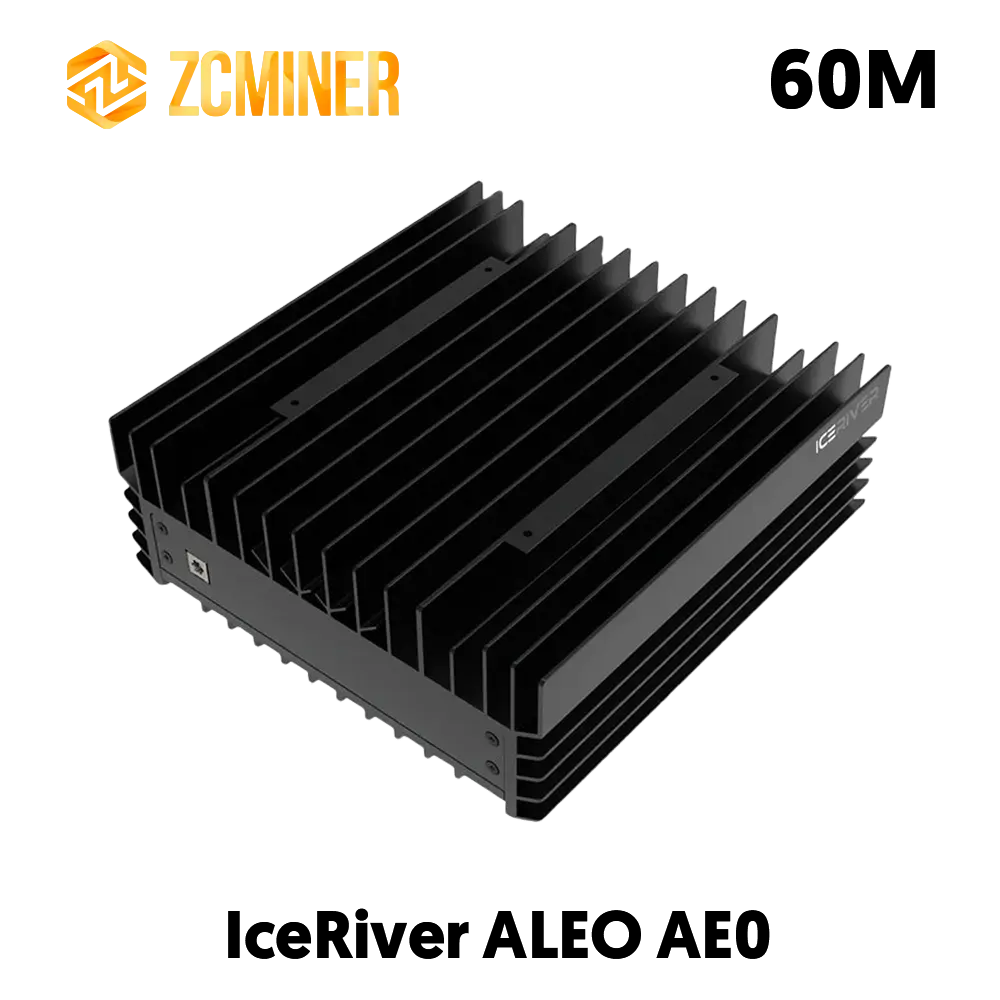
| IceRiver AE1 Lite | Aleo / zkSNARK | About 300 MH/s | About 500 W | Specialist Aleo home mining |
| Canaan Avalon Q | SHA-256 / Bitcoin | About 90 TH/s | About 1,674 W | Full Bitcoin ASIC where power, heat, and noise are planned |
| Bitaxe Supra Hex 701 | SHA-256 / Bitcoin | About 4.2 TH/s | About 90 W | Open-source learning and solo experimentation |
Availability, price, power modes, and firmware support can change. This guide intentionally does not embed fixed prices. Open each product page to review the current listing, included accessories, voltage requirements, shipping terms, and warranty information.
7Plan Power, Noise, and Airflow
The installation site determines whether a miner that looks compact on a product page is actually suitable for a home. Continuous electrical load, exhaust temperature, sound character, dust, humidity, and room recirculation matter more than physical size alone.
Use the correct circuit
Confirm voltage, plug type, continuous-load capacity, cable rating, grounding, and power-supply requirements. Have a qualified electrician review high-load installations.
Judge the location, not only dB
Fan pitch, surfaces, doors, distance, and nighttime operation affect perceived noise. A utility room can behave very differently from a bedroom or office.
Separate intake and exhaust
Give the miner cool intake air and move hot exhaust away. Recirculated exhaust raises fan speed, noise, component temperature, and failure risk.
Prefer stable connectivity
Ethernet is usually the simplest option for discovery and uptime. If Wi-Fi is supported, verify signal quality and keep miner management off untrusted networks.
Daily kWh = wall watts / 1,000 × 24 Daily electricity cost = daily kWh × local price per kWh
For example, a 630 W device uses about 15.12 kWh per day before ventilation overhead. A 1,674 W device uses about 40.18 kWh per day. Multiply by your actual local rate and include any cooling, pool, hosting, or import costs.
For a deeper calculation framework, use the Bitcoin Mining Electricity Cost Guide.
8Beginner Setup Workflow
Exact menus differ by manufacturer, but the operating sequence is broadly similar. Complete the site and account preparation before applying power.
For a complete Bitcoin example, follow the Beginner's ASIC Miner Setup Guide.
9Costs, Profitability, and Scaling
Mining economics change with coin price, network difficulty, block rewards, transaction fees, pool fees, uptime, and hardware efficiency. A screenshot from a calculator is a time-specific estimate, not a promise of future income.
Estimated net cash flow = mining revenue − electricity − pool fees − cooling − maintenance − other operating costs Simple payback period = total landed hardware cost / estimated net monthly cash flow
If estimated net monthly cash flow is zero or negative, the simple payback period is not meaningful. Recalculate with downside scenarios for lower coin price, higher difficulty, lower uptime, and repair costs.
Pool mining can smooth payouts but cannot eliminate market or operating risk. Solo mining can produce a full block reward, but expected value over a long period is different from cash received this month. Cloud or hosted hashrate introduces contract and counterparty risk in addition to mining risk.
Scale only after the first unit proves the site
- Record at least several weeks of measured wall power, temperature, accepted-share rate, rejects, and downtime.
- Confirm the room can remove additional heat without recirculation.
- Check the electrical service and breaker capacity before adding devices.
- Keep an emergency shutdown and maintenance process.
- Recalculate economics using current difficulty, price, pool fee, and product cost.
10Security and Purchase Risks
Mining hardware combines a network-connected controller, firmware, pool credentials, and a payout address. Treat it as infrastructure rather than an ordinary household gadget.
- Change default dashboard credentials and do not expose the management interface directly to the public internet.
- Download firmware from a trusted official source and confirm the exact model before installation.
- Use a separate trusted network segment when practical and keep router firmware current.
- Enable strong authentication on pool, email, and store accounts.
- Verify payout addresses and protect wallet recovery material offline.
- Confirm whether the listing is new, used, repaired, or preorder stock and review warranty and return terms.
- Treat fixed-return cloud-mining claims, urgency, private-message payment requests, and guaranteed ROI as warning signs.
Review the ASIC Firmware Security Guide and the Seven Mining Mistakes Beginner Checklist before deployment.
11Frequently Asked Questions
Can home mining still be profitable in 2026?
It can be profitable under some combinations of hardware efficiency, electricity cost, uptime, pool fees, network conditions, and coin price, but it is not guaranteed. Calculate with current data and include downside scenarios before buying.
Which miner is best for a complete beginner?
The best first miner is one whose algorithm, power requirement, noise, heat, firmware, pool support, and purchase cost you can verify and safely operate. A compact device is usually easier for learning than a full-size industrial ASIC.
Can I run a miner on a normal household outlet?
Some low-power devices may fit an appropriate household circuit, while higher-load ASICs may require dedicated wiring or a different voltage. Requirements vary by country, outlet, circuit, and continuous-load rules. Check the exact specification and consult a qualified electrician where needed.
Is a quiet miner silent?
No. A lower dB rating does not mean silent, and fan pitch can still be noticeable. Room surfaces, distance, airflow restrictions, and ambient temperature also change perceived noise.
Should a beginner mine Bitcoin solo or use a pool?
For a full Bitcoin ASIC, a pool is usually the practical default because it reduces payout variance. Compact solo miners are better treated as education or lottery-style participation rather than predictable income.
Can one ASIC mine different algorithms?
Usually not. ASIC hardware is built for a specific algorithm. A card-based platform may support different algorithms by using different compatible cards, but the installed hardware still determines what it can mine.
How long should I test one miner before scaling?
There is no universal period, but several weeks of stable measurements are more useful than a single profitable day. Track power, heat, noise, accepted shares, rejects, uptime, pool payouts, and maintenance.
Is cloud mining the same as home mining?
No. Home mining means you operate hardware in your own environment. Cloud or hosted hashrate relies on a provider and adds ownership, fee, custody, withdrawal, and contract risks.
12References and Further Reading
- Bitcoin Developer Guide: Mining — technical explanation of solo and pooled mining, shares, block construction, and payout variance.
- U.S. Department of Energy: Energy Saver Guide — practical household energy-efficiency and electricity-use context.
- CISA: Secure Our World — password, multifactor authentication, update, and phishing guidance for connected systems.
- FTC: What to Know About Cryptocurrency and Scams — warning signs relevant to cloud-mining and guaranteed-return offers.
- What Is Cryptocurrency Mining? — proof-of-work and mining fundamentals.
- How to Calculate Crypto Mining Profits — revenue, electricity, fees, and scenario analysis.
Final Verdict
Home mining is most useful when the equipment matches the room, circuit, algorithm, and learning goal. Start with one manageable unit, measure the real operating conditions, and scale only after the site proves it can handle continuous power, heat, noise, networking, and maintenance.
Do not choose a miner by headline hashrate or a temporary profitability screenshot. Choose it by verified compatibility, wall efficiency, total landed cost, safe installation, and the amount of financial and operational risk you can tolerate.
Disclaimer: This article is general educational information, not financial, investment, electrical, tax, or hardware-repair advice. Mining revenue, network difficulty, coin prices, pool terms, product specifications, availability, electricity rates, and regulations can change. Verify current information and use qualified local professionals where appropriate.


Leave a comment
This site is protected by hCaptcha and the hCaptcha Privacy Policy and Terms of Service apply.