
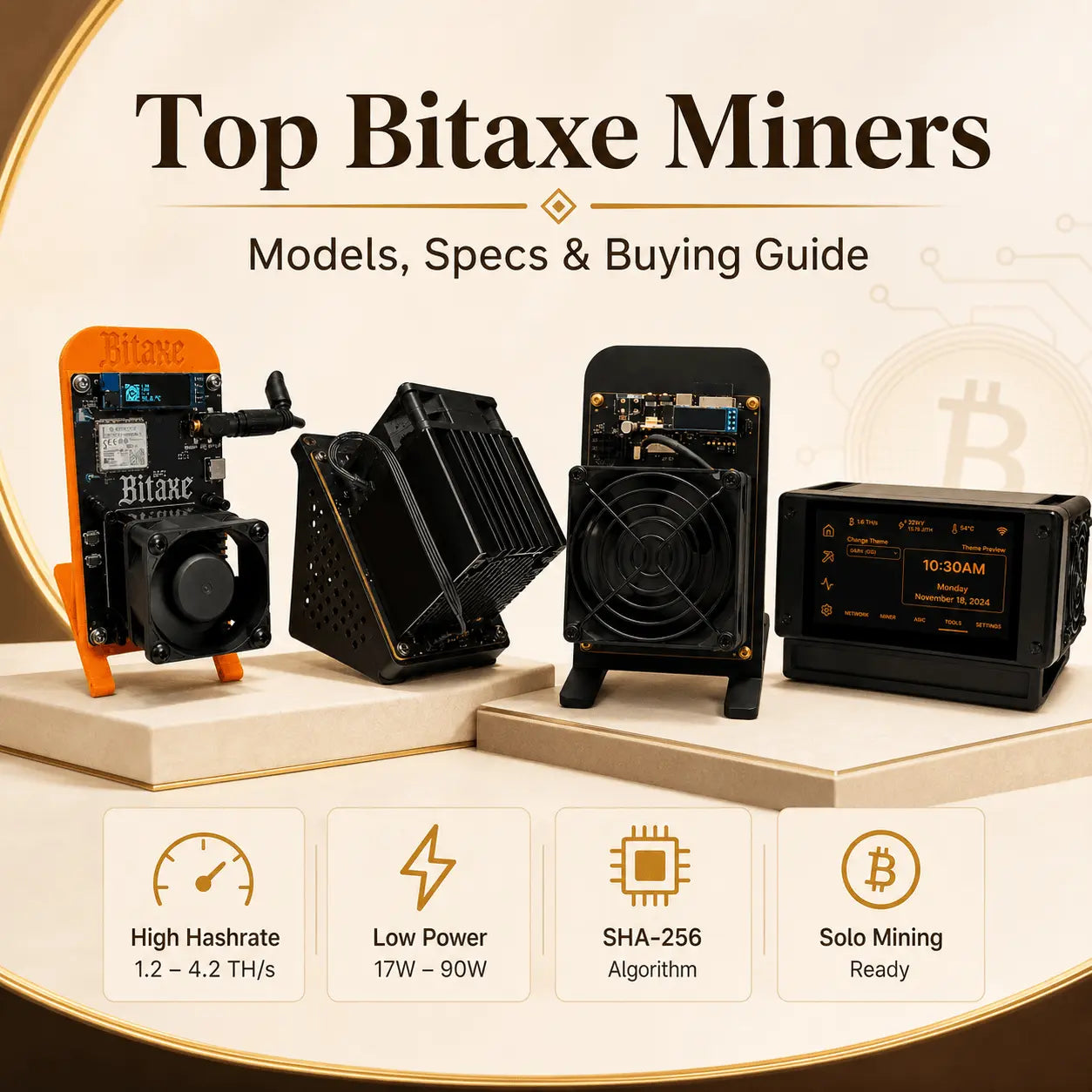
Top Bitaxe Miners Compared:
Models, Specs, and Buying Guide
Low-power SHA-256 mining · solo-mining experiments · desk-friendly hardware · model comparison · realistic expectations
On This Page
1Why Bitaxe Miners Are Different
Bitaxe miners sit in a very different category from industrial Bitcoin ASICs. They are compact, low-power, open-source SHA-256 devices built for learning, experimentation, and small-scale participation. A full-size ASIC is judged by fleet economics, electricity contracts, cooling design, and daily revenue. A Bitaxe is judged by whether it helps you understand mining without requiring a loud machine, a high-amperage circuit, or a dedicated facility.
That distinction matters for buyers. A Bitaxe can hash against the Bitcoin network, connect to pools, and participate in solo-mining experiments, but it should not be evaluated like an Antminer or Whatsminer. The hashrate is tiny compared with industrial hardware, so expected earnings are modest and solo block discovery is an extreme long shot. The real value is hands-on education: configuring a miner, monitoring hashrate, watching temperature behavior, understanding pool shares, and seeing how a real ASIC chip behaves.
Bitaxe miners are excellent learning devices and fun solo-mining tools. They are not a reliable income machine for ordinary buyers, especially at residential electricity rates.
2Quick Picks by User Type
The best Bitaxe model depends on what you want to learn or build. A first-time user usually benefits from low power draw and simple setup. A hobbyist who already understands the basics may prefer a dual-chip or six-chip model. Someone using the miner in a shared room may care more about the current quiet-cooling bundle than maximum output.
On October 20, 2026, the ZC MINER Bitaxe collection showed four available listings: Gamma 601, Gamma 601 Silent, GT 800, and Supra Hex 701. Availability and bundle contents can change, so use the linked product page as the final check before ordering.
3Bitaxe Model Comparison
A short comparison table is useful, but it should not be the only decision tool. These devices are sold in batches, and specs can vary by board revision, firmware, tuning mode, fan choice, and seller bundle. The current store lineup also differs from the July version of this guide: GT 800 and Gamma 601 Silent are now listed, while Bitaxe Touch is not part of the current collection. Before ordering, confirm the exact board, chip configuration, power supply, display, case, firmware, and warranty terms on the live product page.
| Model | Hashrate class | ASIC layout | Current role | Best fit |
|---|---|---|---|---|
| Bitaxe Gamma 601 | About 1.2 TH/s | 1 × BM1370 | Lowest-cost current listing | Low-power learning and solo-mining experiments. |
| Gamma 601 Silent | About 1.2 TH/s | 1 × BM1370 | Quiet-cooling variant | Shared rooms and noise-sensitive setups. |
| Bitaxe GT 800 | About 2.4 TH/s | 2 × BM1370 | Dual-chip step-up | More hashrate while staying desk-friendly. |
| Supra Hex 701 | About 4.2 TH/s | 6 × BM1368 | Highest-output current listing | Users who want the strongest small-device output. |
Hashrate still matters, but at Bitaxe scale it should be balanced against placement, power, cooling, firmware support, and monitoring. A device you actually enjoy running will teach you more than a stronger device that is inconvenient to manage. Power use also changes with frequency, voltage, fan profile, silicon variation, and firmware, so treat seller figures as operating-mode estimates rather than guarantees.
4Bitaxe Gamma 601: Best Simple Entry Point
The Gamma 601 is the easiest model to recommend for a first Bitaxe purchase. It keeps power draw low, produces little heat, and gives beginners a practical way to learn SHA-256 mining without turning the project into an electrical or acoustic problem. For many users, this is exactly the right starting point.
The current listing is rated at about 1.2 TH/s. The open-source Gamma design uses one BM1370 ASIC, and the project documentation places this class close to the chip's 15 J/TH efficiency target under suitable settings. Actual hashrate, wall power, temperature, and error rate depend on the individual chip, firmware, voltage, frequency, fan, power supply, and room conditions.
Its expected hashrate is modest, but that is not a weakness if your goal is education. You can learn how to configure Wi-Fi, point the miner at a pool or solo-mining endpoint, monitor accepted shares, and watch how hashrate changes with temperature and tuning. Because the power draw is low, the running cost stays small enough for long experiments.

New users who want a forgiving, low-power miner for learning, dashboards, pool setup, and solo-mining curiosity.
5Bitaxe GT 800: Best Compact Step-Up
The current Bitaxe GT 800 listing is for buyers who already know they want more than a single-chip starter unit. It is rated at about 2.4 TH/s and uses two BM1370 ASICs, providing a clear comparison point for searches such as Bitaxe Gamma vs Bitaxe GT: the GT class roughly doubles the chip count and listed hashrate, but it also increases cooling, power-supply, and firmware demands.
Board number matters here. The official BitaxeGT project describes version 801 as the first formal Gamma Turbo release and notes component and layout changes from version 800-series designs. Firmware support can therefore differ between boards reporting 800 and 801. Check the board revision shown by the seller and use firmware that explicitly supports that revision; do not assume an image for one GT board is safe for another.
This is the model class to consider if you want a more capable first setup without moving to a six-chip unit. Give it open airflow, a correctly rated power supply, and a stable Wi-Fi signal, then judge stability from accepted shares and a long monitoring window rather than a brief peak hashrate.

6Bitaxe Supra Hex 701: Best Higher-Hashrate Option
The Supra Hex 701 class is the performance-focused option in this comparison. Its six BM1368 ASICs and approximately 4.2 TH/s listed output put it well above the single-chip Gamma and dual-chip GT classes. It is built for hobbyists who want more active hashrate from a compact open-source miner without stepping into full industrial mining. At this level, the device becomes less of a passive desk gadget and more of a small hardware project that should be placed thoughtfully.
The main advantage is output. The main tradeoff is power, heat, and setup discipline. Around 90W is still manageable for a home or lab environment, but it is enough to make airflow matter. Avoid enclosed spaces, dusty corners, or unstable power strips. If you choose this class, choose it because you want more performance and are willing to manage the environment properly.

7Gamma 601 Silent: Best for Noise-Sensitive Rooms
The Gamma 601 Silent listing keeps the same 1.2 TH/s class as the standard Gamma while packaging it as the quieter option. It is the more practical choice when the miner will sit in an office, bedroom-adjacent area, classroom, or shared workspace and fan character matters more than adding hashrate.
Do not treat “silent” as a promise of zero sound. Air-cooled electronics still need a fan, and noise changes with temperature, fan curve, dust, mounting, and tuning. Confirm the included fan and power supply on the current product page. If the room is already warm, choose stability and cooling margin over aggressive settings.

Bitaxe Touch remains a useful display-focused concept, and the Bitaxe project now maintains touch-display work for GT-family hardware. It was not one of the four products in the ZC MINER Bitaxe collection checked on October 20, 2026, so this guide does not present it as a current store choice. Buyers comparing a Touch bundle should verify the base miner, board revision, display protocol, network interface, and firmware before purchase.
8What to Check Before Buying
Before buying any Bitaxe miner, decide whether your real goal is learning, solo-mining experimentation, display-based monitoring, or maximum small-device hashrate. That goal should decide the model, not the largest number on a spec sheet.
- Confirm the exact board revision, chip configuration, and firmware support.
- Check whether a correctly rated power supply, case, fan, antenna, and display are included.
- Verify whether the model uses Wi-Fi, Ethernet, or both.
- Plan airflow even for low-power models, especially if running 24/7.
- Use realistic solo-mining expectations; treat block discovery as a long-shot event.
- Check the current ESP-Miner release notes before changing firmware.
- Review stock status, warranty terms, delivery time, and return policy before ordering.
For home use, keep the setup boring: stable power, open air, reliable internet, and easy monitoring. The more boring the setup, the more useful the experiment becomes. Buyers comparing this category with other compact hardware can also use our Bitcoin miners under $1,000 guide, while first-time solo miners should review the odds and risks in our lotto miner guide.
9FAQ
Can Bitaxe miners make meaningful profit?
Usually no. At this scale, Bitaxe miners are better understood as learning devices and solo-mining experiments. Pool payouts are typically small, and solo mining is lottery-style.
Which current Bitaxe is best for beginners?
The standard Gamma 601 is the clearest entry point for most beginners. Choose the Gamma 601 Silent listing when the same 1.2 TH/s class is attractive but fan noise matters more in the intended room.
Bitaxe Gamma vs GT: what is the main difference?
The current Gamma 601 listing uses one BM1370 and is rated around 1.2 TH/s, while the GT 800 listing uses two BM1370 ASICs and is rated around 2.4 TH/s. The GT offers more output but requires more attention to power, cooling, board revision, and firmware compatibility.
Bitaxe Gamma vs Supra Hex: which should I choose?
Choose Gamma for the lowest-cost, lowest-power learning path. Choose Supra Hex 701 when compact hashrate is the priority and you are prepared to manage the higher wall power, heat, and airflow of a six-chip unit.
Should I choose the highest hashrate model?
Only if you are comfortable managing the extra power and heat. For many buyers, usability, monitoring, and low running cost matter more than the highest hashrate.
Can Bitaxe miners join mining pools?
Yes, Bitaxe devices can be configured for pool or solo-mining setups through compatible firmware and pool settings. Always follow the current firmware documentation for your exact model.
Are Bitaxe GT 800 and GT 801 the same board?
No. The official BitaxeGT project describes revision 801 as the first formal Gamma Turbo release and documents hardware changes from earlier 800-series boards. Confirm the board revision before choosing firmware or replacement parts.
10References and Data Sources
- Bitaxe GitHub OrganizationPrimary open-source project hub for Bitaxe-related hardware and software repositories.
- Bitaxe FOSS Miner ListOfficial model list used to verify ASIC layouts for Gamma, GT, and Supra Hex classes.
- Bitaxe Gamma Hardware RepositoryPrimary design reference for the single-BM1370 Gamma platform.
- BitaxeGT Hardware RepositoryPrimary reference for GT hardware, including revision 801 notes and changes from earlier boards.
- ESP-Miner Firmware RepositoryOpen-source firmware reference for Bitaxe and related ESP32-based mining devices.
- ESP-Miner ReleasesRelease history useful for checking current firmware support and update cadence.
- ZC MINER Bitaxe CollectionCurrent store lineup and availability snapshot checked on October 20, 2026.
Final Verdict
Bitaxe miners are best judged by learning value, usability, and fit for your space, not by profit promises. Among the current store listings, the Gamma 601 is the simplest entry point, the Gamma 601 Silent is the quieter room-friendly variant, the dual-chip GT 800 is the compact step-up, and the Supra Hex 701 is the higher-output hobby option.
Choose the model that matches your goal, confirm the exact board revision and current product specifications before ordering, and treat Bitaxe mining as hands-on Bitcoin education first. GT 801 and Touch remain useful comparison terms, but they should not be mistaken for the four products currently listed in the store collection.


Leave a comment
This site is protected by hCaptcha and the hCaptcha Privacy Policy and Terms of Service apply.