
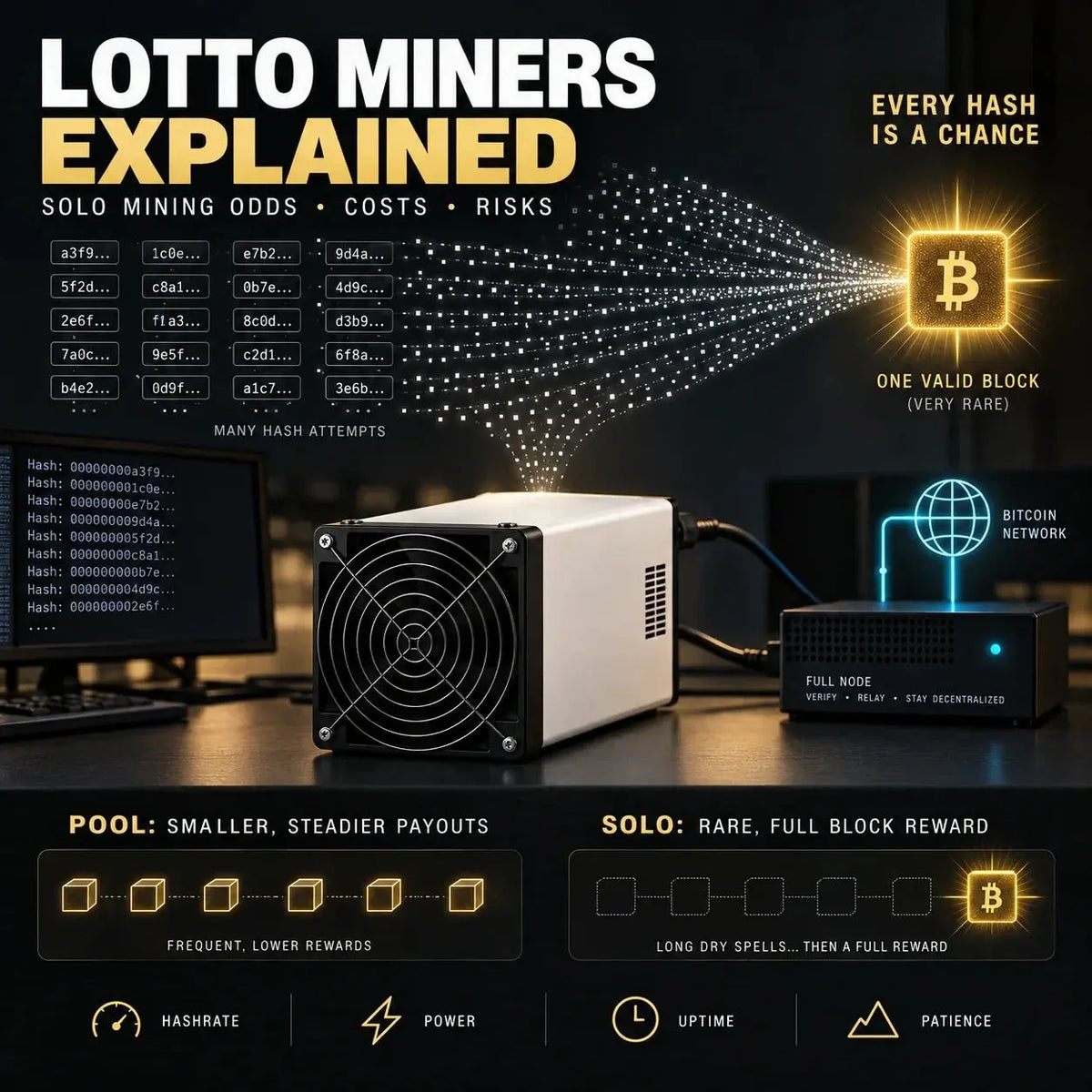
Lotto Miners Explained:
Solo Mining Odds, Costs, and Risks
SHA-256 hashing · solo block probability · compact home miners · electricity cost · realistic expectations
On This Page
1Quick Answer
A lotto miner is an informal name for a small miner used for solo, winner-takes-all Proof-of-Work mining. It does not use a special lottery algorithm, generate privileged tickets, or receive easier network work. A SHA-256 lotto miner hashes ordinary Bitcoin-style block-header candidates just like a larger ASIC. The lottery comparison describes the payout pattern: many attempts may produce no block, while one qualifying hash can earn the solo miner the block reward permitted by the chosen service and network.
Compact miners can be useful for learning, home experimentation, decentralization, and heat reuse. They should not be presented as predictable-income machines. If steady payouts matter, pool mining is usually the more practical route.
Mining work is probabilistic in both solo and pool modes. A pool does not make an individual hash more likely to win; it combines many miners and distributes rewards more frequently. Solo mode keeps the reward concentrated but also concentrates the variance.
2What Does "Lotto Miner" Actually Mean?
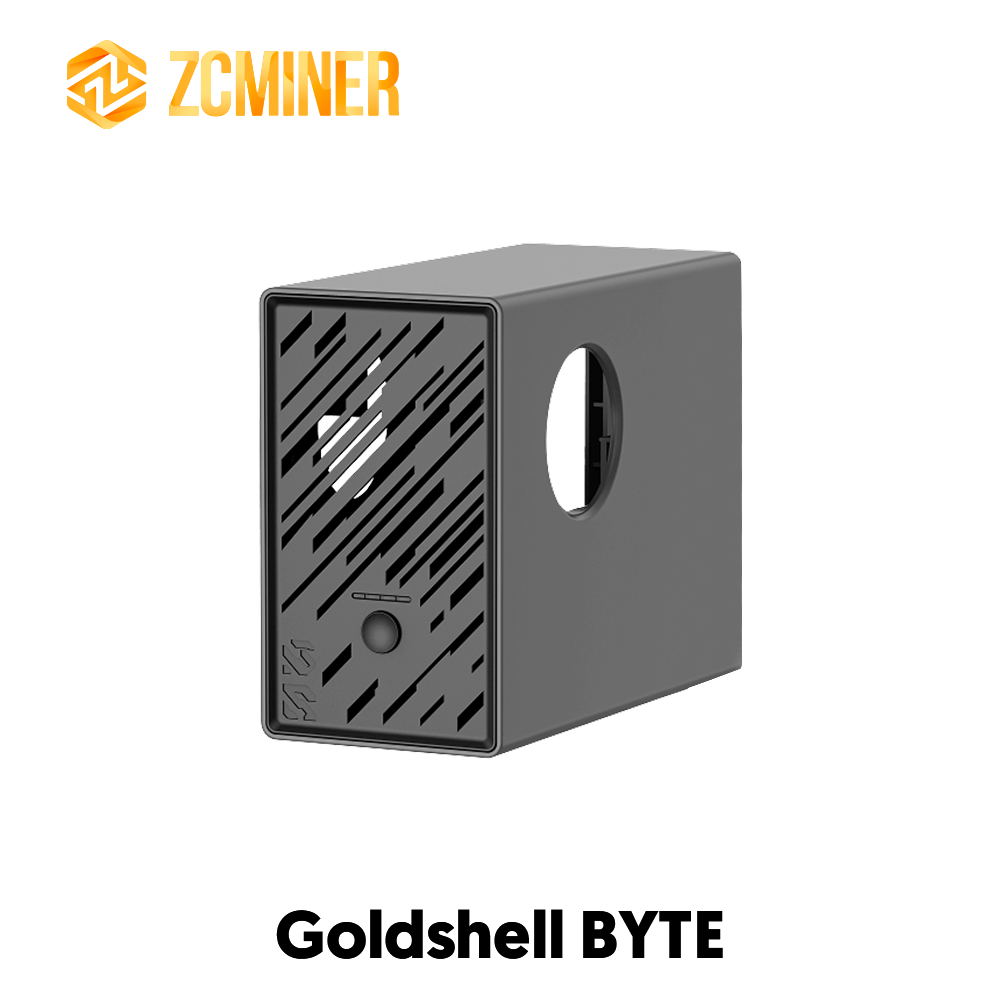
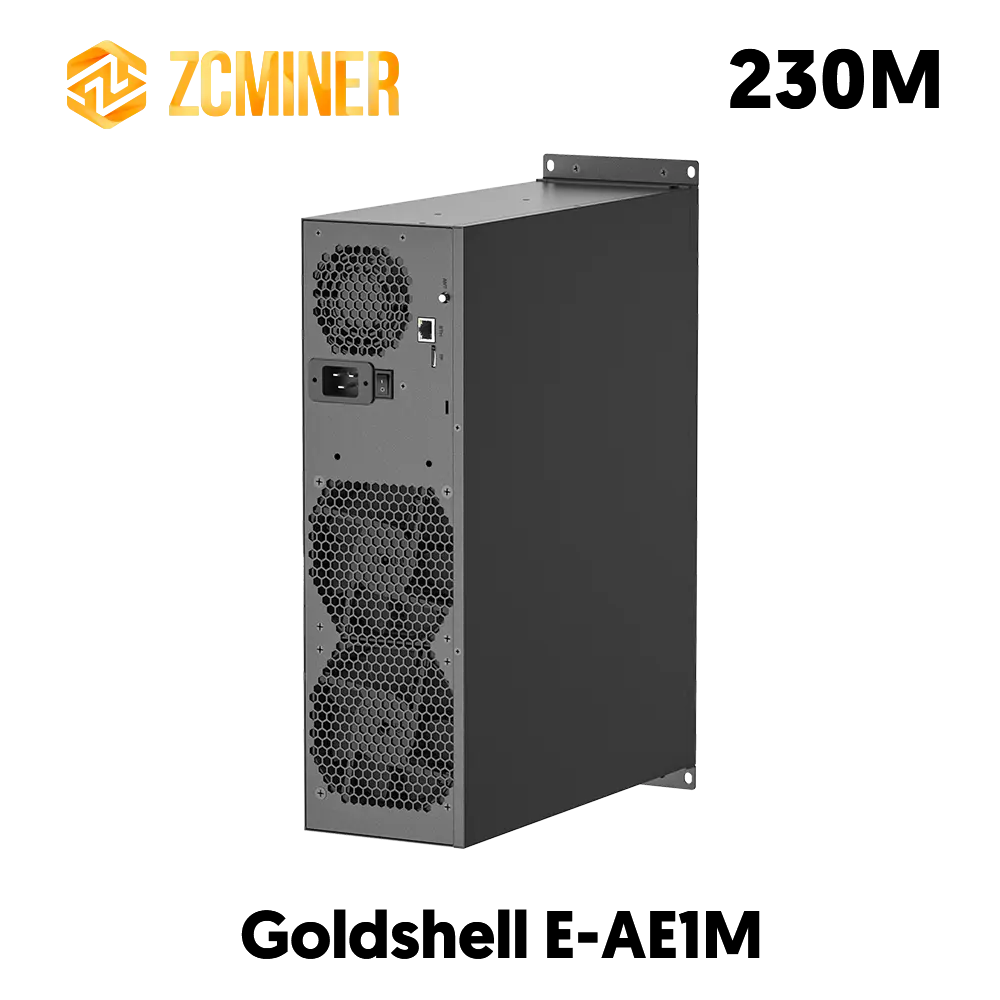
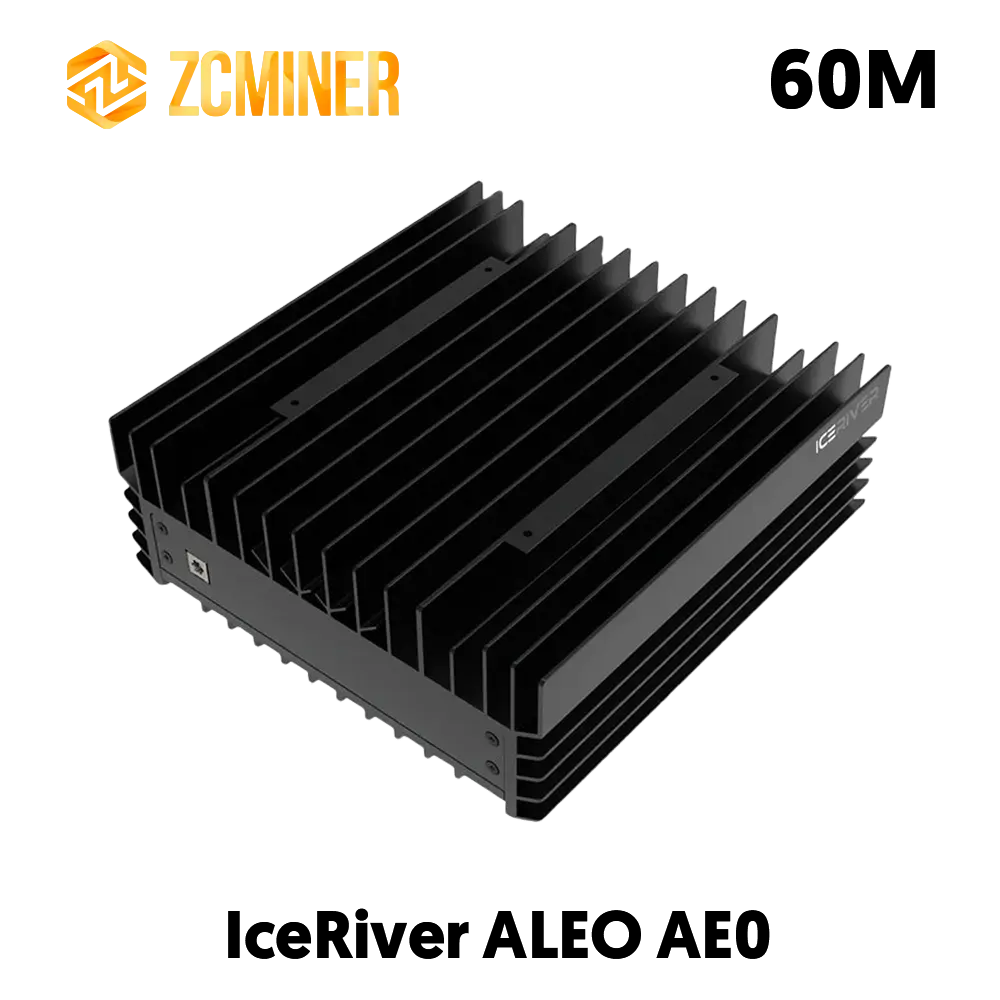
The phrase is community and marketing shorthand, not a formal Bitcoin protocol category. It usually refers to a low-power SHA-256 device configured for solo mining or a solo-style service. Products sold under this idea range from genuine ASIC miners producing terahashes per second to educational displays that calculate only a tiny number of hashes.
The original appeal remains valid: a compact miner can make mining tangible without the electrical load, heat, and noise of a full-size industrial ASIC. The technical explanation, however, matters. The device is not drawing random numbers from a special lottery network. It is repeatedly hashing candidate block headers and comparing each result with a target, which is the same basic Proof-of-Work process used by larger SHA-256 miners.
3How Lotto Mining Works
Bitcoin mining software builds candidate blocks and an 80-byte block header. The miner changes nonce-related data and applies double SHA-256 to each candidate. If the resulting 256-bit value is above the network target, that attempt does not create a valid block. If it is at or below the target, the completed block can be submitted to the network.
- Receive current work. A local node, mining server, or solo service provides information for the next candidate block.
- Construct candidate headers. Mining software prepares the block header and enough changing data to keep the ASIC busy.
- Hash continuously. The ASIC tests vast numbers of candidates every second.
- Check targets. Most results fail. A pool may accept easier shares as proof of work, while a true block must meet the harder network target.
- Submit a valid block. When a network-valid result appears, the block is relayed for validation.
- Apply the payout rules. A true solo setup pays the configured coinbase output; a solo-style service may deduct a fee under its published terms.
Claims about a unique "random number generation rate" or a lottery-only algorithm are misleading for ordinary SHA-256 lotto miners. Each device performs standard hashing work. Hashrate, valid work delivery, uptime, stale-work rate, and network difficulty determine the statistical opportunity.
4How to Estimate Solo Mining Odds
A useful estimate begins with the miner's share of total network hashrate. Let h be the miner's effective hashrate and H be the network hashrate, expressed in the same unit. Bitcoin targets an average of roughly 144 blocks per day, although actual block timing varies.
144 x (h / H)
Approximate expected wait in days: H / (144 x h).
1 - e^(-144 x d x h / H)
This is a probability estimate, not a schedule. A miner can find a block far earlier than the average or run far longer without one.
| Illustrative Network Share | Expected Blocks per Day | Average Wait | What It Means |
|---|---|---|---|
| 1 in 1,000,000 | 0.000144 | About 6,944 days | Roughly 19 years on average, with no deadline or guarantee |
| 1 in 10,000,000 | 0.0000144 | About 69,444 days | Roughly 190 years on average |
| 1 in 100,000,000 | 0.00000144 | About 694,444 days | Roughly 1,900 years on average |
These rows illustrate scale only; they are not estimates for a specific product. Before making a decision, retrieve current network hashrate or difficulty, use measured miner hashrate, account for downtime, and recalculate. Do not confuse expected time with a promise that a block will arrive by that date.
5Lotto Mining vs Pool Mining
| Factor | True Solo Mining | Solo-Style Service | Regular Pool Mining |
|---|---|---|---|
| Reward Pattern | Full configured block reward when successful | Winner receives reward under service terms, usually minus a fee | Frequent smaller payouts based on contributed work |
| Variance | Extremely high for small miners | Extremely high for small miners | Much lower |
| Infrastructure | Node, wallet, block construction, monitoring, and reliable connectivity | Service supplies work and submission infrastructure | Pool supplies jobs, share accounting, and payout system |
| Fees | No pool fee, but infrastructure still has costs | Depends on service terms | Depends on pool and payout model |
| Best Fit | Technically capable operators prioritizing independence | Hobbyists accepting service dependence and rare payouts | Most users seeking measurable, steadier income |
A solo-style endpoint is convenient, but it is not identical to building blocks with your own full node. Check who constructs the block template, who controls the coinbase output, what fee applies, how a successful block is proven, and what happens during service downtime. For the broader decision, use the dedicated solo mining versus mining pools guide.
6Examples of Compact Mining Devices
Device names alone do not prove that a miner is suitable for solo Bitcoin mining. Confirm that the hardware performs SHA-256, that its firmware supports the intended endpoint, and that its measured hashrate and power match the listing. The following examples show why product category matters.
| Example | Type | Listed Performance | Practical Role |
|---|---|---|---|
| Canaan Avalon Nano 3S | Compact SHA-256 ASIC | 6 TH/s, up to 140W | Home mining, learning, pool mining, or high-variance solo experimentation |
| Lucky Miner LV08 | Compact SHA-256 ASIC | 4.5 TH/s, listing approximately 120-125W | Low-power hobby mining; verify current firmware, package, and availability |
| NerdMiner-class device | Educational microcontroller/display | Far below ASIC hashrate | Learning and visualization, not a substitute for a terahash ASIC |
| Full-size SHA-256 ASIC | Industrial mining appliance | Model-dependent, commonly hundreds of TH/s | Higher probability but much greater electrical, heat, and noise requirements |
The Avalon Nano 3S figure above follows Canaan's current 6 TH/s and 140W maximum specification. It is not USB-powered and does not consume less than 5W. Read the separate Lucky Miner review for model-by-model discussion rather than treating every compact device as interchangeable.
7Power Cost and the Price of Waiting
Low power does not mean zero cost. A miner consumes electricity during every unsuccessful attempt, and a long solo dry spell can continue while hardware ages and network competition changes.
| Example Load | Daily Energy | Daily Cost at $0.10/kWh | Annual Cost at $0.10/kWh |
|---|---|---|---|
| 120W | 2.88 kWh | $0.29 | $105.12 |
| 140W | 3.36 kWh | $0.34 | $122.64 |
| 200W | 4.80 kWh | $0.48 | $175.20 |
Daily energy = watts / 1,000 x 24. Multiply daily energy by the actual electricity rate, then add any service fee, cooling load, replacement fan or adapter cost, and downtime. If the miner also provides useful space heat, value that heat separately and seasonally; do not count it as free revenue.
Pool-mining revenue can help measure whether the device is hashing correctly, but it does not predict when a solo block will occur. For a complete cost framework, use the mining electricity cost guide.
8Lotto Miner Setup Checklist
- Verify the algorithm. Confirm SHA-256 and the exact network you intend to mine.
- Choose the reward route. Decide between your own node, a solo-style service, and an ordinary pool. Read the fee and payout rules before connecting.
- Use a wallet you control. Verify the address character by character and test configuration before long-term operation.
- Confirm power requirements. Use the correct manufacturer-rated adapter or PSU. Do not cover a warm adapter or place it on a heat-sensitive surface.
- Provide airflow. Keep intake and exhaust paths clear even for quiet, low-power devices.
- Secure the web interface. Change default credentials, avoid exposing the dashboard directly to the internet, and install firmware only from a trusted source.
- Check pool-side or service-side data. Confirm effective hashrate, accepted shares, rejected or stale shares, connection stability, and worker identity.
- Record a baseline. Save wall power, temperature, fan speed, effective hashrate, firmware version, and uptime so later faults are visible.
New users can first run the device on a regular pool to verify hardware and networking, then switch a planned portion of hashrate to solo mode. The home mining beginner guide covers room, power, network, and heat planning in more detail.
9Who Should Consider One, and What Are the Risks?
- Long zero-reward periods: the most important risk and a normal statistical outcome.
- Misleading probability claims: a seller may quote odds using outdated network hashrate, perfect uptime, or an undefined time period.
- Service dependence: a solo endpoint can fail, reject work, change fees, or apply payout rules the miner did not understand.
- Hardware and adapter heat: compact equipment still requires ventilation and correct power hardware.
- Firmware risk: untrusted downloads or exposed dashboards can redirect hashrate or compromise the local network.
- Opportunity cost: the same hashrate could produce smaller measurable pool payouts instead of waiting for a rare block.
- Resale uncertainty: compact miners can lose value as efficiency, network competition, and buyer demand change.
Avoid listings that promise a block within a fixed time, present expected wait as a deadline, claim a special algorithm makes each hash luckier, hide wall power, or omit the exact mining endpoint and fee. No seller can guarantee when an independent valid block hash will appear.
10FAQ: Lotto Miners and Solo Mining
Is a lotto miner a real type of miner?
It is a real informal category, usually meaning a small miner used for solo mining. It is not a separate Bitcoin consensus device class or a special lottery algorithm.
Does a lotto miner generate random lottery tickets?
No. A SHA-256 ASIC hashes candidate block headers. Because cryptographic hash outputs are unpredictable, each attempt behaves like an independent chance, which creates the lottery analogy.
Can a small miner really find a Bitcoin block?
It is technically possible if the miner produces a hash below the network target. The probability is proportional to its effective share of network hashrate, so the expected wait for a compact device can be extremely long.
Does a higher hashrate guarantee a block?
No. Higher hashrate increases the number of attempts and improves probability over time, but it cannot guarantee a result by a particular date.
Is a solo pool the same as true solo mining?
No. A solo-style service supplies mining jobs and submission infrastructure while keeping a winner-takes-all payout pattern. True solo mining generally involves the operator's own node and block-construction stack. Terms and control differ by service.
Can I switch a compact miner from solo to pool mining?
Often yes, if the firmware supports the selected pool and protocol. Confirm the exact model, firmware, algorithm, pool endpoint, worker format, and wallet requirements.
Are NerdMiner devices equivalent to compact ASIC miners?
No. NerdMiner-style microcontrollers are primarily educational and produce far less hashrate than terahash-class ASIC devices. Compare actual hashrate and power, not case size or display design.
Is lotto mining profitable?
It cannot be treated as predictable income. Compare electricity and ownership cost with the probability model, pool-mining alternative, device utility, and personal value of the learning experience.
11References and Further Reading
- Bitcoin Developer Guide: MiningTechnical explanation of solo and pooled mining, block templates, targets, shares, and block submission.
- Bitcoin Developer Reference: Block HeadersReference for the 80-byte Bitcoin block header, nonce, nBits, and target threshold.
- BIP 22: getblocktemplate FundamentalsDeployed specification for providing miners and proxies with block-construction data.
- Canaan: Avalon Nano 3S SpecificationsManufacturer listing for 6 TH/s hashrate, 140W maximum power, dimensions, operating range, and noise.
Final Verdict
Lotto miners are best understood as compact Proof-of-Work devices used under a high-variance solo payout strategy. They do ordinary SHA-256 work; the unusual part is not the algorithm but the decision to accept many possible zero-payout periods in exchange for a rare full-reward outcome.
Choose one for education, direct participation, or a deliberately limited hobby budget. Choose a regular pool when cash-flow visibility matters. Before switching modes, compare current network data, measured hashrate, power cost, uptime, endpoint control, and the detailed solo-versus-pool framework.


Leave a comment
This site is protected by hCaptcha and the hCaptcha Privacy Policy and Terms of Service apply.