
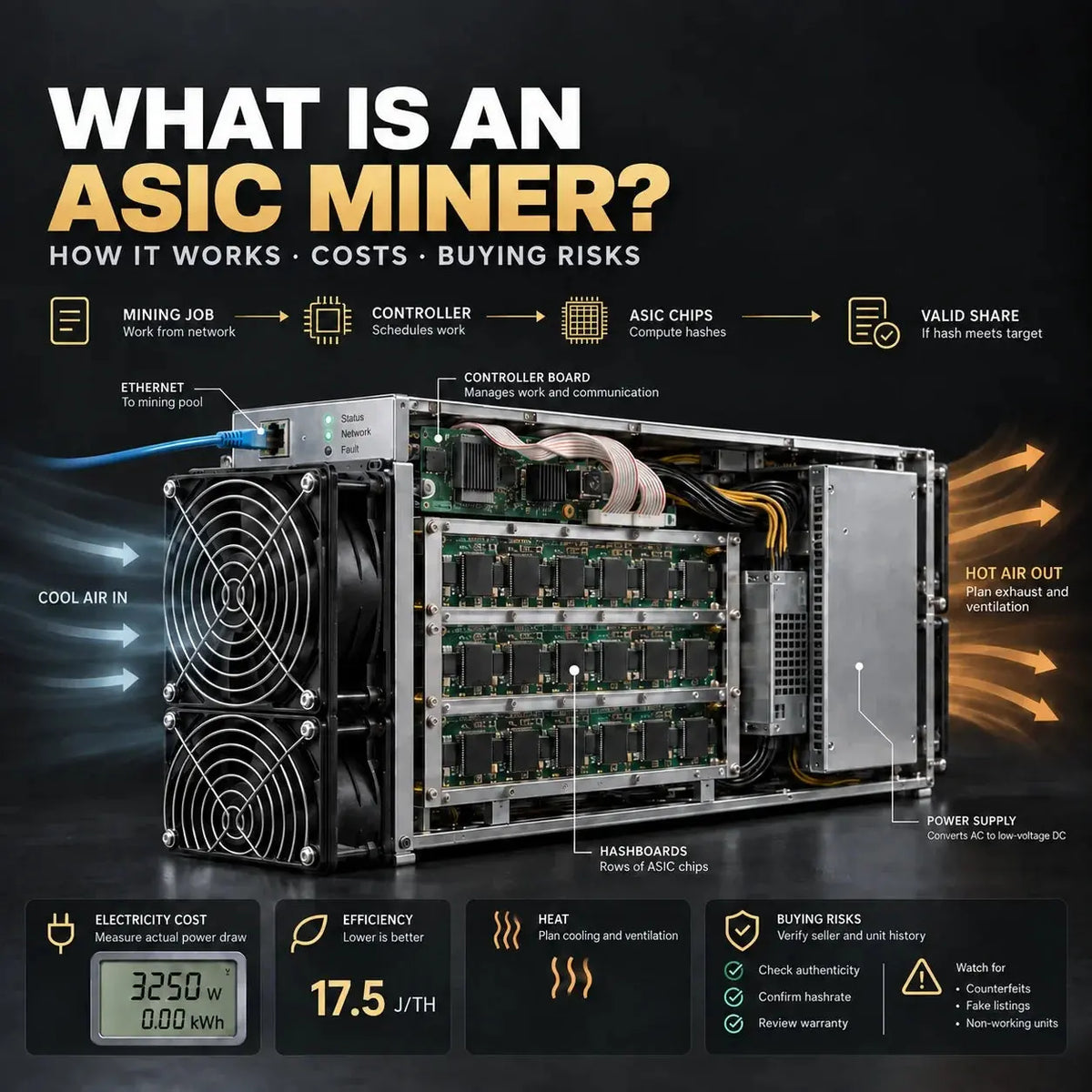
O Que É um Minerador ASIC?
Como Funciona, Custos e Riscos de Compra
Uma introdução prática ao hardware de mineração especializado, hashrate, eficiência, algoritmos, custos de eletricidade, pools e devida diligência do comprador
1O Que Significa Minerador ASIC?
ASIC significa Application-Specific Integrated Circuit (Circuito Integrado de Aplicação Específica). Ao contrário de uma CPU ou GPU, que pode realizar muitas tarefas de computação diferentes, um ASIC é projetado para executar uma classe restrita de cálculos de forma extremamente eficiente.
Na mineração de criptomoedas, o chip é otimizado para um algoritmo específico de Prova de Trabalho (Proof-of-Work), como SHA-256, Scrypt, Equihash ou kHeavyHash. Essa especialização permite que os mineradores ASIC entreguem muito mais hashrate por watt do que o hardware de uso geral no algoritmo que suportam.
Um minerador ASIC é um hardware especializado que executa repetidamente o trabalho de hashing exigido por uma rede de criptomoeda específica. É rápido e eficiente, mas geralmente não pode mudar para um algoritmo não relacionado.
2Como Funciona um Minerador ASIC?
Na mineração de Bitcoin, o software constrói um cabeçalho de bloco de 80 bytes e o envia com um limite-alvo para o hardware de mineração. O ASIC altera repetidamente os valores candidatos e executa o hashing SHA-256 duplo. Um bloco é válido quando o hash de seu cabeçalho é igual ou inferior ao alvo da rede.
- Receber trabalho de mineração: o pool ou nó fornece os dados necessários para construir cabeçalhos de bloco candidatos.
- Gerar hashes: o ASIC testa um número enorme de hashes candidatos a cada segundo.
- Comparar com um alvo: os resultados são verificados em relação ao alvo de compartilhamento do pool e ao alvo de dificuldade da rede.
- Enviar compartilhamentos: os mineradores do pool retornam os compartilhamentos qualificados como prova do trabalho contribuído.
- Ganhar pagamentos: o pool distribui os lucros da mineração de acordo com seu sistema de recompensa e os compartilhamentos aceitos.
A mineração em pool diminui a variância do pagamento ao combinar o hashrate de muitos operadores. A mineração solo mantém a recompensa total do bloco quando bem-sucedida, mas a descoberta de blocos pode ser extremamente imprevisível para pequenos mineradores.
3Quatro Métricas Que Definem um Minerador ASIC
Por Que a Eficiência Importa Mais do Que Apenas o Hashrate
Um minerador com mais hashrate ainda pode ser uma compra mais fraca se consumir desproporcionalmente mais eletricidade. Compare as máquinas usando eficiência, potência total da tomada, custo de aquisição, requisitos de resfriamento e receita esperada, em vez de apenas o hashrate.
4Mineração ASIC vs GPU vs CPU
| Dimensão | Minerador ASIC | Rig de GPU | Mineração de CPU |
|---|---|---|---|
| Especialização | Uma família de algoritmos | Vários algoritmos e cargas de trabalho | Computação de uso geral |
| Eficiência de Mineração | Geralmente a mais alta no algoritmo suportado | Moderada e dependente da moeda | Geralmente a mais baixa |
| Flexibilidade | Baixa | Alta | Alta |
| Opções de Revenda | Depende da demanda de mineração | Mercado mais amplo de jogos e computação | Ampla, mas com baixo valor de mineração |
| Ruído e Calor | Muitas vezes industrial | Variável e ajustável | Geralmente mais baixos |
| Melhor Uso | Mineração contínua dedicada | Mineração ou computação flexível | Algoritmos selecionados amigáveis à CPU |
A especialização ASIC cria tanto sua vantagem quanto seu risco. A máquina pode ser excepcionalmente eficiente enquanto seu algoritmo permanecer lucrativo, mas não pode simplesmente se tornar um computador de uso geral quando a economia da mineração enfraquece.
5Algoritmos ASIC Comuns e Categorias de Moedas
| Algoritmo | Exemplo Comum | Observação para o Comprador |
|---|---|---|
| SHA-256 | Bitcoin e redes compatíveis | Maior categoria ASIC com intensa competição de eficiência |
| Scrypt | Litecoin e ativos de mineração conjunta | A receita pode envolver mais de um fluxo de recompensa |
| Equihash | Zcash e ativos compatíveis | Verifique o conjunto exato de parâmetros Equihash antes de comprar |
| kHeavyHash | Mineração de classe Kaspa | A lucratividade pode mudar rapidamente à medida que o hashrate da rede se expande |
| Blake2B-Sia | Mineração compatível com Sia | Mercado e demanda de revenda mais restritos |
| EtHash / Derivado de EtHash | Redes compatíveis selecionadas | Confirme DAG, memória, firmware e suporte de rede atual |
Nunca presuma que duas moedas descritas como usando um algoritmo semelhante são automaticamente compatíveis com o mesmo minerador. Confirme a variante exata do algoritmo, suporte de firmware, suporte de pool e especificações do vendedor.
6Custos e Lucratividade da Mineração ASIC
A eletricidade é o custo operacional mais previsível. Por exemplo, um minerador que consome 3,5 kW usa 84 kWh por dia. A $0,10/kWh, a energia sozinha custa $8,40 por dia antes de taxas de pool, resfriamento, hospedagem, reparos e tempo de inatividade.
| Tarifa de Eletricidade | Custo Diário a 3,5 kW | Custo de 30 Dias | Custo Anual |
|---|---|---|---|
| $0,05/kWh | $4,20 | $126 | $1.533 |
| $0,07/kWh | $5,88 | $176,40 | $2.146,20 |
| $0,10/kWh | $8,40 | $252 | $3.066 |
| $0,15/kWh | $12,60 | $378 | $4.599 |
| $0,20/kWh | $16,80 | $504 | $6.132 |
Fórmula de Lucro Líquido ASIC
- Receita bruta/dia = moedas mineradas/dia x preço de mercado
- Custo de energia/dia = kW do minerador x 24 x tarifa de eletricidade
- Líquido/dia = receita bruta - energia - taxa de pool - hospedagem - resfriamento - manutenção - tempo de inatividade
- Período de retorno = custo total do hardware / lucro diário líquido
A receita de mineração muda com o preço da moeda, dificuldade da rede, taxas, tempo de atividade e concorrência. O resultado de uma calculadora é um instantâneo, não uma promessa. Use cenários conservadores, base e otimistas.
7Qual Infraestrutura um ASIC Precisa?
8Lista de Verificação para Compra de Minerador ASIC
- Confirme o algoritmo: verifique se o minerador suporta a moeda e a variante exata do algoritmo.
- Verifique as especificações oficiais: verifique hashrate, potência da tomada, voltagem, dimensões, ruído e limites ambientais.
- Calcule o custo total: inclua hardware, envio, imposto, cabos, PDU, fiação, resfriamento e hospedagem.
- Verifique a inclusão de PSU e cabo: o conteúdo do pacote varia por modelo, lote e vendedor.
- Modele cenários de eletricidade: calcule os resultados com sua taxa real e com uma taxa de teste de estresse mais alta.
- Inspecione mineradores usados: solicite hashrate de pool ao vivo, status da placa, registros de temperatura e histórico de reparos.
- Revise os termos da garantia: entenda a cobertura, exclusões, responsabilidade de envio e serviço regional.
- Planeje uma saída: estime a demanda de revenda se a lucratividade enfraquecer ou a rede mudar.
9FAQ: Fundamentos da Mineração ASIC
Um minerador ASIC é melhor que uma GPU?
Um ASIC geralmente é muito mais eficiente em seu algoritmo suportado. Uma GPU é mais flexível e tem usos mais amplos de revenda e não-mineração.
Um minerador ASIC pode minerar qualquer criptomoeda?
Não. Um ASIC suporta um algoritmo específico ou família de algoritmos intimamente relacionada. Ele não pode alternar livremente para algoritmos de mineração não relacionados.
Quanta eletricidade um minerador ASIC usa?
O consumo de energia varia amplamente. Muitos mineradores atuais de tamanho normal refrigerados a ar consomem vários quilowatts continuamente, então sempre verifique a potência da tomada antes de comprar.
Mineradores ASIC são adequados para uso doméstico?
Alguns modelos de baixa potência podem funcionar em casa, mas muitos ASICs industriais são muito barulhentos, quentes e consomem muita energia para espaços de convivência normais.
O que significa J/TH?
J/TH significa joules por terahash. Mede a energia necessária para produzir um terahash de trabalho SHA-256. Valores mais baixos indicam melhor eficiência.
A mineração ASIC é garantida para ser lucrativa?
Não. A lucratividade muda com o preço da eletricidade, custo do hardware, preço da moeda, dificuldade da rede, taxas de pool, tempo de atividade e manutenção.
Estrutura de Decisão
Os mineradores ASIC são máquinas construídas especificamente que trocam flexibilidade por eficiência excepcional. Eles são a escolha de hardware dominante em muitas redes Proof-of-Work estabelecidas, mas sua economia depende de muito mais do que o hashrate anunciado.
Uma compra sensata começa com o algoritmo, a especificação oficial de consumo de energia, a tarifa de eletricidade, os requisitos de infraestrutura e as premissas de receita conservadoras. Se o plano só funciona com tempo de atividade perfeito e preços otimistas de moedas, a margem de segurança é muito pequena.


Deixar comentário
Este site é protegido por hCaptcha e a Política de privacidade e os Termos de serviço do hCaptcha se aplicam.