
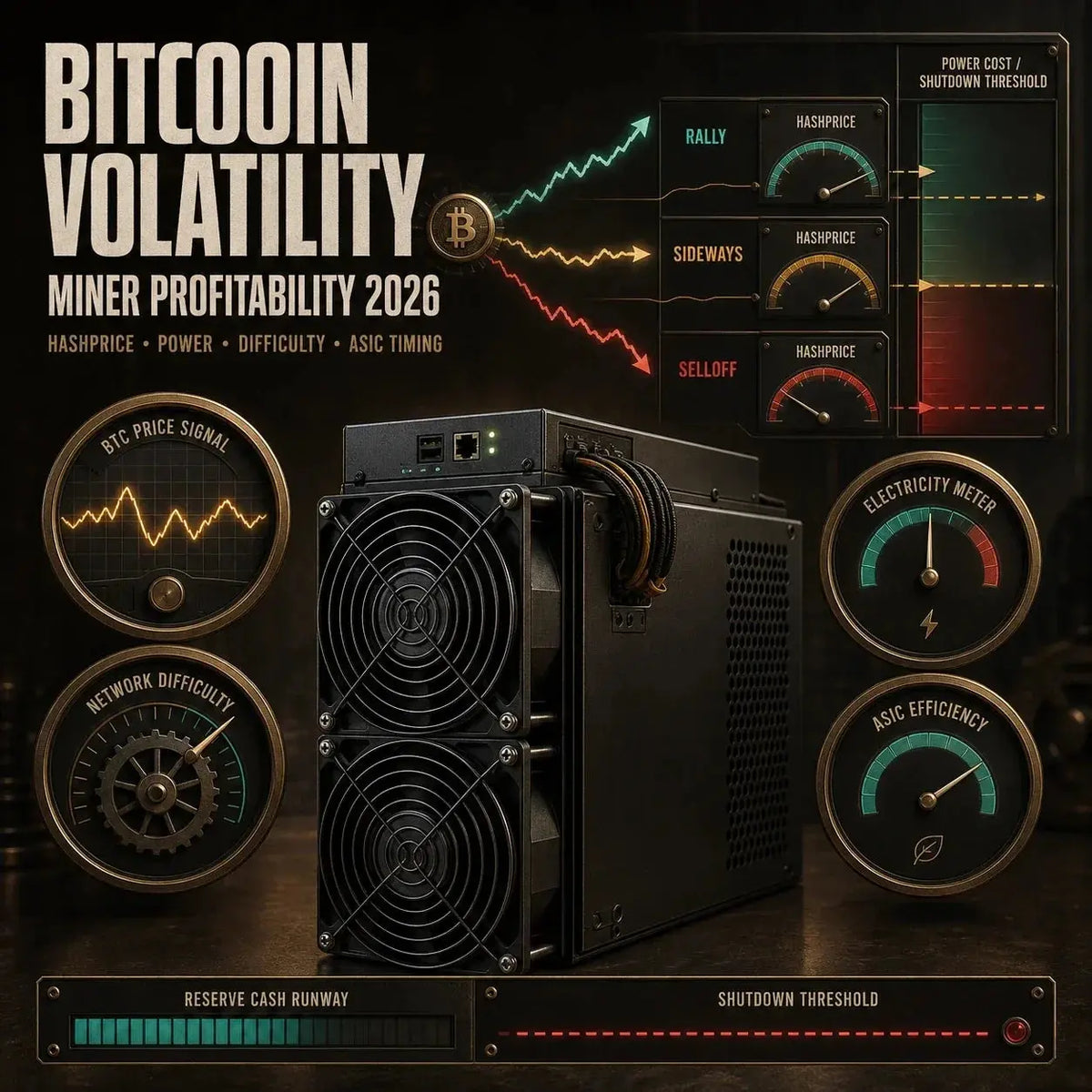
Volatilité des prix du Bitcoin et
Rentabilité des mineurs en 2026
pression sur les prix de hachage · prix d'arrêt · planification des flux de trésorerie · timing ASIC · contrôle des risques
Sur cette page
1Pourquoi la volatilité du Bitcoin frappe différemment les mineurs
La volatilité du prix du Bitcoin modifie la rentabilité des mineurs via le hashprice : Le prix BTC peut déplacer les revenus immédiatement, tandis que les difficultés du réseau, les contrats d'électricité, les frais d'hébergement et les coûts ASIC s'ajustent à des vitesses différentes. Une hausse des prix peut augmenter la marge dans un premier temps, mais la difficulté croissante et les prix du matériel peuvent absorber le gain. Une liquidation peut pousser les machines inefficaces en dessous de leur seuil d’arrêt avant que les coûts ne soient réinitialisés.
Contrairement à un détenteur de spot, un mineur possède du matériel et assure l'alimentation, le refroidissement, la maintenance, l'hébergement et parfois les dettes. Le même mouvement BTC peut donc produire des résultats différents en fonction du coût de l'électricité, de l'efficacité de la machine, de la disponibilité, de la politique de trésorerie et du moment où l'opérateur a acheté le matériel. Pour un contexte plus large du cycle de marché, voir le Cycle des prix du Bitcoin et perspectives du marché.
Pour les mineurs, la vraie question n’est pas de savoir si Bitcoin est haussier ou baissier. La question est de savoir quelle marge reste après que le prix, la difficulté, les frais, la puissance et la disponibilité évoluent les uns par rapport aux autres.
2Hashprice transforme la volatilité du Bitcoin en revenus pour les mineurs
Hashprice est le moyen le plus simple de comprendre les revenus miniers de Bitcoin. Il mesure combien une unité de hashrate peut gagner par jour. Le prix de hachage en USD dépend du prix du Bitcoin, des subventions globales, des frais de transaction et des difficultés du réseau. Le prix du BTC et les frais de transaction peuvent l’augmenter ; une difficulté croissante peut le faire baisser.
C’est important car le prix du Bitcoin peut d’abord augmenter, puis la difficulté s’ajustera plus tard à mesure que davantage de machines s’allumeront. Au début d’un rallye, les mineurs peuvent bénéficier de marges plus solides. Plus tard, la concurrence peut absorber une grande partie de ces gains. En cas de vente massive, le prix peut chuter immédiatement tandis que les difficultés peuvent prendre du temps à s'ajuster, créant ainsi un ciseaument des marges.
3Que se passe-t-il lorsque Bitcoin se rallie ou se vend
Un rallye Bitcoin peut améliorer les revenus miniers quotidiens, renforcer les bilans, augmenter les valeurs ASIC utilisées et rendre l’expansion attrayante. Mais les rallyes peuvent également inciter les mineurs à payer trop cher pour leurs machines, à signer des contrats d'hébergement coûteux ou à supposer que le prix de hachage actuel durera. Si les difficultés rattrapent leur retard et que BTC se refroidit, le mineur qui s’est développé de manière agressive peut se retrouver avec des coûts fixes plus élevés et des marges plus faibles.
Une vente de Bitcoin fonctionne dans la direction opposée. Les revenus chutent en premier, les opérateurs les plus faibles se déconnectent, les prix des machines d’occasion chutent et les mineurs efficaces peuvent gagner un avantage relatif. Les acheteurs les plus forts apparaissent souvent lorsque des concurrents plus faibles sont contraints de vendre du matériel. C’est pourquoi les sociétés minières devraient séparer l’excitation des prix de la discipline financière.
| Mouvement du marché BTC | Effet mineur immédiat | Risque de second ordre | Meilleure réponse |
|---|---|---|---|
| Rassemblement pointu | Revenus en USD plus élevés et sentiment plus fort | Payer trop cher pour les ASIC ou l'alimentation | Verrouillez les hypothèses de marge et évitez de courir après le matériel |
| Portée latérale | L'efficacité et la disponibilité deviennent décisives | Marge lente qui saigne en raison de la difficulté | Améliorer les conditions d’alimentation et la discipline de maintenance |
| Vente rapide | Les revenus chutent avant la réinitialisation des coûts | Arrêt forcé ou stress de trésorerie | Utiliser des seuils d’arrêt et des réserves de trésorerie |
| Augmentation des frais | Augmentation temporaire des revenus | En supposant que les frais restent élevés | Traitez les gains exceptionnels liés aux frais comme des flux de trésorerie bonus |
4Prix d’arrêt et discipline d’équilibre
Le prix d'arrêt d'un mineur est le prix BTC ou le niveau de prix de hachage où le fonctionnement de la machine ne couvre plus l'électricité et les coûts d'exploitation. Le nombre exact dépend du joule par terahash, du tarif de l'électricité, des frais de pool, des frais d'hébergement, de la disponibilité, du refroidissement, du coût de réparation et du fait que l'opérateur valorise le BTC extrait au prix au comptant ou le conserve dans son bilan.
Les mineurs domestiques disposant d’un volume élevé d’électricité au détail peuvent atteindre des niveaux d’arrêt plus tôt que les fermes disposant d’une puissance industrielle. Les ASIC plus anciens peuvent devenir non rentables plus rapidement que les unités de la génération actuelle. Les contrats d'hébergement peuvent également changer les choses, car les frais mensuels fixes peuvent continuer même si la machine est hors ligne. Un seuil d’arrêt est un contrôle opérationnel, pas une prévision du prix du Bitcoin.
Un modèle opérationnel simple est bénéfice quotidien = revenus miniers bruts - électricité - frais de pool et d'hébergement - frais d'exploitation courants. L'électricité à elle seule équivaut à la puissance du mineur en kW multipliée par 24 heures et le tarif énergétique. Utilisez le Guide des coûts d’électricité pour le minage de Bitcoin et le Guide d'efficacité des ASIC pour tester ce calcul.
Chaque mineur doit connaître trois chiffres avant un choc de prix : le seuil de rentabilité, le seuil d'arrêt et le prix BTC nécessaire pour rembourser l'ASIC pendant la période de détention prévue.
5Planification des flux de trésorerie, de la trésorerie et de la dette
La volatilité du Bitcoin devient dangereuse lorsque les mineurs s’appuient sur un timing parfait. Si les revenus sont payés en BTC mais que les factures d’électricité sont payées en monnaie fiduciaire, l’opérateur a un déséquilibre monétaire. Détenir chaque pièce peut fonctionner pendant un cycle haussier fort, mais cela peut également laisser le mineur à court de liquidités lors d'un retrait. La vente de chaque pièce supprime les gains de trésorerie mais peut protéger les opérations.
Un plan équilibré sépare souvent les pièces extraites en liquidités d’exploitation, liquidités de réserve et avoirs à long terme. Les grands opérateurs peuvent également utiliser des produits de couverture, d’hébergement, d’électricité à taux fixe ou de hashrate. Les petits mineurs peuvent toujours appliquer la même logique en conservant une source de liquidités et en évitant les achats de matériel qui nécessitent des prix haussiers constants.
6Comment la volatilité des prix modifie l'achat et la vente d'ASIC
Les prix des ASIC ont tendance à suivre les attentes de rentabilité. Lorsque le BTC augmente et que le prix du hachage s'améliore, les machines d'occasion peuvent devenir plus chères car le retour sur investissement semble plus rapide. Lorsque le BTC chute, les mêmes modèles peuvent être rapidement réduits. Cela signifie que le meilleur investissement minier n’est souvent pas la machine avec le hashrate le plus élevé, mais l’achat effectué au bon moment du cycle.
Pendant les périodes haussières, les acheteurs devraient éviter d’utiliser les revenus de pointe comme seul cas de retour sur investissement. Pendant les périodes baissières, ils devraient éviter de supposer que chaque remise est une bonne affaire. Un ASIC bon marché avec une efficacité médiocre et une énergie coûteuse peut toujours être une mauvaise affaire. L'achat le plus important combine un matériel efficace, un support fiable, un hébergement réaliste et un modèle de prix BTC conservateur.
7Matrice de stratégie pour différents types de mineurs
| Type de mineur | Exposition principale | Réponse à la volatilité | Mesure clé |
|---|---|---|---|
| Mineur à domicile | Tarif électrique élevé, bruit, chaleur, petite échelle | Utilisez des mineurs silencieux et efficaces et évitez les achats garantis par la dette | Coût quotidien net après électricité |
| Mineur hébergé | Frais d'hébergement, disponibilité, conditions du contrat | Examiner les clauses de fermeture, le paiement du pool et la transparence des frais | Prix de hachage réel ajusté en fonction de la disponibilité |
| Petite ferme | Capacité électrique, réparations, mix machines | Conservez des liquidités de réserve et faites d'abord la rotation des unités inefficaces | J/TH au niveau de la flotte et piste de trésorerie |
| Acheteur d'extension | Calendrier du matériel et blocage du capital | Modélisez les cas BTC haussiers, de base et baissiers avant de commander | Période de récupération selon le scénario de base |
8Liste de contrôle de la volatilité des mineurs
- Suivez le hashprice chaque semaine : Il combine le prix, les frais, les subventions et la difficulté du BTC en une seule mesure destinée aux mineurs.
- Sensibilité électrique du modèle : Recalculez le bénéfice selon plusieurs prix de l'électricité et scénarios BTC.
- Séparer les revenus des flux de trésorerie : Les revenus BTC ne paient pas les factures tant qu’ils n’ont pas été convertis ou financés.
- Vérifiez la valeur de revente de l'ASIC : La valeur des machines d’occasion peut chuter plus rapidement que prévu en période de faibles marges.
- Définissez une règle d'arrêt : Décidez à l’avance quand suspendre les anciennes machines au lieu d’espérer une récupération.
- Gardez une réserve : La piste de trésorerie empêche la vente forcée de BTC ou de matériel au pire moment.
- Ne courez pas après les gros titres : Un article haussier sur le prix du Bitcoin n’est pas un plan d’affaires minier complet.
9FAQ
Un prix Bitcoin plus élevé rend-il toujours le minage rentable ?
Non. Un prix BTC plus élevé contribue aux revenus en USD, mais la difficulté croissante, le coût de l'énergie, les frais d'hébergement, les temps d'arrêt et la dépréciation du matériel peuvent encore effacer la marge.
Pourquoi les mineurs peuvent-ils souffrir même lorsque Bitcoin est dans un marché haussier ?
Les mineurs peuvent payer trop cher pour les ASIC, signer des contrats d’électricité coûteux ou se développer juste avant que les difficultés n’augmentent. L’action haussière des prix ne supprime pas le risque opérationnel.
Les mineurs devraient-ils fermer leurs portes lors d’un crash de Bitcoin ?
Seulement si les coûts de fonctionnement dépassent les revenus réalistes et s’il n’y a aucune raison stratégique de continuer. La décision doit être basée sur le prix de hachage, le taux d'énergie, la disponibilité et l'efficacité de la machine.
Les ASIC utilisés sont-ils meilleurs en cas de baisse de prix ?
C’est possible, mais seulement lorsque l’efficacité, le risque de réparation, le coût de l’énergie et le délai de récupération fonctionnent toujours selon des hypothèses prudentes.
Que doivent surveiller les mineurs en premier ?
Le prix du hachage, le coût de l'électricité, la difficulté du réseau, les frais de transaction, la disponibilité et l'exposition à la trésorerie BTC sont les principaux éléments du tableau de bord.
10Références
- Indice de hashrate : Hashprice Insight BoardTableau de bord public des prix de hachage et contexte de volatilité pour les revenus miniers Bitcoin.
- mempool.space : Tableau de bord minierExtraction de Bitcoin en direct, blocage, frais et données réseau.
- FRED : taux effectif des fonds fédérauxRéférence de macroliquidité pour des conditions plus larges d’actifs à risque.
- EIA américaine : données sur l'électricitéPrix officiels de l’électricité et données sectorielles pour la recherche sur le coût de l’énergie.
Verdict final
La volatilité des prix du Bitcoin affecte les mineurs via le prix de hachage, et non par les gros titres. Un rallye peut améliorer les marges, mais il peut également gonfler les prix des ASIC et inciter à une expansion excessive. Un krach peut nuire aux flux de trésorerie, mais il peut également créer de meilleurs points d’entrée pour les opérateurs efficaces disposant d’un capital de réserve.
La meilleure stratégie minière repose sur des tests de résistance. Connaissez votre prix d'arrêt, conservez de l'argent pour vos factures d'électricité, achetez du matériel avec des hypothèses de retour sur investissement prudentes et traitez les hausses de frais ou les rebonds soudains du BTC comme une hausse plutôt que comme le scénario de base.




Laisser un commentaire
Ce site est protégé par hCaptcha, et la Politique de confidentialité et les Conditions de service de hCaptcha s’appliquent.