
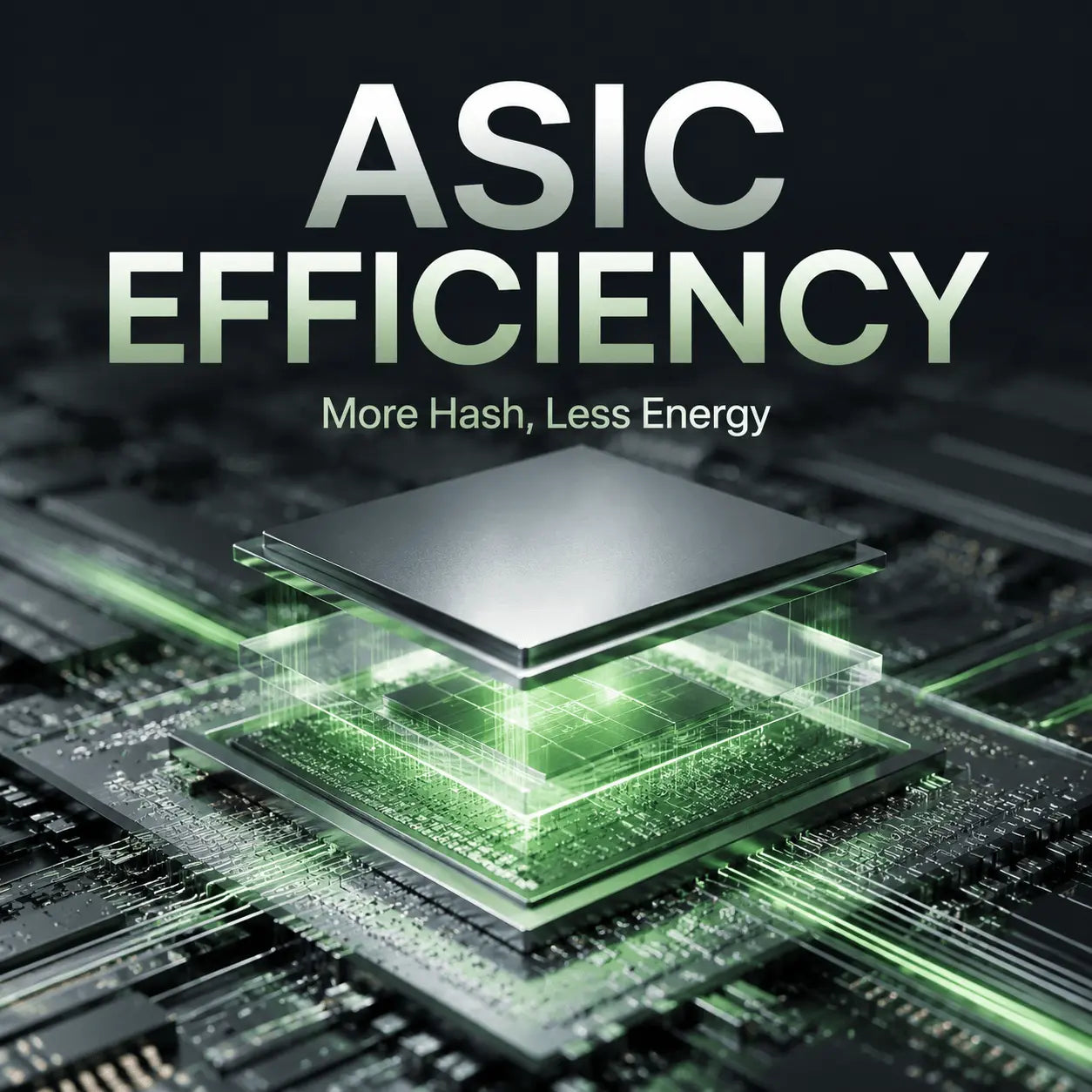
Efficacité des mineurs ASIC 2026 :
Stratégie américaine en matière de tarifs d’électricité
Efficacité J/TH · Coûts de l'énergie aux États-Unis · Refroidissement par air ou hydroélectricité · Planification du seuil de rentabilité · Cadre de sélection du matériel
Sur cette page
1Pourquoi l’efficacité décide des marges minières en 2026
En 2026, le minage de Bitcoin aux États-Unis n’est plus un simple concours pour savoir qui peut brancher le plus de hashrate. La question la plus utile est de savoir si chaque terahash peut survivre à votre tarif d'électricité après des difficultés, les frais de pool, les frais généraux de refroidissement, les temps d'arrêt et le financement du matériel sont inclus.
C'est pourquoi l'efficacité des mineurs ASIC est si importante. L'efficacité est généralement exprimée en joules par terahash, ou J/TH. Un nombre J/TH inférieur signifie que le mineur utilise moins d’électricité pour produire la même quantité de travail SHA-256. Lorsque la concurrence sur les réseaux s’intensifie, cette différence devient la marge entre une machine qui peut continuer à fonctionner et une autre qui devrait être éteinte.
Le marché américain rend cela particulièrement important car la tarification de l’électricité est fragmentée. Un mineur travaillant dans une installation d’hébergement industrielle au Texas, un entrepôt dans le Midwest, un site commercial en Californie et un garage résidentiel peuvent tous être confrontés à des situations économiques complètement différentes. Les moyennes nationales de l'Energy Information Administration des États-Unis sont utiles pour le contexte du marché, mais une décision minière doit être basée sur le tarif réel fourni dans le contrat : frais d'énergie, frais de demande, frais de livraison, conditions de réduction, taxes et coût de refroidissement.
2Commencez par le taux d’électricité, pas par le mineur
De nombreux acheteurs comparent encore d’abord les mineurs par hashrate. Cela donne à une fiche technique un aspect intéressant, mais elle peut donner lieu à de mauvais achats. Une machine à 300 TH/s n'est pas automatiquement meilleure qu'une machine à 230 TH/s si la plus grande unité consomme trop d'énergie pour votre niveau tarifaire.
Le processus plus propre consiste à commencer par votre coût d’énergie et à revenir en arrière. Si votre site paie environ 0,05 $ le kWh, vous pouvez envisager des machines hydroélectriques à haut débit, car la répartition de l'électricité peut justifier à la fois la machine et l'infrastructure qui l'entoure. Si votre site paie 0,08 $ par kWh, les mineurs premium refroidis par air peuvent constituer le meilleur équilibre. Si votre véritable coût global est supérieur à 0,12 $ par kWh, la sélection du matériel devient défensive : seules les unités les plus efficaces méritent un examen sérieux, et même dans ce cas, le plan nécessite des hypothèses prudentes.
C’est également là que les moyennes des États peuvent induire les mineurs en erreur. Les tableaux EIA peuvent indiquer si une région est généralement bon marché ou chère, mais un mineur paie rarement la moyenne simple. Une facture d'hébergement peut regrouper l'électricité, la main-d'œuvre de réparation, la gestion et la marge des installations en un seul chiffre, de sorte que le mineur doit modéliser le coût en espèces réel.
3J/TH et mathématiques du seuil de rentabilité
Le moyen le plus simple de comparer les machines est de convertir l’efficacité en coût de l’électricité par unité de hashrate. Un terahash fonctionnant à 15 J/TH consomme 15 watts. Sur une journée complète, cela représente 0,36 kWh par TH. À 0,08 $ par kWh, le coût quotidien de l'électricité est d'environ 0,0288 $ par TH avant les frais généraux de refroidissement. Une machine de 12 J/TH au même tarif coûte environ 0,0230 $ par TH et par jour. La différence semble minime jusqu’à ce qu’elle se multiplie sur des centaines ou des milliers de terahashes pendant des années.
Ce calcul explique pourquoi un mineur avec un J/TH inférieur peut souvent survivre à un mois difficile, alors que le matériel plus ancien ne le peut pas. Les revenus du minage de Bitcoin changent constamment en fonction du prix du BTC, des frais de transaction, du hashrate global et des difficultés du réseau. Le coût de l’électricité est la partie qui arrive à chaque cycle de facturation. La réduction des watts par terahash donne à l’opérateur plus de marge pour absorber la volatilité.
Le coût quotidien de l’électricité est d’environ : watts mineurs divisés par 1 000, multipliés par 24, multipliés par votre tarif tout compris $/kWh. Ajoutez le refroidissement, les temps d'arrêt, les frais de pool, les frais d'hébergement, les hypothèses de réparation et le financement avant de qualifier une machine de rentable.
4Classes de modèles ASIC 2026 pour les opérateurs américains
Le marché 2026 comprend trois grandes catégories de matériel : les équipements hydroélectriques frontières pour les grands sites dotés d'une infrastructure liquide, les équipements refroidis par air haut de gamme pour un déploiement plus simple et le matériel plus ancien qui nécessite généralement une énergie très bon marché ou un cas d'utilisation spécial.
Les spécifications exactes peuvent varier selon le lot, le micrologiciel, la température, le mode d'alimentation et la mise à jour du fabricant. Les acheteurs doivent vérifier la page officielle du produit ou les spécifications de la facture avant l'achat. Le tableau ci-dessous est mieux utilisé comme cadre de planification et non comme substitut à la confirmation de lot actuelle.
| Classe modèle | Plage d'efficacité | Refroidissement | Tarif américain le plus adapté | Note de planification |
|---|---|---|---|---|
| Hydroélectrique frontalière Classe S23 Hyd / S21 XP Hyd |
Sub-13 J/TH lorsque les spécifications du lot sont confirmées | Hydroélectricité | Faible puissance industrielle | Idéal pour les sites à l’échelle MW qui comprennent déjà les procédures de plomberie, de boucles de liquide de refroidissement et de disponibilité. |
| Refroidi par air haut de gamme Classe S21 XP / S21 Pro |
Environ 13,5-15 J/TH sur les spécifications officielles pour les modèles sélectionnés | Aérien | Pouvoir commercial compétitif | Souvent le choix le plus pratique pour les flottes hébergées et les opérateurs qui souhaitent un déploiement plus simple. |
| Génération actuelle standard Classe S21 |
Environ 17,5 J/TH sur les spécifications officielles communes | Aérien | Uniquement de l’énergie à très faible coût | Peut fonctionner dans des cas spécifiques, mais les marges diminuent rapidement aux tarifs commerciaux ordinaires. |
| Équipement hérité Flottes de l’ère S19 et plus anciennes |
J/TH généralement beaucoup plus élevé | Rénovations à air ou à immersion | Situations particulières uniquement | Nécessite une énergie très bon marché, une réutilisation de la chaleur, des revenus de réduction ou un plan de revente pour rester rationnel. |
5Refroidissement par air ou hydro-refroidissement
Le choix du refroidissement doit suivre l’échelle du site. Les mineurs hydro-refroidis peuvent offrir une excellente densité et stabilité thermique, mais ce sont autant des produits d’infrastructure que des produits matériels. Le mineur a besoin de pompes, de distribution de liquide de refroidissement, de rejet de chaleur, de surveillance, de contrôle de la qualité de l'eau, de pièces de rechange, de personnel qualifié et d'un plan de maintenance. Cela peut constituer un avantage considérable sur un grand site et une distraction coûteuse sur un petit site.
Les mineurs refroidis par air restent la solution par défaut pour de nombreux opérateurs américains car le déploiement est plus simple. Ils s'adaptent aux configurations standard de racks ou d'étagères, peuvent être déplacés plus facilement entre les sites d'hébergement et ne nécessitent pas de boucle liquide complète. Le compromis est la chaleur, le bruit, l’exposition à la poussière et une efficacité légèrement plus faible au bord d’attaque.
6Niveaux de tarifs d’électricité aux États-Unis
Un modèle de planification américain utile divise les mineurs en niveaux de tarifs. Le premier niveau est une puissance industrielle très faible. C’est là que les grandes installations peuvent envisager des équipements hydroélectriques et des déploiements à haute densité, surtout si elles participent également à des programmes de réduction ou de réponse à la demande. Le deuxième niveau est celui de l’énergie commerciale compétitive, où les mineurs refroidis par air haut de gamme sont souvent les plus judicieux car ils combinent une bonne efficacité avec des opérations plus simples.
Le troisième niveau concerne l’énergie commerciale ou industrielle légère coûteuse. Dans cette gamme, l'opérateur doit être très sélectif. Une machine qui semble rentable sur un marché BTC fort peut devenir fragile lorsque les difficultés augmentent ou que les frais diminuent. Le quatrième niveau est l’électricité résidentielle. L’exploitation minière à domicile peut toujours être éducative, utile pour la réutilisation de la chaleur ou attrayante pour les amateurs, mais elle ne doit pas être modélisée de la même manière que l’exploitation minière industrielle.
Les données nationales sur l’électricité sont utiles pour filtrer les marchés. Cela ne suffit pas pour un bon de commande. Demandez le prix de livraison tout compris, comment les frais de demande sont gérés, ce qui se passe pendant la réduction et si la facture change de façon saisonnière.
7Facteurs opérationnels au-delà de l’efficacité
L’efficacité ne fonctionne pas de manière isolée. Un mineur à faible J/TH peut toujours être décevant si le site présente une mauvaise disponibilité, une ventilation faible, un mauvais contrôle du micrologiciel, un accès limité aux réparations ou des pénalités d'alimentation coûteuses. En 2026, les meilleurs opérateurs traitent le mineur comme une partie d’un système d’installation plutôt que comme une boîte autonome.
La réponse à la demande en est un exemple. Dans certaines régions des États-Unis, les mineurs peuvent réduire leur charge en cas de stress du réseau et recevoir une compensation ou des conditions d’alimentation améliorées. Cela peut améliorer la rentabilité d’un site flexible, mais cela modifie également le modèle de revenus. Un mineur qui s'arrête gagne fréquemment moins de Bitcoin, de sorte que le paiement de réduction doit être comparé à la perte de revenus miniers et à toute usure supplémentaire de l'équipement de cyclisme.
Les achats sont également importants. Le matériel importé peut entraîner des retards d’expédition, des frictions au niveau de la garantie et une incertitude sur le micrologiciel. La disponibilité nationale peut coûter plus cher au départ, mais peut réduire les temps d'arrêt.
8Liste de contrôle de l'acheteur pour l'efficacité ASIC 2026
Avant d'acheter, confirmez le hashrate officiel du mineur, la puissance du mur et l'efficacité pour le lot exact proposé. Demandez si les chiffres cités correspondent au mode normal, au mode hautes performances ou à des conditions de laboratoire optimisées. Vérifiez si l'alimentation est incluse, si le micrologiciel est en stock et si la garantie reste valable dans votre environnement de refroidissement prévu.
Ensuite, modélisez le site. Utilisez votre coût d’électricité tout compris, et non un tarif marketing. Incluez les frais de demande, les frais d’hébergement, la charge de refroidissement, la disponibilité, les réserves de réparation, les frais de pool et la possibilité d’une faiblesse des prix BTC. Comparez ensuite la machine à un seuil de revente ou d’arrêt.
- Confirmez le J/TH, les watts et le hashrate officiels pour le lot exact.
- Calculez le coût quotidien de l’électricité à votre tarif réel livré.
- Ajoutez les frais de refroidissement, les hypothèses de disponibilité, la réserve de réparation et les frais d'hébergement.
- Vérifiez si l'air, l'hydroélectricité ou l'immersion correspondent aux compétences de l'équipe du site.
- Modélisez les cas de baisse pour un prix BTC inférieur, une difficulté plus élevée et des revenus de frais inférieurs.
- Documentez une règle de revente, de relocalisation ou d’arrêt avant de faire évoluer la flotte.
9FAQ
Qu'est-ce qu'un bon chiffre d'efficacité ASIC en 2026 ?
Pour une exploitation minière sérieuse de Bitcoin, plus bas est mieux. Les machines haut de gamme modernes dans la gamme J/TH de faible à moyenne adolescence sont beaucoup plus compétitives que les flottes plus anciennes. Les classes Hydro peuvent baisser, mais les acheteurs doivent vérifier les spécifications officielles du lot et le coût de l’infrastructure du site.
Les mineurs résidentiels peuvent-ils profiter des tarifs d’électricité américains ?
Cela dépend du tarif exact, du prix de la machine, du prix du BTC, de la difficulté, de la réutilisation de la chaleur et des objectifs du mineur. À des tarifs résidentiels élevés, de nombreuses configurations sont mieux considérées comme des systèmes de loisirs ou d’apprentissage, à moins que l’électricité ne soit particulièrement bon marché.
L’hydro-refroidissement est-il toujours meilleur que le refroidissement par air ?
Non. L’hydro-refroidissement peut être excellent à grande échelle, mais il ajoute des exigences en matière d’infrastructure et de maintenance. Le refroidissement par air est souvent préférable pour les petites flottes, les déploiements plus rapides et les opérateurs sans expérience en refroidissement liquide.
Dois-je acheter le mineur de hashrate le plus élevé disponible ?
Pas automatiquement. Le hashrate n’a d’importance qu’une fois le coût de l’énergie inclus. Une machine plus efficace et de moindre puissance peut surpasser une machine plus grande si la plus grande unité est mal adaptée au tarif d'électricité du site.
10Références et sources de données
- US EIA Electric Power Mensuel, tableau 5.6.ADonnées officielles sur les prix de l'électricité aux États-Unis par État, utiles dans le contexte des tarifs au niveau du marché.
- Bitmain Antminer S21 XP SpécificationsPage d'assistance officielle pour les spécifications de hashrate, de puissance et d'efficacité du S21 XP.
- Bitmain Antminer S21 Pro SpécificationsPage d'assistance officielle pour les spécifications de planification et les hypothèses de fonctionnement du S21 Pro.
- Référence du développeur Bitcoin : obtenir la difficultéRéférence technique principale pour la métrique de difficulté du réseau utilisée dans les modèles de revenus miniers.
- Méthodologie de l’indice de consommation d’électricité de Cambridge BitcoinMéthodologie institutionnelle expliquant comment l'efficacité du matériel minier et la consommation d'électricité sont modélisées.
Verdict final
Le meilleur mineur ASIC pour un opérateur américain en 2026 n’est pas la machine la plus rapide. Il s'agit de la machine dont l'efficacité, la méthode de refroidissement et le plan d'entretien correspondent au tarif d'électricité réel de l'opérateur.
Commencez par le contrat d'électricité, calculez le coût tout compris par kWh, puis choisissez le matériel par J/TH. Cela maintient la décision fondée sur l’économie minière.



Laisser un commentaire
Ce site est protégé par hCaptcha, et la Politique de confidentialité et les Conditions de service de hCaptcha s’appliquent.