
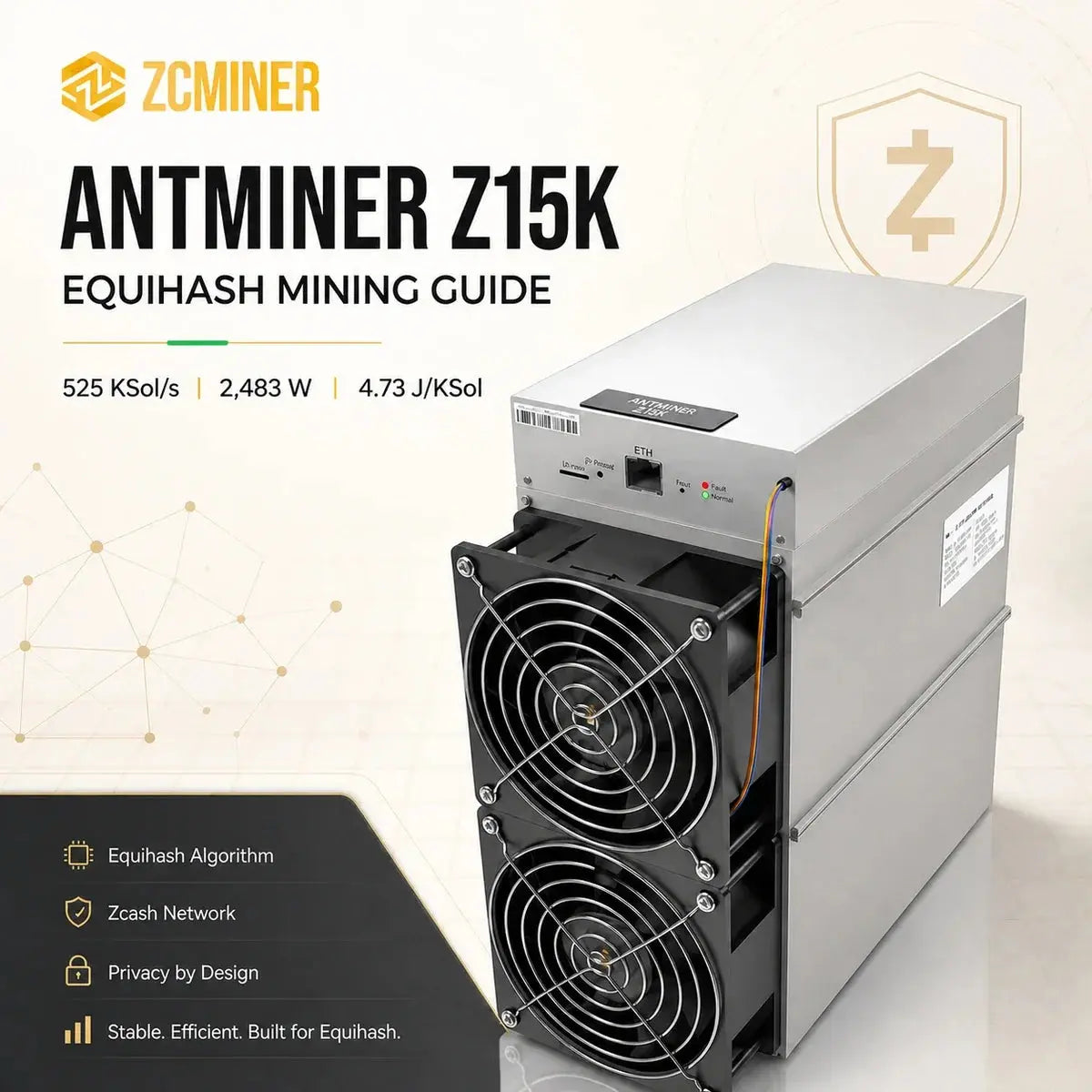
Bitmain Antminer Z15K Guide:
Everything You Need to Know
525 KSol/s Equihash performance · power and heat planning · Zcash setup · current buying risks
On This Page
1Is the Antminer Z15K a Good Fit?
The Bitmain Antminer Z15K is a specialized air-cooled ASIC listed at 525 KSol/s on Equihash, with 2,483 W power consumption and 4.73 J/KSol efficiency. Its main current use case is Zcash mining through a compatible pool. It is not a Bitcoin miner, cannot switch to SHA-256, and should not be treated as a quiet plug-and-play appliance.
The Z15K makes the most sense for a buyer who already has a continuous 200-240 V power plan, controlled exhaust, wired networking, a supported Zcash pool, and an electricity model that still works under conservative revenue assumptions. Current listings use delivery-batch variants, so the batch date, price, included power equipment, warranty, and final specification sheet must be confirmed before payment.
Buy for verified Zcash/Equihash deployment, not for a fixed daily-profit screenshot. The important numbers are measured wall power, pool-side accepted hashrate, electricity rate, uptime, batch terms, and the current ZEC mining environment.
2Antminer Z15K Specifications at a Glance
| Specification | Current Listed Value | Why It Matters |
|---|---|---|
| Manufacturer / model | Bitmain Antminer Z15K | Confirm the exact model and delivery batch on the invoice. |
| Algorithm | Equihash | It cannot mine SHA-256, Scrypt, kHeavyHash, or other algorithms. |
| Hashrate | 525 KSol/s | Pool-side accepted hashrate is the operating metric that matters. |
| Power | 2,483 W | Equivalent to about 59.6 kWh per 24 hours before facility overhead. |
| Efficiency | 4.73 J/KSol | Lower values indicate less energy per unit of Equihash work. |
| Dimensions | Approximately 245 x 133 x 290 mm | Allow additional clearance for cables, intake, and exhaust. |
| Weight | Approximately 9 kg | Rack shelves and shipping plans should carry the full installed load. |
| Network | RJ45 Ethernet | A wired local network is required for discovery and pool access. |
| Environment | 5-45°C; 5-95% humidity | Published limits are not targets; cooler, clean air gives more margin. |
These values appear across current seller listings, including the ZC MINER product page. Bitmain's public support library did not yet show a standalone Z15K specification page when reviewed. Verify the document supplied with your batch before sizing circuits or a facility.

Bitmain Antminer Z15K (525 KSol/s)
Check the live product page for delivery-batch options, current price, availability, shipping terms, included equipment, and warranty details.
3Equihash, Zcash, and the Mineable-Coin Question
Zcash remains a proof-of-work network using Equihash. A pool measures accepted shares and pays according to its reward method, fees, network conditions, and the worker's valid contribution. Zcash documentation notes that modern difficulty requires ASIC hardware for practical mining.
Do not interpret “Equihash” as “every coin that ever used Equihash.” Parameters and active consensus matter. The Z15K is marketed for the Zcash-compatible Equihash workload, commonly identified as Equihash 200,9. A pool must explicitly support the exact network and hardware combination.
Some current Z15K articles still list Horizen (ZEN) as a second mining target. Horizen officially migrated balances from its legacy ZEND mainchain and EON chain to Base in July 2025 and discontinued the old chains. ZEN is therefore not a current Equihash mining revenue source in 2026. Confirm live pool support before assuming any alternative coin is mineable.
Zcash activated NU6.3, Ironwood, on July 28, 2026. It changed shielded-pool behavior and node requirements but did not advertise an ASIC performance improvement. Miners rely on pools to maintain compatible node software.
4Power, Heat, Noise, and Site Planning
At 2.483 kW, the Z15K consumes about 59.6 kWh per day and 1,787.8 kWh in a 30-day month before ventilation or cooling overhead. Miner-only electricity costs approximately $3.58 per day at $0.06/kWh, $5.96 at $0.10/kWh, and $8.94 at $0.15/kWh. Use your actual tariff, including demand charges or time-of-use pricing where applicable.
Almost all consumed electricity becomes heat. A 2,483 W load releases roughly 8,472 BTU per hour. Prevent exhaust recirculation, provide replacement air, and include facility fans in operating cost.
The mining electricity cost guide explains the kWh method in more detail. Always measure real wall power after the miner reaches stable operating temperature.
5Practical Z15K Setup Workflow
- Inspect the shipment. Record the serial number and delivery batch. Check the chassis, fans, control board, connectors, PSU, and included cables before energizing the unit.
- Prepare the exhaust path. Leave the intake and fan outlets unobstructed. Do not test a 2.5 kW miner in a sealed room.
- Connect Ethernet. Attach the miner to the same local network as the computer used for configuration.
- Connect approved power equipment. Verify the exact batch requirements. Avoid light-duty extension cords, loose adapters, or underrated power strips.
- Find the IP address. Use the router's client list or the official IP-report method supported by the control board.
- Open the web interface. Sign in locally, change default credentials, confirm the model and firmware, and record the initial configuration.
- Add pool endpoints. Enter a current Zcash pool URL, worker name, and password. Configure backup endpoints if the interface permits them.
- Verify pool-side work. Let the miner stabilize, then compare dashboard hashrate with accepted pool hashrate, rejected shares, temperatures, and uptime.
Allow the pool average to stabilize. Establish a known-good baseline before tuning or considering firmware changes.
6Profitability Without a Fixed Payback Promise
Daily income is not a hardware specification. ZEC price, difficulty, subsidy, fees, rejected work, uptime, exchange cost, taxes, batch price, and delivery timing all change.
Model gross mining revenue minus pool fees, electricity, cooling or hosting, expected downtime, and maintenance. Compare the result with complete landed cost under conservative, base, and optimistic cases.
The break-even electricity rate can be calculated as daily gross revenue after pool fees divided by 59.6 kWh. Recalculate it with live inputs before payment and after the miner goes online. If the conservative case requires a large ZEC price increase to work, the purchase is a market bet rather than a resilient mining operation.
Do not reuse a 7-to-9-month payback estimate from another article. A valid model needs the current batch price, your electricity rate, the current network, pool terms, and measured accepted hashrate.
7Z15K vs. Z15 and Z15 Pro
| Model | Hashrate | Power | Efficiency | Decision Role |
|---|---|---|---|---|
| Antminer Z15 | 420 KSol/s | 1,510 W | 3.6 J/KSol | Older unit with lower total load; condition and price dominate used-unit value. |
| Antminer Z15K | 525 KSol/s | 2,483 W | 4.73 J/KSol | Current batch option with more hashrate than Z15 but higher energy per unit of work. |
| Antminer Z15 Pro | 840 KSol/s | 2,780 W | 3.31 J/KSol | Higher-output, more efficient option where purchase price and site capacity fit. |
The Z15K name does not make it the efficiency leader. Published figures show lower J/KSol for both Z15 and Z15 Pro, so compare acquisition price, delivery timing, warranty, condition, circuit capacity, and the cost of reaching your target hashrate.
For a deeper comparison of the established models, read the Z15 Pro vs. Z15 buying guide. For Z15 Pro-specific installation and risk details, use the Antminer Z15 Pro mining guide.
8Maintenance and Security
- Track a baseline: log wall power, accepted hashrate, reject rate, temperatures, fan speed, and uptime after commissioning.
- Control dust: inspect filters, intake, heat sinks, and fans on a schedule appropriate to the room.
- Protect airflow: investigate rising temperatures or fan speed before hashrate falls.
- Use verified firmware: confirm the exact model and checksum or source; never install firmware from an unsolicited message.
- Restrict management access: change credentials, keep the web interface off the public internet, and isolate miners where practical.
- Stop on electrical damage: discoloration, hot connectors, unstable power, or repeated shutdowns require inspection rather than repeated restarts.
Maintenance should protect stable operation, not chase marginal tuning gains. Keep the factory configuration and purchase records available for warranty or repair discussions.
9Antminer Z15K Buying Checklist
- Delivery batch: confirm the exact month, estimated ship date, cancellation terms, and whether the order is stock or preorder.
- Specification document: obtain the batch sheet and confirm hashrate tolerance, power tolerance, voltage, plugs, and included PSU or cables.
- Total landed cost: include shipping, insurance, duties, tax, payment fees, and any hosting setup cost.
- Warranty path: identify who handles diagnosis, parts, repair shipping, and dead-on-arrival claims.
- Pool compatibility: confirm a current Zcash endpoint and payout method before the machine ships.
- Site readiness: finish the circuit, PDU, Ethernet, intake, exhaust, noise, and monitoring plan before arrival.
- Current price: use the live product page rather than screenshots or prices embedded in older articles.
10Antminer Z15K FAQ
What algorithm does the Antminer Z15K use?
It is listed for the Equihash workload used by Zcash. It cannot mine Bitcoin's SHA-256 algorithm or unrelated proof-of-work algorithms.
How much electricity does the Z15K use?
At the listed 2,483 W, miner-only energy use is about 59.6 kWh per day or 1,787.8 kWh per 30 days. Cooling and ventilation add more.
Can the Antminer Z15K mine Horizen in 2026?
No current ZEN mining revenue should be assumed. Horizen migrated from its legacy chains in July 2025 and discontinued them. Verify any alternative Equihash network directly with an active pool.
Is the Z15K suitable for a bedroom or office?
No. Current listings place noise near 72 dB, and the 2,483 W load produces substantial continuous heat. Use a dedicated, ventilated mining area.
Is the Antminer Z15K more efficient than the Z15 Pro?
Not by the published J/KSol figures. Z15K is listed at 4.73 J/KSol, while Z15 Pro is listed around 3.31 J/KSol. Compare live purchase price, batch timing, site capacity, and total cost.
11References
Primary and established sources were reviewed for protocol status, mining operation, and model comparison. External references open in a new tab and are marked nofollow.
- Zcash Documentation: Mining GuideOfficial overview of Equihash proof of work, ASIC operation, pools, setup, and payout considerations.
- Zcash NU6.3: Ironwood Network UpgradeOfficial activation record and explanation of the July 28, 2026 network upgrade.
- Zcash Network InformationOfficial network, reward-allocation, governance, and improvement-proposal context.
- BITMAIN Support: Z15 Series SpecificationsManufacturer documentation for the established Z15 series used in model comparison.
- Horizen Documentation: Migration OverviewOfficial confirmation that legacy ZEND and EON balances migrated in July 2025 and the old chains were discontinued.
Final Verdict
The Antminer Z15K is a current Equihash option for operators who want 525 KSol/s in one air-cooled unit, but it is not the automatic efficiency leader of the Z15 family. Its value depends on the live batch price, delivery date, power cost, site readiness, pool compatibility, and warranty path.
Verify the batch document and build a conservative Zcash model before ordering. If the electrical, heat, or revenue assumptions only work under perfect conditions, a different miner or a hosted deployment deserves comparison.


Hinterlassen Sie einen Kommentar
Diese Website ist durch hCaptcha geschützt und es gelten die allgemeinen Geschäftsbedingungen und Datenschutzbestimmungen von hCaptcha.