
What Is an ASIC Miner?
How It Works, Costs, and Buying Risks
purpose-built chips · mining workflow · hashrate and efficiency · electricity cost · buyer due diligence
On This Page
1What Does ASIC Miner Mean?
An ASIC miner is a computer built to repeat the hashing work for one specific Proof-of-Work algorithm. ASIC stands for application-specific integrated circuit. Unlike a CPU or GPU, which can run many kinds of software, an ASIC chip is designed for a narrow function and normally cannot be reconfigured for an unrelated mining algorithm.
That specialization is the source of both its strength and its risk. On a supported algorithm, an ASIC can produce far more mining work per watt than general-purpose hardware. If the target network, coin economics, or algorithm changes, however, the machine has few alternative uses.
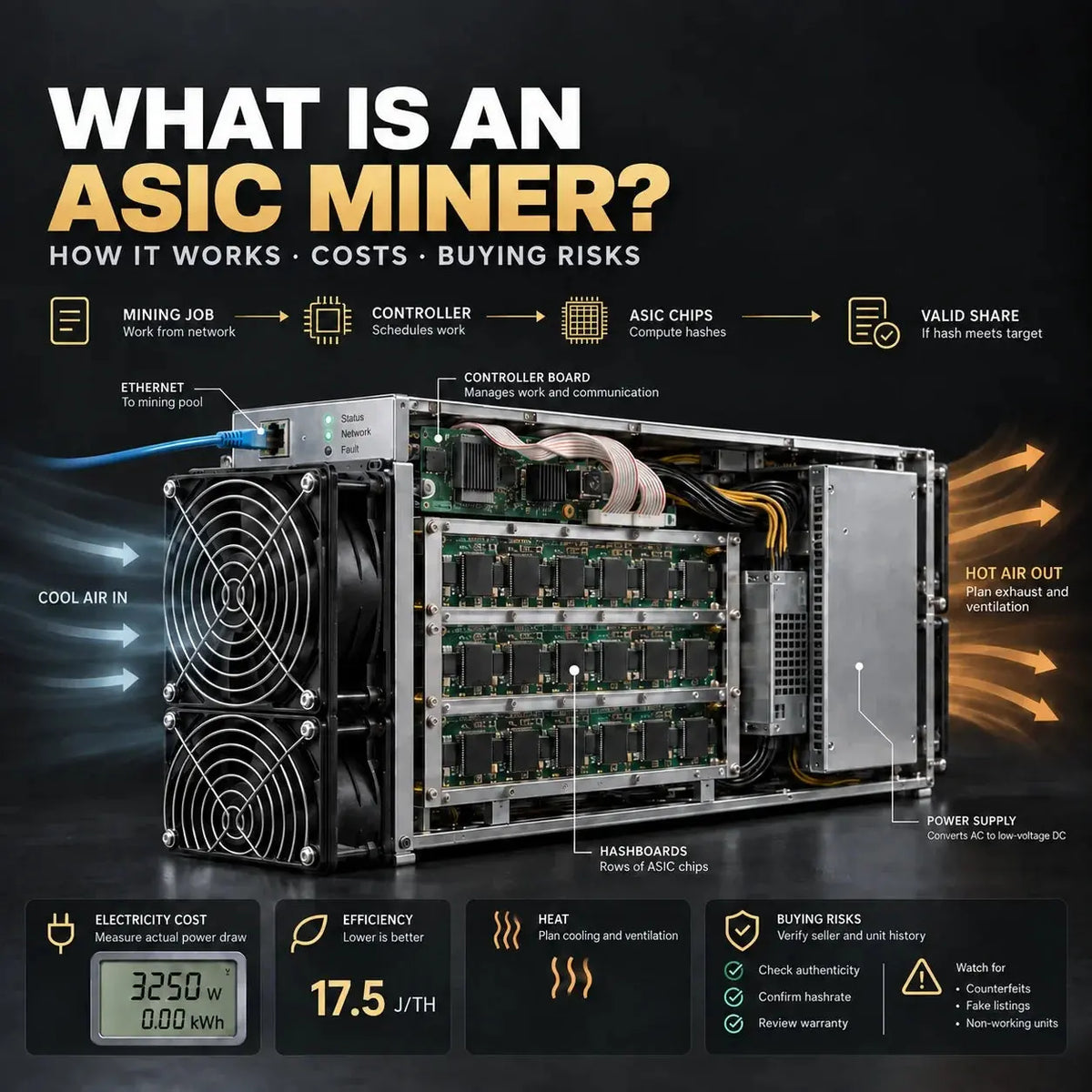
An ASIC miner is a purpose-built hashing appliance. It receives mining jobs from a pool or node, tests candidate hashes at very high speed, submits valid shares, and converts electricity into heat while it runs.
2What Is Inside an ASIC Miner?
Although the case resembles a compact server, a miner contains several systems that must work together. A failure in the power supply, cooling path, controller, network, or one hashboard can reduce output even when the ASIC chips themselves are functional.
3How Does an ASIC Miner Work?
Proof-of-Work mining is a probability-based search. The miner is not solving a puzzle once in the ordinary sense; it is testing enormous numbers of candidate values until one result is below a required target. For Bitcoin, mining software constructs an 80-byte block header and the ASIC applies double SHA-256 hashing to candidate headers.
- Receive a job. A mining pool or local node provides block-template data and a share target.
- Prepare candidate work. The controller assigns changing values and work ranges to the hashboards.
- Generate hashes. ASIC chips calculate candidates continuously at their configured frequency and voltage.
- Compare results. The controller checks whether a result meets the easier pool target or the harder network target.
- Submit accepted shares. Qualifying work is sent to the pool as evidence of the miner's contribution.
- Receive payouts. The pool applies its payout method, fees, thresholds, and accepted-share records.
A pool reduces payout variance by combining work from many miners. Solo mining preserves the full block reward when successful but can involve very long, unpredictable waits. See the detailed solo-versus-pool comparison before choosing a payout route.
4Four Metrics That Define an ASIC Miner
Advertised Power vs Measured Wall Power
Manufacturer specifications are a planning baseline, not a substitute for a stabilized wall measurement. Actual draw can vary with operating mode, input voltage, ambient temperature, firmware, chip condition, and PSU efficiency. Measure the complete system after warm-up at the intended settings, then leave electrical headroom instead of sizing a circuit to a best-case number.
Efficiency units must also be read in context. J/TH is common for SHA-256 equipment, while other algorithms may use J/GH, J/MH, or J/KSol. These values should not be compared across unrelated algorithms as if they measured identical work. The companion hashrate guide explains the units in more detail.
5ASIC vs GPU vs CPU Mining
| Dimension | ASIC Miner | GPU Rig | CPU Mining |
|---|---|---|---|
| Design Goal | One algorithm family | Parallel general-purpose workloads | General computing |
| Efficiency | Usually highest on its supported algorithm | Moderate and coin-dependent | Usually lowest for ASIC-dominated networks |
| Flexibility | Low | High | High |
| Resale Options | Depends heavily on mining demand | Gaming, AI, rendering, and compute markets | Broad use, but limited mining value |
| Noise and Heat | Often industrial | Variable and tunable | Usually lower |
| Best Use | Dedicated continuous mining | Flexible mining or compute | Selected CPU-friendly algorithms |
An ASIC is not automatically the best machine for every operator. It is the strongest fit when the algorithm is established, electricity and heat removal are planned, and the operator accepts narrow resale options. A GPU may be more appropriate when workload flexibility matters more than maximum mining efficiency.
6Common ASIC Algorithms and Compatibility
| Algorithm | Common Network Example | Buyer Check |
|---|---|---|
| SHA-256 | Bitcoin and compatible networks | Compare TH/s, J/TH, wall power, voltage, and pool support |
| Scrypt | Litecoin and merged-mined assets | Confirm pool reward composition and payout policy |
| Equihash | Zcash and compatible assets | Verify the exact Equihash parameter set; similar names do not guarantee compatibility |
| kHeavyHash | Kaspa-class mining | Model rapid difficulty and network-hashrate changes |
| BLAKE2B-Sia | Sia-compatible mining | Confirm the exact BLAKE2b implementation, firmware, and pool protocol |
| Ethash-Derived | Selected compatible networks | Check memory requirements, firmware, DAG support, and current network rules |
Two networks may use related names while requiring different parameters, headers, firmware, or pool protocols. Confirm the exact coin, algorithm variant, firmware version, and pool compatibility before purchasing or repointing hardware.
7How Much Does an ASIC Miner Cost?
There is no single ASIC price. Small educational miners, older used units, current full-size air-cooled machines, and hydro systems occupy very different price and infrastructure ranges. Market price also moves with coin economics, hardware generation, condition, warranty, location, and availability. The useful number is therefore total installed cost, not the machine's listing price.
Electricity Example: A 3.5 kW Miner
A 3.5 kW miner running for 24 hours uses 84 kWh per day. At $0.10/kWh, the miner's direct electricity cost is $8.40 per day before pool fees, cooling, hosting, maintenance, and downtime.
| Electricity Rate | Daily Cost | 30-Day Cost | Annual Cost |
|---|---|---|---|
| $0.05/kWh | $4.20 | $126.00 | $1,533.00 |
| $0.07/kWh | $5.88 | $176.40 | $2,146.20 |
| $0.10/kWh | $8.40 | $252.00 | $3,066.00 |
| $0.15/kWh | $12.60 | $378.00 | $4,599.00 |
| $0.20/kWh | $16.80 | $504.00 | $6,132.00 |
Power cost per day = miner kW x 24 x electricity rate. Net daily result equals gross mining revenue minus power, pool fees, hosting, cooling, repairs, and downtime. A simple payback estimate divides total installed cost by expected net daily cash flow, but the result is meaningful only when net cash flow stays positive.
Use conservative, base, and optimistic scenarios because coin price, fees, network difficulty, uptime, and competition change. The ASIC electricity cost guide provides a deeper planning framework.
8Benefits and Limitations of Using an ASIC
| Potential Benefit | Matching Limitation |
|---|---|
| High hashrate per watt on a supported algorithm | Cannot freely switch to unrelated algorithms or general computing |
| Compact, standardized mining appliance | Power, heat, and noise can be unsuitable for ordinary rooms |
| Pool setup and remote monitoring are usually straightforward | Firmware, pool, and network outages still require active monitoring |
| Predictable electrical load simplifies facility planning | 24/7 load can expose weak circuits, connectors, and ventilation |
| Purpose-built ecosystem for continuous mining | Resale value depends on algorithm demand and hardware competitiveness |
The practical benefit is not hashrate alone. It is the ability to produce supported Proof-of-Work efficiently and consistently within a suitable facility. The practical risk is concentration: one machine, one algorithm family, one power plan, and a narrow exit market.
9What Infrastructure Does an ASIC Need?
- Correct voltage and phase. Match the manufacturer's input specification and PSU. Never assume a domestic outlet is suitable.
- A continuous-load electrical plan. Use appropriate breakers, conductor size, receptacles, grounding, connectors, and safety headroom.
- Heat removal. Nearly all consumed electrical power becomes heat in the room and must be exhausted or transferred.
- Noise control. Full-size air-cooled ASICs can be unsuitable for living areas even when the electrical supply is adequate.
- Stable wired networking. Ethernet reduces disconnects, stale shares, and monitoring gaps.
- Monitoring and response. Track pool-side hashrate, accepted and rejected shares, chip temperature, fan speed, board status, errors, and uptime.
Electrical work and fire safety are site-specific. High-power installations should be reviewed by a qualified electrician familiar with continuous loads and the applicable local code.
10ASIC Miner Buying Checklist
- Confirm the exact algorithm: verify the coin, algorithm variant, firmware, and pool before comparing prices.
- Check original specifications: record nominal hashrate, wall power, efficiency, voltage, dimensions, noise, and environmental limits.
- Calculate total installed cost: include shipping, tax, electrical work, cables, PDU, ventilation, hosting, and spares.
- Verify package contents: PSU, power cord, control cable, and accessories vary by model and seller.
- Stress-test electricity: calculate the project at your actual rate and a higher rate, not only a favorable online estimate.
- Inspect a used unit: request current pool-side hashrate, per-board status, temperature records, error logs, repair history, and a time-stamped test.
- Review warranty and return terms: understand coverage, exclusions, repair location, shipping responsibility, and dead-on-arrival procedure.
- Protect the firmware: change default credentials, isolate mining devices, use trusted firmware, and verify updates. Follow the ASIC firmware security checklist.
- Plan the exit: estimate resale demand and shutdown conditions before the purchase, not after margins disappear.
Be cautious when a seller cannot provide live pool data, hides board-level faults, offers only a short startup video, refuses serial-number evidence, or promises guaranteed daily profit. A clean exterior does not prove healthy chips, power stages, sensors, or fans.
11FAQ: ASIC Mining Basics
Is an ASIC miner better than a GPU?
An ASIC is usually more efficient on its supported algorithm. A GPU is more flexible and has broader non-mining and resale uses. The better choice depends on the target network, power cost, facility, and need for flexibility.
Can an ASIC miner mine any cryptocurrency?
No. It supports a specific algorithm or closely related family. Even similar algorithm names can hide incompatible parameters or protocols, so compatibility must be confirmed for the exact network.
How much does an ASIC miner cost?
Prices vary widely by performance, generation, condition, warranty, and market demand. Compare total installed cost rather than listing price: hardware, shipping, tax, electrical work, cooling, pool fees, maintenance, and expected downtime all matter.
How much electricity does an ASIC miner use?
It depends on the model. Small devices may use household-appliance levels of power, while full-size units can draw several kilowatts continuously. Use the official specification for planning and a wall measurement for operating decisions.
What does J/TH mean?
J/TH means joules per terahash and is commonly used for SHA-256 miners. It describes energy per unit of hashrate; lower is generally more efficient. Other algorithms use different hashrate units, so compare like with like.
Can an ASIC miner run at home?
Some low-power miners can. Many full-size units require high-power circuits, strong ventilation, and noise isolation that ordinary living spaces do not provide. Check all three constraints before purchase.
Does higher hashrate guarantee more profit?
No. Higher hashrate can increase gross output on the same algorithm, but profit also depends on wall power, electricity price, difficulty, coin price, pool fees, uptime, cooling, and hardware cost.
Is ASIC mining guaranteed to be profitable?
No. A calculator is a snapshot, not a promise. Use several scenarios and define shutdown, repair, and resale thresholds before committing capital.
12References and Further Reading
- NIST: Application-Specific Integrated CircuitsA concise definition of hardware designed and manufactured for a specific function.
- Bitcoin Developer Guide: MiningTechnical background on block templates, mining work, pool shares, and solo versus pooled mining.
- Bitcoin Developer Reference: Block ChainReference for the serialized 80-byte Bitcoin block header and Proof-of-Work fields.
- U.S. Department of Energy: Energy BasicsBackground for calculating electrical energy from power and operating time.
Decision Framework
ASIC miners exchange flexibility for specialized efficiency. The right purchase begins with the exact algorithm, measured wall power, electricity rate, electrical and cooling capacity, seller evidence, and conservative revenue assumptions.
If the plan only works with perfect uptime, rising coin prices, and no repair or resale loss, the margin of safety is too small. Learn the broader mining workflow in the Bitcoin mining guide, then verify the chosen machine against the actual site.


Leave a comment
This site is protected by hCaptcha and the hCaptcha Privacy Policy and Terms of Service apply.