
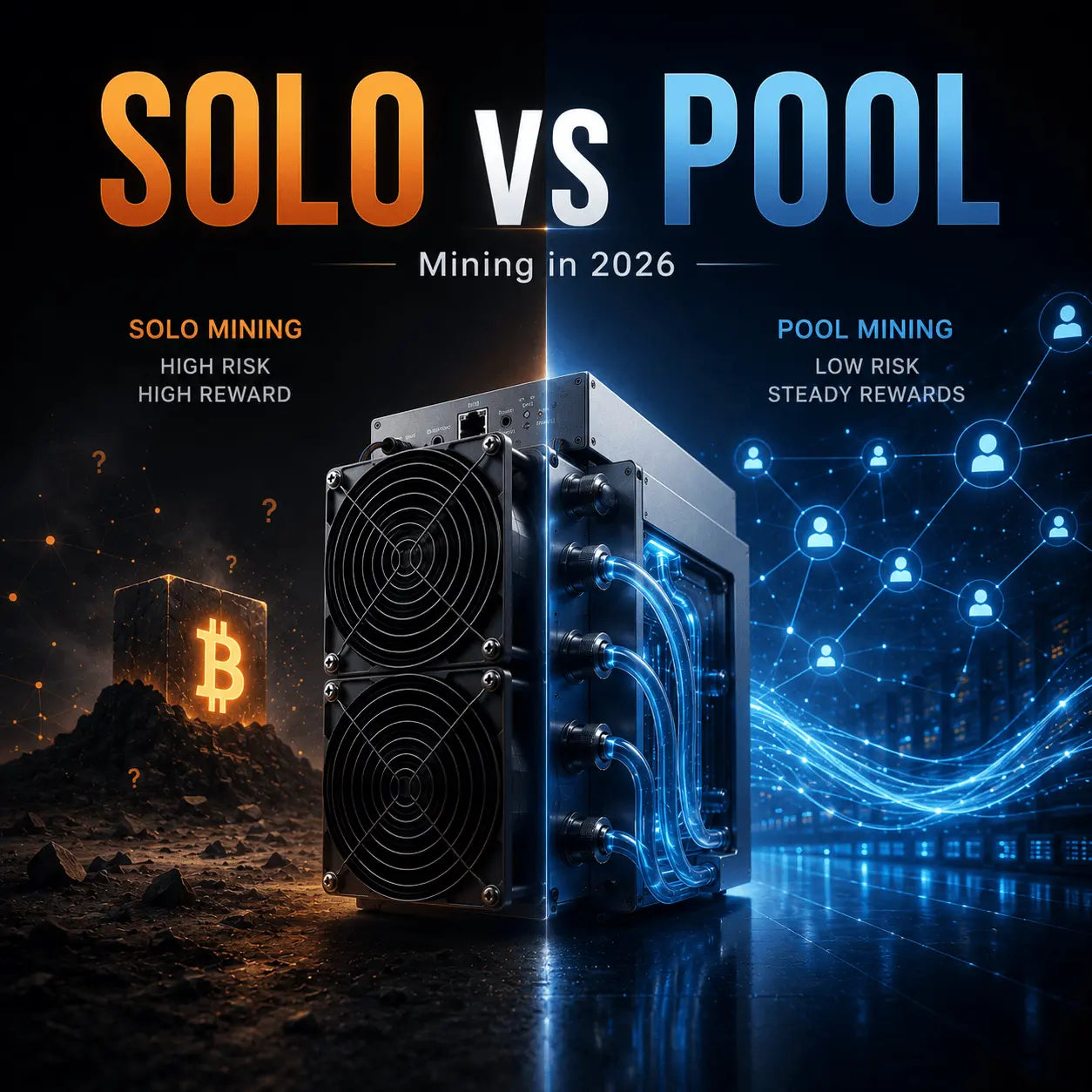
Solo Mining vs Mining Pools
Which Strategy Makes Sense in 2026?
ASIC mining · Bitcoin block rewards · Pool payout models · Variance risk · Decentralization trade-offs
On This Page
1Quick Answer
Which is better, solo mining or pooled mining? For most ASIC miners in 2026, pool mining is the better primary strategy. Bitcoin's block subsidy is 3.125 BTC, network competition is intense, and a small miner's chance of finding a block alone is so low that solo mining usually behaves more like a lottery ticket than an operating business. Pools convert unpredictable block discovery into recurring payouts that can be matched against electricity, hosting, repairs, and hardware financing.
Solo mining still has a legitimate role, but it belongs to a narrower set of cases: very large industrial farms, technically capable miners who want maximum protocol independence, or hobby miners who understand the odds and treat the activity as a sovereignty-first experiment. The mistake is not solo mining itself. The mistake is expecting solo mining to produce stable revenue with only one machine, a small rack, or even a modest farm.
Use a pool for dependable income. Consider solo mining only when you can tolerate long no-revenue periods, or when the solo allocation is a small, deliberate part of a broader strategy.
2How Solo Mining and Pool Mining Work
Solo mining means your ASICs work toward finding a full valid Bitcoin block without sharing the reward with other miners. You normally run your own Bitcoin node or connect through solo-mining infrastructure, point your machines at that setup, and wait. If your miner finds a block, you receive the block subsidy plus transaction fees. If another miner finds the next block first, you receive nothing for that round.
Pool mining changes the payout mechanism. Thousands or millions of ASICs submit lower-difficulty proofs of work called shares. These shares do not create Bitcoin blocks by themselves, but they measure each miner's contribution. When the pool finds a block, the pool distributes rewards according to its payout rules. The miner gives up a fee and some autonomy, but receives smoother income.
A solo pool supplies connectivity and share tracking, but it normally pays only the worker that finds a full block. A regular pool combines participant work and distributes smaller rewards under FPPS, PPS+, PPLNS, or a similar policy. True solo mining goes further by using the miner's own node and block-template infrastructure.
| Method | Reward Flow | Main Responsibility |
|---|---|---|
| True Solo | Full reward only when your operation finds a block | Node, templates, connectivity, monitoring, and payout control |
| Solo Pool | Finder receives the block reward minus stated service terms | Pool provides infrastructure; miner still accepts full variance |
| Regular Pool | Rewards are distributed from contributed shares | Miner verifies payout rules, fees, security, and pool reliability |
3The Variance Problem in 2026
Mining is probabilistic. A miner's expected reward is based on its share of total network hashrate, but the actual timing of rewards is random. At today's network scale, the gap between "expected value over a very long time" and "cash received this month" can be enormous for small miners. That is the core reason pools exist.
A single modern ASIC may be powerful compared with older home equipment, but it is tiny compared with the global Bitcoin network. Even a small commercial deployment can face an expected solo block interval measured in years or decades. The miner might get lucky tomorrow, but a business cannot safely budget around that possibility. Electricity providers, hosting sites, and lenders do not wait for probability to even out.
Expected blocks per day = your hashrate ÷ network hashrate × expected network blocks per day. Then expected waiting time in days = 1 ÷ expected blocks per day. Bitcoin targets roughly one block every ten minutes, but actual timing is random and network hashrate changes. This is an expectation, not a countdown or guarantee. Use current hashrate data and test multiple scenarios before spending electricity on a solo allocation.
If hashrate, difficulty, and efficiency are unfamiliar, review the hashrate and difficulty guide before using the formula.
Solo mining can have the same long-run expected value before fees, but the timing risk is very different. Pools reduce variance; they do not magically create more Bitcoin per hash.
4Why Mining Pools Win for Most ASIC Operators
The strongest argument for pool mining is predictable cash flow. Miners have recurring costs: electricity, hosting invoices, maintenance, network service, staff, firmware management, and sometimes debt payments. Pool payouts help match revenue to those expenses. That makes business planning more realistic, especially after the halving compressed block-subsidy revenue.
Pools also reduce operational complexity. The miner configures a stratum URL, worker name, and password, then monitors hashrate and rejection rates from a dashboard. The pool handles share accounting, block distribution, payout calculation, and often transaction-fee smoothing. This convenience is one reason even sophisticated operators continue to use pools.
| Factor | Pool Mining Advantage | Why It Matters |
|---|---|---|
| Cash Flow | Daily or frequent payouts | Helps cover fixed operating costs |
| Scale | Works from one ASIC to large farms | Low barrier to participation |
| Operations | Simple miner configuration | Less node and payout infrastructure to maintain |
| Variance | Rewards are smoothed across participants | Reduces the chance of long no-revenue periods |
5When Solo Mining Actually Makes Sense
Solo mining can make sense for very large operators with enough hashrate to find blocks regularly. At that scale, avoiding pool fees can be meaningful, and direct control over block construction may matter. Large miners may also have the technical staff needed to run nodes, monitor block templates, manage network connectivity, and respond quickly to failures.
Solo mining can also make philosophical sense. Some miners want to reduce dependence on large pools because concentrated block production can create concerns about censorship pressure, template control, and network resilience. A miner who values decentralization may choose solo mining or a smaller pool even if the dashboard payout is less convenient.
Finally, solo mining can be a hobby strategy. A home miner or small operator may knowingly choose solo mining for the chance of a rare full block payout. That is valid as long as the budget treats the electricity as a hobby expense, not as a predictable investment return.
6Pool Payouts, Setup, Security, and Troubleshooting
Not every mining pool pays the same way. FPPS, or Full Pay Per Share, pays miners for valid shares based on expected block rewards and an estimate of transaction-fee revenue. It is popular because it offers smoother revenue, but the pool usually charges a higher fee because it absorbs more variance risk.
PPS+ separates part of the payout logic, often treating the block subsidy and transaction-fee component differently. PPLNS, or Pay Per Last N Shares, pays based on a rolling window of contributed shares when a block is found. PPLNS can have lower fees, but payouts fluctuate more with pool luck and miner uptime.
| Model | Best For | Main Trade-Off |
|---|---|---|
| FPPS | Small and mid-size miners needing predictable income | Higher fees in exchange for smoother payouts |
| PPS+ | Miners comparing fee and transaction-fee treatment | Terms vary by pool, so read the payout policy carefully |
| PPLNS | Larger stable miners comfortable with variance | Lower fees may come with more payout fluctuation |
| Solo Pool | Lottery-style solo miners | No steady payout unless your worker finds a full block |
How to Choose a Mining Pool
Compare the written payout policy rather than a promotional revenue number. Record the payout model, stated fee, transaction-fee treatment, minimum payout, settlement schedule, server regions, supported protocol, account requirements, and procedure for changing a payout address. Confirm whether the pool publishes status history and gives clear rejected-share reasons.
Safe Setup Checklist
- Use the exact algorithm, network, regional endpoint, port, worker name, and payout address shown by the pool's official documentation.
- Never provide a wallet seed phrase or private key to a pool dashboard. A payout address is enough for ordinary mining configuration.
- Use a unique account password, enable two-factor authentication when available, and protect payout-address changes.
- Keep a verified backup endpoint and test failover before treating pool revenue as dependable.
- Record accepted, rejected, and stale shares after setup; miner-side hashrate alone does not prove the pool is crediting work.
For the full configuration sequence, use the Bitcoin ASIC setup guide. Before changing firmware or credentials, follow the ASIC firmware security checklist.
Common Pool Problems
Model the operating impact with the electricity cost guide and mining profit calculation guide. Pool choice changes variance and fees; it does not remove electricity or hardware risk.
7The Hybrid Strategy
A hybrid strategy routes the hashrate needed for operating cash flow to a pool while dedicating only a deliberate, budgeted portion to solo mining. The correct split is not a universal percentage. It depends on fixed costs, reserve cash, fleet size, expected solo-block interval, and how much zero-revenue time the operator can tolerate.
This approach is not magic. The solo machines still face extremely low odds unless the allocation is large. But it can be psychologically and strategically cleaner than going all-in on either side. It can also support decentralization if the miner avoids sending every hash to the largest pools.
For miners curious about solo mining, a small allocation is usually more rational than switching an entire farm away from pool revenue.
8Decision Checklist for ASIC Miners
The right strategy depends less on ideology and more on your operating constraints. If you need monthly income, choose a pool. If your power cost is high, choose a pool and focus on efficiency before experimenting. If your operation is large enough that block discovery becomes frequent, solo mining deserves a serious model.
Write the decision down with current inputs: fleet hashrate, network hashrate, expected waiting time, electricity cost, pool fee and payout rules, downtime reserve, and minimum cash-flow requirement. Recalculate after material difficulty, tariff, fee-policy, or fleet changes.
- Choose pool mining if you run one ASIC, a small farm, or any operation with fixed monthly bills.
- Consider FPPS if predictable payouts matter more than minimizing the last fraction of pool fees.
- Consider PPLNS if you have stable uptime and can tolerate reward fluctuation.
- Use solo mining carefully when you understand the variance and can afford long no-revenue periods.
- Watch pool concentration because Bitcoin's health depends on broad, resilient block production.
9FAQ: Solo Mining vs Mining Pools
Is solo mining profitable in 2026?
It can be profitable for very large miners or lucky small miners, but it is not predictable for most ASIC operators. Pool mining is usually the practical income strategy.
Do mining pools pay less than solo mining?
Pools charge fees, so expected revenue per hash can be slightly lower before considering variance. The benefit is smoother and more frequent payouts.
Which payout model is best for small miners?
FPPS is often the easiest model for small miners because it reduces payout variance and makes cash-flow planning simpler.
Can I split hashrate between a pool and solo mining?
Yes. Many miners can point different workers to different destinations, creating a hybrid setup with pool income and a small solo allocation.
Does pool mining hurt Bitcoin decentralization?
Pool concentration can raise decentralization concerns because a small number of pools may influence block production. Miners can reduce this risk by comparing pool size, policies, and payout terms.
Is a solo pool the same as true solo mining?
No. A solo pool provides shared infrastructure and share tracking but usually pays only the worker that finds a full block. True solo mining uses your own node and block-template infrastructure, so you control more of the process and also carry more operational responsibility.
How can I estimate how long solo mining may take?
Divide your hashrate by current network hashrate, multiply by expected network blocks per day, and invert the result. The answer is a statistical expectation, not a deadline; the actual wait can be much shorter or much longer.
10References and Data Sources
The sources below were selected for protocol authority, broad industry use, and direct relevance to mining data. Links open in a new tab and are marked nofollow.
- Bitcoin Developer Guide: Block ChainTechnical reference for Bitcoin proof of work, blocks, confirmations, and chain mechanics.
- Bitcoin.org: How Bitcoin WorksWidely used educational explanation of Bitcoin transactions, mining, and network validation.
- Mempool.space Mining Hashrate and Difficulty GraphsPublic Bitcoin network data resource for reviewing hashrate and difficulty trends.
- Cambridge Bitcoin Electricity Consumption IndexInstitutional research resource for Bitcoin mining energy context and industry-scale electricity analysis.
- arXiv: RPPLNS and Mining Pool Payout DesignAcademic reference discussing pay-per-last-N-shares, variance reduction, fairness, and miner incentives in proof-of-work mining pools.
- BIP 22: getblocktemplate FundamentalsBitcoin mining work-template interface and block-proposal foundation.
- BIP 23: Pooled Mining ExtensionsTechnical extensions for pooled mining, long polling, share targets, and block proposals.
- Stratum V2 Mining ProtocolCurrent protocol specification for distributing mining jobs and submitting shares.
- Stratum V2 Job Declaration ProtocolSpecification for miner-selected custom jobs and pool coordination.
Final Verdict
Pool mining should be the default strategy for most ASIC miners in 2026 because it turns rare block discovery into usable operating income. The fee is usually worth paying when electricity and hosting bills arrive every month.
Solo mining still matters, but mainly for large-scale operators, decentralization-focused miners, and hobbyists who accept lottery-level variance. The rare solo win is exciting; the pool payout is what keeps most machines running.


Leave a comment
This site is protected by hCaptcha and the hCaptcha Privacy Policy and Terms of Service apply.