
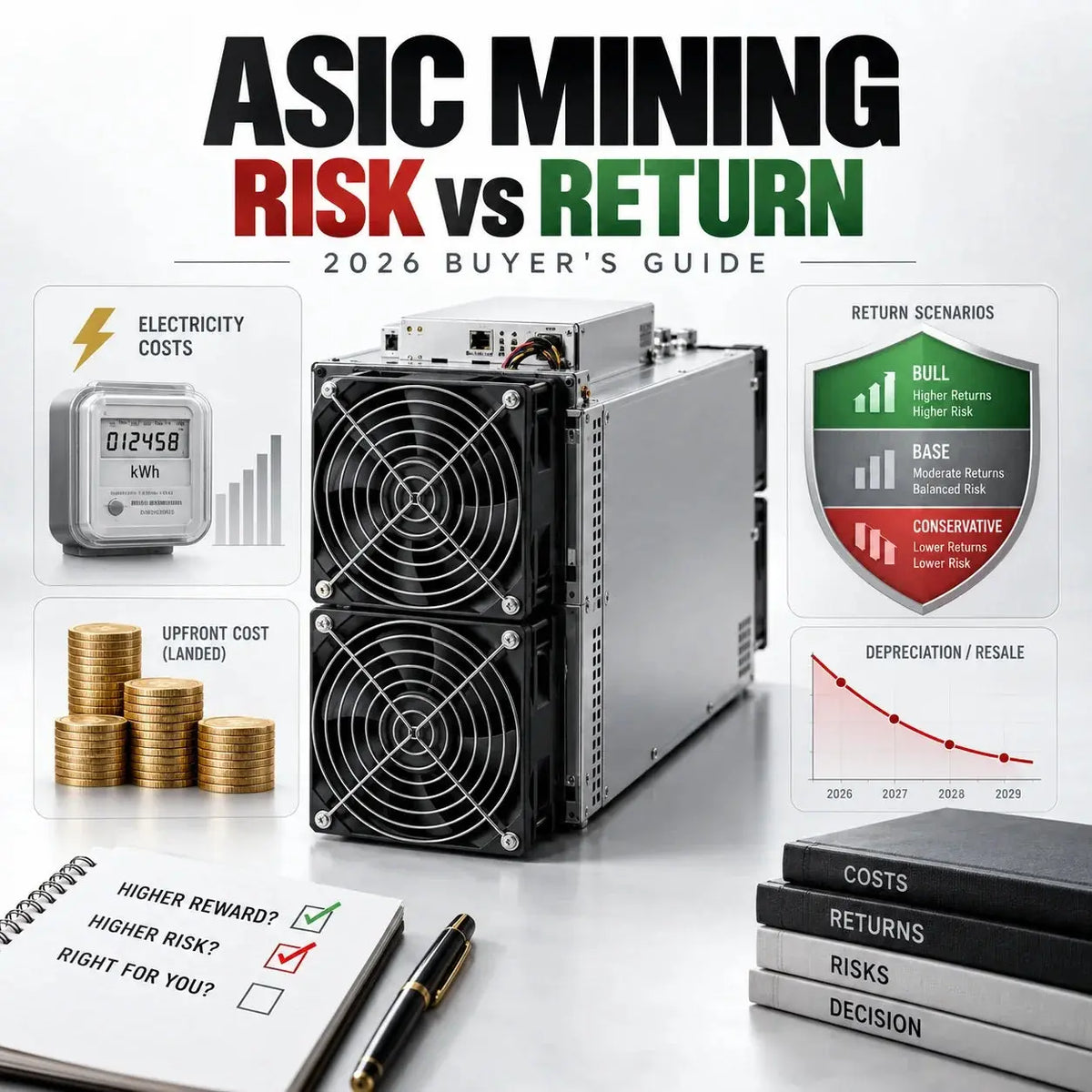
Is Investing in ASIC Mining Worth the Risk in 2026?
landed cost · electricity · downtime · depreciation · scenario analysis · exit planning
On This Page
1Quick Verdict: Is ASIC Mining Worth the Risk?
ASIC mining can be worth the risk when you have a verified low operating cost, suitable power and cooling, reliable uptime, and enough financial room to survive a weak revenue period. It is usually a poor fit when the purchase depends on today's calculator result remaining unchanged, when residential infrastructure is marginal, or when the buyer needs a fast and guaranteed payback.
An ASIC is not a passive income machine. It is a specialized operating asset whose revenue can change daily while electricity, hosting, repair, and financing costs continue. The correct question is therefore not simply, "How much does this miner earn today?" It is, "Does this project remain acceptable when revenue falls, costs rise, or the hardware loses resale value?"
Buy only if the conservative case is survivable, the base case produces acceptable cash flow, and the project still makes sense without relying on a guaranteed coin price, difficulty level, or resale buyer.
2What Are You Actually Investing In?
Buying an ASIC means committing capital to a narrow combination of hardware, algorithm, network economics, power access, and operating discipline. The machine has value because it can perform one Proof-of-Work function efficiently. That specialization also limits its alternatives when the target network becomes less attractive.
ASICs are normally algorithm-specific; they are not general computers that can freely switch to an unrelated algorithm. Before evaluating return, confirm the exact coin, algorithm variant, firmware, pool protocol, and operating mode. The ASIC miner fundamentals guide explains that technical boundary in detail.
3Build the ASIC Mining Return Model
A useful model separates the purchase from ongoing operation. The product price is only the first line. A realistic capital budget includes every cost required to receive, install, power, cool, and commission the miner.
| Cost Layer | Include | Commonly Missed |
|---|---|---|
| Landed hardware | Miner, PSU, shipping, insurance, duties, taxes, payment fees | Voltage-specific cords, customs handling, damage claims |
| Site preparation | Breaker, conductors, receptacle, PDU, networking, rack | Electrician labor, permits, spare circuit capacity |
| Thermal and acoustic | Ducting, extraction, filtration, fans, noise control | Summer ambient conditions and recirculated exhaust |
| Operating | Electricity, pool fee, hosting, cooling, monitoring | Demand charges, downtime, labor, rejected shares |
| Lifecycle | Fans, PSU, boards, cleaning, freight for repair | Depreciation, resale fees, tax treatment, disposal |
Gross mining revenue - electricity - pool/service fees - cooling - maintenance - downtime allowance
Keep this operating result separate from the initial capital cost. A miner can be cash-flow positive today and still fail to repay its total installed cost before it becomes uncompetitive.
Use measured wall power and the pool's rolling effective hashrate after the system stabilizes. Nameplate specifications are useful for planning, but they do not capture every site, firmware, temperature, or equipment condition.
4Seven Core Risks of ASIC Mining
| Risk | How It Damages Return | Practical Control |
|---|---|---|
| Revenue volatility | Coin price, fees, reward rules, network hashrate, and difficulty change mined value | Use current network data and bear/base/bull cases; never treat one calculator snapshot as a forecast |
| Electricity and cooling | A higher tariff or hot season can remove operating margin | Verify the full tariff, measure wall draw, and model cooling or hosting charges |
| Efficiency obsolescence | Newer hardware can deliver more work per watt and reduce the older unit's competitiveness | Compare efficiency within the same algorithm and avoid paying only for headline hashrate |
| Downtime and repair | Failed fans, boards, PSUs, network, or pools stop accepted work while fixed costs continue | Monitor pool-side output, hold critical spares, and understand repair logistics |
| Depreciation and liquidity | Used value may fall faster than expected or buyers may disappear | Set exit triggers and a conservative salvage value before purchase |
| Site and logistics | Wrong voltage, noise, heat, import delays, or damage can make the unit unusable | Complete the electrical, ventilation, customs, and delivery plan first |
| Counterparty and security | Seller, hosting, pool, firmware, wallet, or account failures can redirect money or hashrate | Verify counterparties, use trusted firmware, change credentials, and enable MFA |
These risks are connected. For example, a hot room can increase fan wear and instability; instability lowers pool-side hashrate; weaker cash flow delays payback; and delayed payback exposes the owner to more hardware depreciation. A credible analysis therefore evaluates the full system rather than one attractive specification.
5Calculate Electricity Cost Before Revenue
Electricity is usually the most predictable major operating cost, but the rate must be the rate you actually pay. It can include energy charges, delivery charges, taxes, time-of-use periods, demand charges, hosting markups, or seasonal pricing. U.S. Energy Information Administration guidance also shows that electricity prices vary by customer type and location, so a universal profitability threshold is unreliable.
(Miner watts / 1,000) x 24 x electricity rate per kWh
A 3,200 W miner uses 76.8 kWh per day at full uptime. Multiply 76.8 by the all-in rate, then add any separate cooling or hosting cost.
| All-In Rate | 3.2 kW Daily Cost | 30-Day Cost | Annual Cost |
|---|---|---|---|
| $0.05/kWh | $3.84 | $115.20 | $1,401.60 |
| $0.08/kWh | $6.14 | $184.32 | $2,242.56 |
| $0.10/kWh | $7.68 | $230.40 | $2,803.20 |
| $0.15/kWh | $11.52 | $345.60 | $4,204.80 |
| $0.20/kWh | $15.36 | $460.80 | $5,606.40 |
This table is a power-cost example, not a profitability prediction. Compare it with revenue calculated from current network conditions and your actual pool result. For circuit planning, cooling load, and tariff details, use the dedicated mining electricity cost guide.
6Stress-Test Three Scenarios
Forecasting one number creates false precision. Build three cases from the same transparent inputs, record the date of each assumption, and update them before committing funds.
Bear Case
- Lower coin price or fee revenue
- Higher difficulty or network competition
- Higher electricity or hosting rate
- Lower uptime and repair allowance
- Conservative resale value
Base Case
- Current measured assumptions
- Normal pool fee and rejects
- Realistic seasonal cooling
- Expected maintenance reserve
- Documented exit timing
Bull Case
- Stronger mined-asset value
- Stable difficulty and fees
- High sustained uptime
- No major repair event
- Healthy resale demand
The bear case is not a prediction that everything will go wrong. It answers whether the project can tolerate ordinary adverse changes without forcing the owner to sell the miner, stop paying hosting, or take unsafe operational shortcuts. If the project survives only in the bull case, the risk is already visible.
7Payback, ROI, and Cash Flow Are Different
Total landed and installed cost / estimated monthly net cash flow
Do not report a finite payback when monthly net cash flow is zero or negative. Recalculate after meaningful changes in power rate, network difficulty, price, uptime, or operating mode.
A strong spreadsheet also tracks cumulative cash flow, repair reserve, expected resale proceeds, and tax treatment. The mining profitability calculation guide provides a broader model, while the ASIC lifecycle guide explains how age and efficiency affect the decision.
8ASIC Mining vs Buying Coin, Mining Stocks, or ETFs
Operating an ASIC is one way to gain exposure to mining economics, but it is not interchangeable with owning the mined asset or a financial security.
| Route | You Control | Main Risks | Operational Work |
|---|---|---|---|
| Own and operate an ASIC | Hardware, pool, operating mode, site, uptime | Power, hardware, difficulty, price, repair, resale | High |
| Buy the mined asset | Position size, custody method, sale timing | Price, custody, exchange, regulation | Low to moderate |
| Mining company stock | Security selection and portfolio size | Market, management, debt, dilution, execution | Low |
| Mining or infrastructure ETF | Fund choice and allocation | Market, fees, holdings, tracking, concentration | Low |
This page focuses on the owner-operator decision. For a dedicated comparison of direct hardware ownership, public mining companies, and funds, read Mining as an Investment: Hardware vs Stocks vs ETFs.
9ASIC Purchase Due-Diligence Checklist
- The exact coin, algorithm variant, firmware, and pool compatibility are confirmed.
- Hashrate, wall power, efficiency, voltage, plug, noise, size, and environmental limits are recorded.
- The seller, model, condition, serial evidence, warranty, return terms, and payment route are verified.
- Total landed cost includes shipping, insurance, duties, taxes, payment fees, and accessories.
- A qualified person has reviewed circuit capacity, protection, cabling, grounding, and continuous load.
- Air intake, exhaust, room heat, dust, humidity, seasonal temperature, and noise have a workable plan.
- The all-in electricity or hosting rate is documented, including variable and hidden charges.
- Bear, base, and bull cases use dated assumptions for revenue, difficulty, uptime, and resale.
- Pool fees, payout method, threshold, regional endpoint, rejected shares, and failover are understood.
- Repair logistics, spare fans or PSU, expected downtime, and support response are budgeted.
- Default credentials will be changed and firmware will come from a trusted source.
- An exit trigger exists for negative cash flow, poor efficiency, repeated failure, or resale decline.
For used hardware, request current pool-side performance, board status, temperatures, error logs, repair history, and a time-stamped operating test. A clean exterior alone does not prove healthy chips or power stages.
10Reduce Risk After Deployment
- Establish a stock baseline. Record wall power, pool-side hashrate, temperatures, fan speed, rejects, and errors before tuning.
- Monitor delivered work. Pool-side rolling hashrate and accepted shares matter more than a brief local dashboard peak.
- Keep heat moving one way. Prevent hot exhaust from returning to the intake and review conditions during the hottest season.
- Change default credentials. Keep management interfaces private, isolate devices where practical, and use trusted firmware. Follow the ASIC firmware security checklist.
- Recalculate monthly. Update power rate, actual payout, uptime, fees, repair reserve, and resale value instead of relying on the purchase-day forecast.
- Use an exit policy. The ASIC depreciation and exit guide explains when efficiency, downtime, and resale may justify selling.
Public-network mining revenue cannot be guaranteed. The FTC identifies promises of guaranteed cryptocurrency profits as a scam warning sign. No seller, pool, host, or calculator can lock future coin price, difficulty, fees, uptime, or hardware condition.
11FAQ: ASIC Mining Investment Risk
Is ASIC mining passive income?
No. Automation reduces daily effort, but the owner still manages power, cooling, pool connectivity, firmware, monitoring, maintenance, repairs, security, and financial reporting.
What electricity rate makes ASIC mining profitable?
There is no universal cutoff. Profitability depends on the exact miner, algorithm, network conditions, coin value, fees, uptime, cooling, hosting, and total acquisition cost. Use your all-in rate and current data.
Should I buy the highest-hashrate miner?
Not automatically. Compare efficiency, wall power, total installed cost, condition, voltage, noise, repair support, and expected resale within the same algorithm.
Can an ASIC switch to any profitable coin?
No. It is limited to a specific algorithm family and may also require compatible firmware, headers, or pool protocols. Verify each network before assuming compatibility.
Is a short payback estimate proof of low risk?
No. A short estimate can be produced by optimistic price, difficulty, uptime, or resale assumptions. Test the same purchase under adverse inputs and include all landed and operating costs.
Is used ASIC hardware too risky?
Not always. The price may compensate for age, but only when condition, test data, repair history, warranty, shipping, efficiency, and spare-part availability are understood.
How often should I recalculate the project?
Review it at least monthly and after a major change in electricity, hosting, price, difficulty, network rules, uptime, repair status, or hardware market value.
When is ASIC mining probably not worth it?
When power or hosting costs are unverified, the site is unsuitable, financing requires fast payback, revenue must stay at today's level, losses are unaffordable, or the seller and equipment cannot be verified.
12References and Further Reading
- Bitcoin Developer Guide: MiningTechnical explanation of block templates, targets, solo mining, pooled mining, and shares.
- U.S. Energy Information Administration: Electricity Prices and FactorsOfficial explanation of why electricity prices vary by location, customer type, and cost structure.
- FTC: What To Know About Cryptocurrency and ScamsConsumer guidance on guaranteed returns, impersonation, payment demands, and cryptocurrency fraud.
- CISA: Secure Our WorldOfficial guidance on strong passwords, MFA, phishing awareness, and software updates.
Final Verdict
ASIC mining is worth considering only when the operating advantage is real and the downside is affordable. Verify the algorithm, calculate the complete installed cost, measure electricity, model downtime and depreciation, and decide in advance when to stop or sell.
The strongest purchase is not the one with the largest calculator number. It is the one whose assumptions you can explain, monitor, and survive when conditions move against you.



Leave a comment
This site is protected by hCaptcha and the hCaptcha Privacy Policy and Terms of Service apply.