
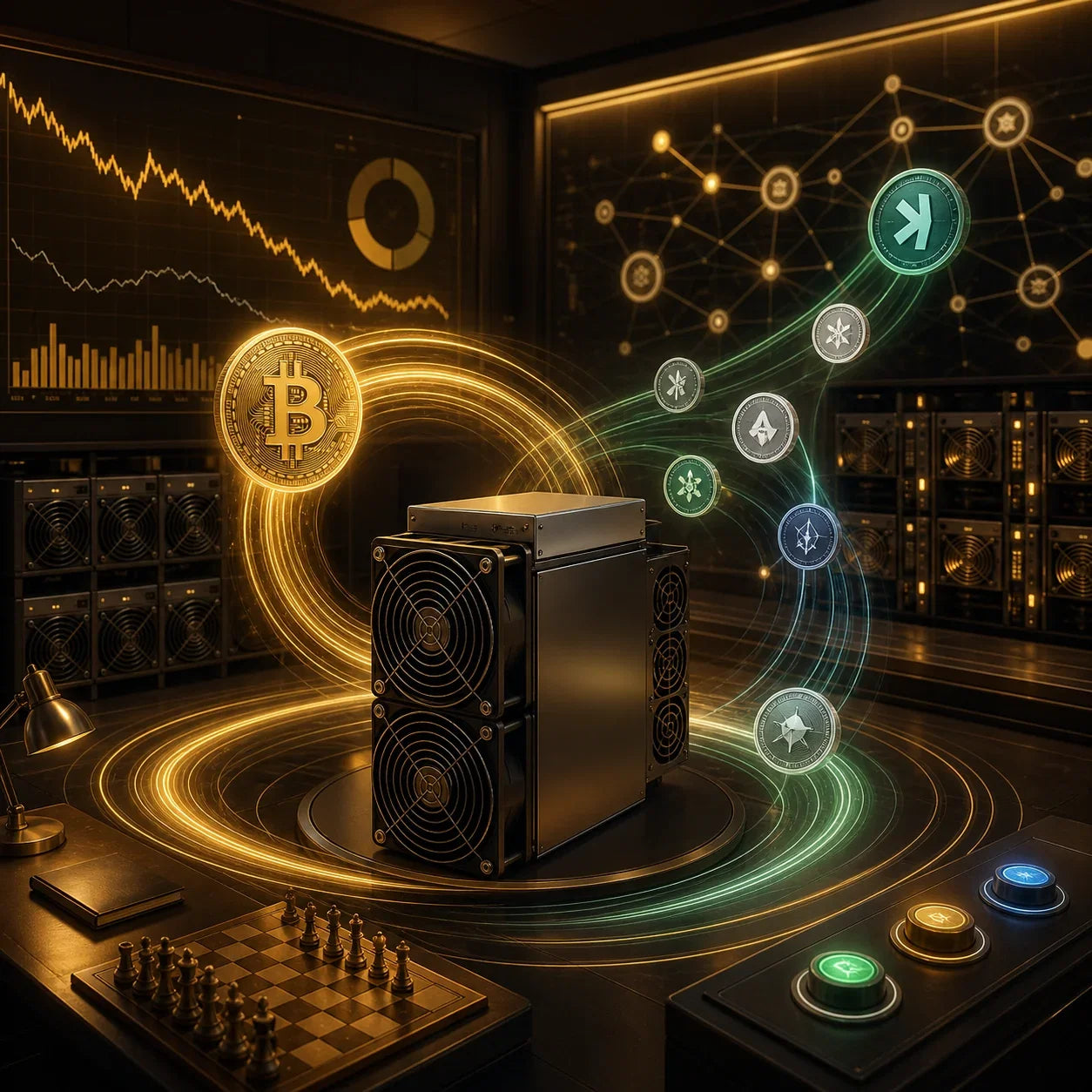
Altcoin Cycles and
Mining Decisions in 2026
BTC dominance · capital rotation · altcoin season signals · ASIC timing · exit discipline
On This Page
1Why Altcoin Mining Needs a Cycle Framework
Altcoin mining decisions should not be based only on today's calculator result. Non-Bitcoin proof-of-work coins can move faster than Bitcoin, but they also carry higher liquidity risk, sharper difficulty changes, weaker resale markets, and shorter narrative cycles. A miner who buys hardware because one altcoin is trending may discover that profitability disappears when difficulty follows price.
The previous article about the absence of an altcoin season should be merged into this broader mining guide because the real business question is not whether an altcoin season exists today. The question is how BTC dominance, capital rotation, liquidity, and coin-specific mining economics should change hardware timing and exit planning.
Altcoin mining works best when market rotation, mining difficulty, exchange liquidity, hardware efficiency, and resale options all support the same thesis.
2BTC Dominance: The First Signal to Watch
BTC dominance measures Bitcoin's share of the total crypto market. It is not a perfect indicator, but it helps miners understand where risk appetite sits. When dominance rises sharply, capital is often concentrating in Bitcoin and safer large-cap crypto exposure. When dominance starts to weaken after a Bitcoin-led rally, altcoins may begin receiving incremental attention.
For miners, dominance matters because altcoin revenue is usually tied to both coin price and liquidity. A KAS, LTC, DOGE, or other PoW miner may look attractive during a rotation phase, but if liquidity remains trapped in Bitcoin, the altcoin's price may not support the difficulty increase that follows new ASIC deployment.
3Altcoin Season Signals Are Useful, Not Sufficient
Altcoin season indexes compare broad altcoin performance against Bitcoin over a defined window. They can identify whether the wider market is rewarding risk beyond BTC. But they do not say which proof-of-work coin is mineable at a good margin, whether a specific ASIC has a healthy resale market, or whether exchange liquidity is deep enough for regular payouts.
A miner should read these indexes as a temperature gauge, not a purchase signal. If the index is low, altcoin mining may still work for a specific coin with strong fees, low difficulty, or cheap hardware. If the index is high, the market may already be crowded and ASIC payback assumptions may be too optimistic.
Do not buy an altcoin ASIC only because an altcoin season chart is rising. Confirm coin liquidity, mining difficulty trend, hardware efficiency, power cost, and resale demand first.
4How Market Rotation Changes Mining ROI
Altcoin mining ROI can change faster than Bitcoin mining ROI because many altcoin networks are smaller. A modest price increase can attract a large amount of new hashrate relative to network size. That can quickly reduce coin output per miner, even if the token price remains strong.
Miners should also consider payout liquidity. If a coin trades mainly on a few venues, a profitable calculator reading may not translate into easy conversion. Slippage, withdrawal limits, wallet reliability, exchange access, and tax records all matter. Mining revenue is only valuable if it can be stored, sold, or used without excessive friction.
5Algorithm and Hardware Choices
Different altcoin algorithms create different hardware risks. Scrypt miners may mine Litecoin and Dogecoin through merged-mining economics, while KHeavyHash miners focus on Kaspa. Blake-family, Equihash, and other algorithm families have their own liquidity and hardware cycles. A miner should know whether the ASIC can switch coins or whether it depends on one network.
| Mining Segment | Cycle Opportunity | Main Risk | Decision Focus |
|---|---|---|---|
| Kaspa / KHeavyHash | Fast network growth and strong narrative cycles | Difficulty can rise quickly after ASIC adoption | Check hashrate growth and KAS liquidity before buying |
| Litecoin / Dogecoin Scrypt | Merged-mining exposure and deeper history | Hardware can become expensive in bullish meme cycles | Model LTC and DOGE revenue separately |
| Equihash / Zcash | Privacy narrative can return during surveillance cycles | Regulatory and liquidity uncertainty | Use conservative coin-price and resale assumptions |
| Emerging PoW Coins | Early entry can produce high upside | Low liquidity, exchange risk, wallet risk, and fast obsolescence | Limit allocation and plan conversion before mining |
6Altcoin Mining Decision Matrix
A useful decision matrix separates market conditions from operating conditions. If BTC dominance is falling, altcoin liquidity is improving, difficulty is not yet overheated, and hardware prices are reasonable, expansion can make sense. If dominance is rising, altcoin volume is weak, and ASIC prices are still based on yesterday's profitability, waiting may be better.
| Condition | Buy | Hold | Exit or Reduce |
|---|---|---|---|
| BTC dominance | Weakening after BTC-led rally | Sideways and stable | Rising sharply with weak altcoin volume |
| Coin liquidity | Improving across credible venues | Stable and usable | Thin order books or withdrawal friction |
| Difficulty | Lagging price gains | Rising gradually | Rising faster than price |
| ASIC pricing | Discounted or conservative payback | Fair relative to revenue | Priced for a perfect bull case |
| Power cost | Low enough to survive drawdowns | Average but manageable | High retail power with narrow margin |
7Exit Planning Before You Buy
Altcoin miners often focus on entry timing but neglect exit planning. Before buying a machine, define the conditions that would make you sell the ASIC, switch pools, convert mined coins, or stop mining. This is especially important for single-algorithm machines tied to one coin's liquidity cycle.
Exit planning should include hardware resale channels, expected depreciation, spare parts availability, firmware support, pool reliability, wallet access, and conversion routes. If the only plan is to hold mined coins until a perfect altcoin season, the operation is depending on market timing rather than mining discipline.
For every altcoin ASIC purchase, write down the coin-price case, difficulty case, power-cost case, and resale case. If one of those breaks the payback model, reduce size or wait.
8Altcoin Miner Checklist
- Check BTC dominance: Identify whether capital is concentrating in Bitcoin or rotating outward.
- Confirm liquidity: Look at exchange depth, withdrawal support, and conversion costs.
- Watch difficulty: Rising hashrate can erase token-price gains quickly.
- Model power cost: Altcoin volatility punishes high electricity rates.
- Stress test payback: Use bull, base, and bear coin-price assumptions.
- Review hardware resale: Narrow algorithm machines can become hard to sell after a cycle turns.
- Plan coin handling: Decide which portion to sell for operating cash and which portion to hold.
9FAQ
Is altcoin season required for profitable altcoin mining?
No. A specific coin can be profitable before a broad altcoin season, but broad rotation can improve liquidity and sentiment.
Should miners buy altcoin ASICs when BTC dominance falls?
Falling dominance is a useful signal, but miners still need to verify coin liquidity, difficulty trend, ASIC pricing, and power cost.
Are altcoin miners riskier than Bitcoin miners?
Often yes. Smaller networks can have faster difficulty changes, thinner liquidity, and more volatile hardware resale values.
Which altcoin mining metric matters most?
Net profitability after electricity and fees matters most, but it should be combined with difficulty trend, liquidity, and hardware resale risk.
Should mined altcoins be held or sold?
That depends on cash flow. Many miners sell part of production to cover power and keep only a planned treasury portion.
10References
- Blockchaincenter: Altcoin Season IndexBroad market indicator for comparing altcoin performance against Bitcoin.
- Kaspa WikiOfficial Kaspa ecosystem reference for network and mining context.
- WhatToMinePublic mining profitability calculator used for cross-coin comparisons.
- minerstat: Kaspa Mining DataPublic KAS mining profitability and network data dashboard.
- minerstat: Litecoin Mining DataPublic LTC mining profitability and network data dashboard.
Final Verdict
Altcoin mining in 2026 is a timing and discipline problem. BTC dominance and altcoin season indicators can tell miners when risk appetite is changing, but they do not replace coin-level profitability, liquidity, difficulty, and hardware analysis.
The best altcoin miners do not simply chase the newest narrative. They buy when payback still works under conservative assumptions, keep cash for operating costs, and know exactly when they will hold, convert, switch, or exit.




Leave a comment
This site is protected by hCaptcha and the hCaptcha Privacy Policy and Terms of Service apply.