
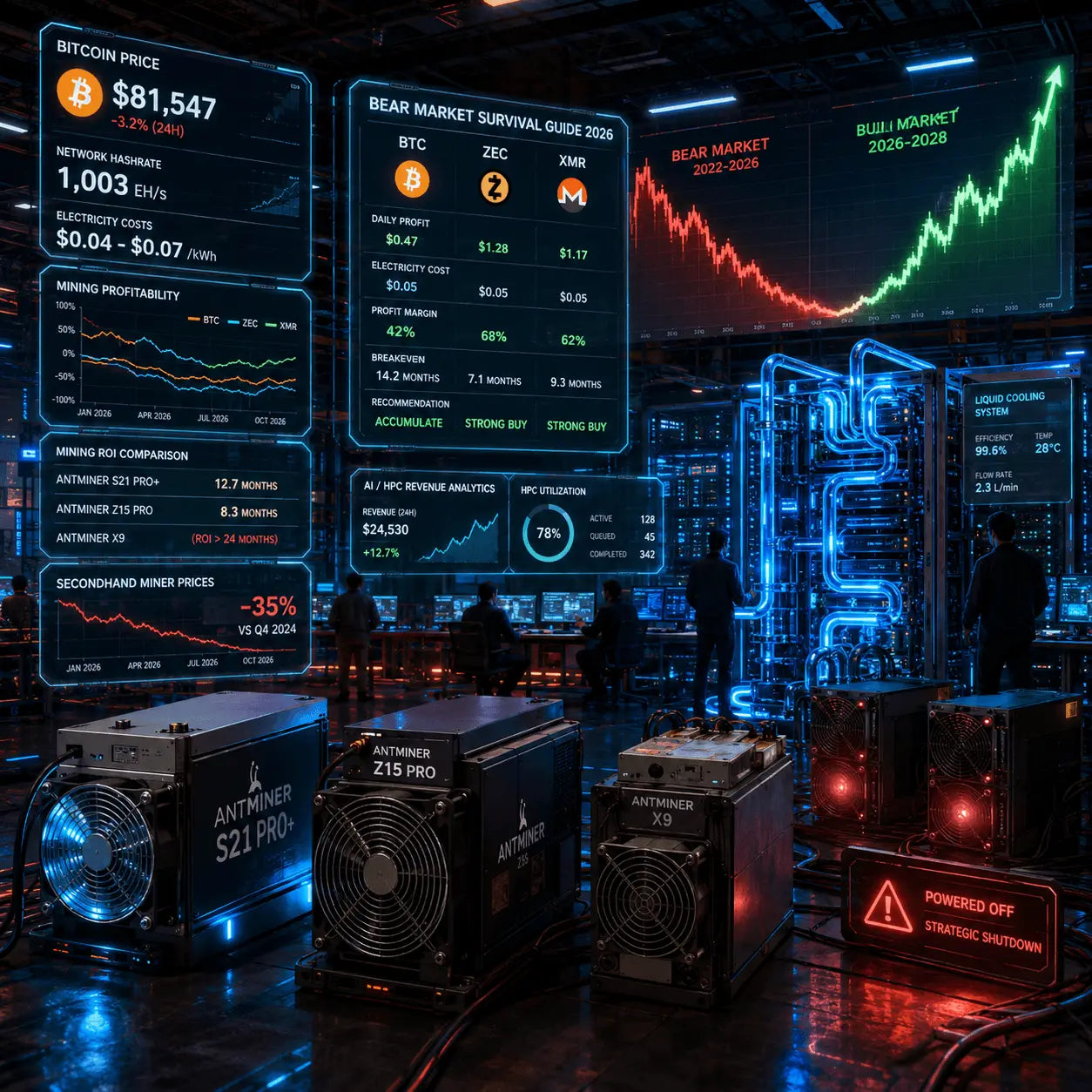
In the world of cryptocurrency, an old saying goes: "Bull markets make you money, bear markets make you legendary." Entering 2026, with the full effect of the halving (block rewards now reduced to 3.125 BTC) and macroeconomic fluctuations, the mining industry has entered a typical "shakeout period." For ordinary miners, this may mean shrinking profits or even losses. But for strategic miners, this is precisely the golden window for low-cost expansion and asset structure optimization.
This guide, based on the latest strategic report from ZC MINER and current market data as of May 2026 (BTC: $81,547, network hashrate: 1,003 EH/s), breaks down six priority bear market survival strategies.
⚠️ Disclaimer: Mining profitability fluctuates with cryptocurrency prices, network difficulty, and electricity costs. All figures reflect live data as of May 12, 2026 (BTC: $81,547 | Network hashrate: 1,003 EH/s). Collateral lending carries liquidation risk. This article is for informational purposes only and does not constitute financial advice.
Why is the bear market the critical period for miners to "make their legend"?
Core conclusion: A bear market is not the end; it is the ultimate test of a miner's financial resilience and operational capability. Exceptional miners sell coins in bull markets and buy hashrate in bear markets.
In a bear market, the network hashrate remains high while prices consolidate at the bottom, causing Hashprice to hit historic lows. High-energy-consumption older machines hit their shutdown price, "tourist" miners are exiting, while institutions and seasoned miners are quietly accumulating. History proves that the cyclical nature of the crypto market has never been broken — enduring 2026 is precisely about preparing for the liquidity explosion around the 2028 halving. Every coin mined in a bear market is low-cost holdings; every investment in hashrate during a bear market will be magnified multiple times in a bull market.
H2: What is the most dangerous mistake in a bear market?
Core conclusion: The deadliest mistake in a bear market is keeping all machines running and waiting for prices to recover, thereby burning through cash reserves on unprofitable operations.
Many miners' instinct is to "tough it out" — hoping prices will rebound soon, so they keep all machines running. This is precisely how mining businesses die before the bull market arrives.
The correct approach is to triage your fleet by profitability.
Based on current electricity cost of 81,547:
| Miner | Power | Net/Day @$0.07 | Break-Even BTC | Status at $60K BTC |
|---|---|---|---|---|
| Antminer S21 Pro+ 234TH | 3,510W | $3.20 | $52,842 | ✅ Still profitable |
| Antminer S21+Plus 216TH | 3,564W | $2.41 | $58,127 | ⚠️ Marginal |
| Older gen 90W/TH machine | ~9,000W | ~$1.00 | ~$74,000 | ❌ Shut down |
Proactively shut down machines that fall into the red zone. The electricity you save is real cash — use it to extend your runway. When the situation is severe, selling underperforming hardware to raise liquidity is a legitimate strategic move. Reducing your fleet by 30% to preserve 12 months of operating capital is vastly preferable to running at a loss until you are forced to liquidate everything at the worst possible price.
Target reserve: maintain 12–18 months of electricity costs in fiat at all times. This is the bear market survival threshold.
H2: Should you sell BTC to pay electricity bills when prices are low?
Core conclusion: Selling BTC at bear market prices to cover electricity bills is one of the most value-destructive actions a miner can take. Collateralized borrowing is a structurally superior alternative.
If you are holding BTC and facing cash flow pressure, using BTC as collateral to borrow stablecoins or fiat allows you to pay operating costs without selling your BTC.
How It Works
You deposit BTC as collateral and borrow stablecoins or fiat at a fraction of the collateral value (typically 40–60% LTV). The borrowed funds cover your operating costs; your BTC position remains intact and benefits fully from any price recovery. When you repay the loan, you reclaim your collateral.
Mining-Specific Options
-
Electricity fee loans: Designed specifically for miners, using mining hardware or BTC as collateral to directly finance electricity costs. This is one of the most friction-free options for large-scale operators.
-
Institutional crypto lending platforms: Several established platforms offer BTC-collateralized loans with competitive rates, suitable for miners with significant BTC holdings.
Risk Management
Collateral lending carries liquidation risk. If BTC price falls significantly after you take the loan, you may face a margin call requiring additional collateral.
Best practice: Borrow at a conservative LTV (40% or lower), and maintain a buffer that covers a 30–40% BTC price drop before your position is at risk. Never borrow the maximum available against your collateral.
The core principle: A bear market low is exactly the wrong time to sell BTC. Loans let you preserve the position you will need when prices recover.
H2: What should you do when BTC price falls below mining cost?
Core conclusion: When the market price of BTC drops below your all-in mining cost, every coin you mine is acquired at above-market cost. In this scenario, the rational move is to reduce mining operations and redirect the saved electricity budget toward direct BTC purchases on the open market.
There is a counterintuitive moment in every crypto bear market where buying BTC on the open market becomes cheaper than mining it. Recognizing this inflection point and acting on it is one of the highest-leverage decisions a miner can make.
Know Your All-In Mining Cost
Your real cost to mine one BTC includes electricity, hardware depreciation, maintenance, and overhead.
At 50,000–0.04/kWh, that drops to 35,000 per BTC.
When to Act
When the market price of BTC drops below your all-in mining cost:
-
Reduce mining operations to the minimum required to maintain network presence and hardware health
-
Redirect the saved electricity budget toward direct BTC purchases on the open market
Historically, BTC has traded below the global average mining cost for no more than 3–6 months in any given bear cycle. These windows are short but represent genuine once-per-cycle buying opportunities. Miners are uniquely positioned to act on them because they already have the infrastructure, wallets, and market awareness in place.
H2: Why is a bear market the best time to lock in low-cost electricity contracts?
Core conclusion: Electricity cost is the single largest variable separating profitable miners from unprofitable ones. And bear markets are the best time to negotiate — not bull markets.
Hosting facilities and industrial power providers have the same fixed costs regardless of BTC price. When miner demand drops in a bear market, hosting facilities have excess capacity and genuine motivation to offer better terms. The dynamic reverses sharply in a bull market: facilities fill up, waitlists form, and operators have no reason to discount rates.
What to Target
| Item | Target |
|---|---|
| All-in rate | 0.06/kWh (including cooling and network) |
| Contract term | 2–3 years — long enough to lock in the advantage through the next bull cycle |
| Clause | Ensure the contract allows hardware changes |
The Math
The difference between 0.04/kWh on a 100-machine operation drawing 350 kW is approximately 182,000 in preserved capital — enough to buy a significant position in secondhand hardware at the bottom.
H2: If you have secured cheap electricity, what should you buy in a bear market?
Core conclusion: If you have locked in low-cost electricity, the bear market secondhand hardware market is where serious scale-up happens. High-cost miners forced to sell hardware; low-cost miners with cash reserves are the natural buyers.
In the 2018–2019 and 2022 bear markets, secondhand ASIC prices fell to 20–40% of new machine prices. An S21 Pro that retails at 400–$700 secondhand at the depth of a bear cycle.
ROI Comparison (at $600 acquisition cost)
| Purchase Price | Net/Day @$0.07 | ROI at Current BTC | ROI if BTC 2x |
|---|---|---|---|
| $2,070 (new) | $3.20 | 21.6 months | ~10 months |
| $600 (secondhand bear market) | $3.20 | 6.3 months | ~3 months |
The Difficulty Dividend
When large numbers of miners shut down, Bitcoin network difficulty adjusts downward — typically within 2 weeks of the hashrate drop. This means the miners who stay online after a wave of capitulation earn a larger share of every block reward without doing anything differently. Buying cheap secondhand hardware at the bottom of a bear market captures both the low entry price and the difficulty-adjusted revenue uplift.
H2: Are there other miners to consider besides Bitcoin in a bear market?
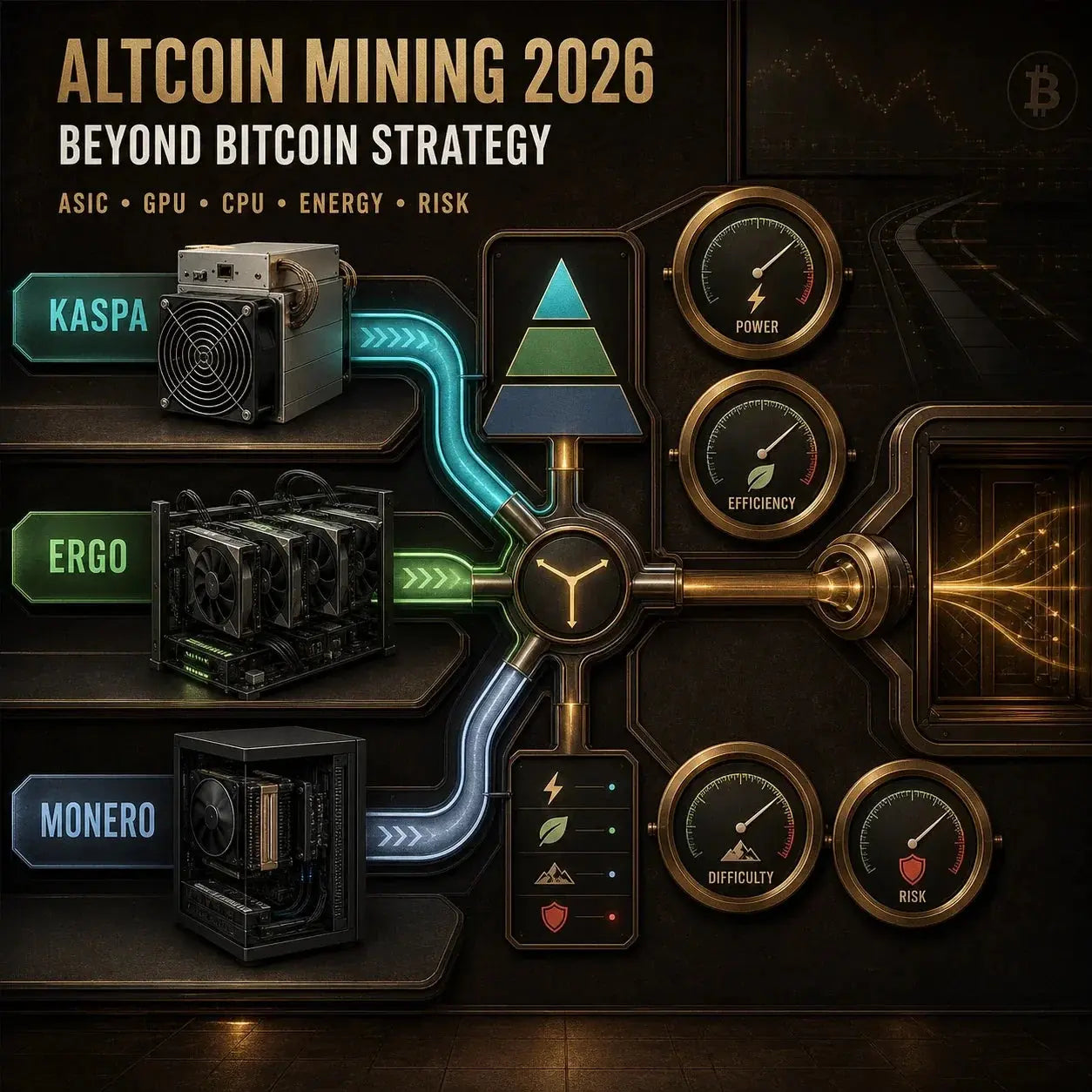
Core conclusion: Coins like Zcash (ZEC) and Monero (XMR) have different market dynamics, different investor bases, and different regulatory narratives — which means their price cycles do not always align with BTC's. During certain phases of a bear market, allocating a portion of your capital to altcoin miners provides natural decorrelation.
During specific phases of a BTC bear market — particularly when regulatory pressure on transparent chains increases — privacy coins have historically outperformed BTC on a percentage basis.
Top Altcoin Miner Profitability at $0.07/kWh (May 2026)
| Miner | Coin | Net/Day | Price | ROI | Break-Even Coin Drop |
|---|---|---|---|---|---|
| Antminer Z15 Pro | ZEC ($560.82) | $43.86 | $3,700 | 2.8 mo | -90% (ZEC to $56) |
| Antminer X9 | XMR ($414.58) | $22.61 | $5,600 | 8.3 mo | -84% (XMR to $66) |
The Z15 Pro's electricity cost is only 9% of its gross revenue — meaning ZEC would need to fall 91% from current prices before the machine stops covering its own power bill. That is an extraordinary margin of safety that no BTC miner can match at current network difficulty levels.
H2: How can miners participate in AI and HPC transformation during a bear market?
Core conclusion: In 2026, Bitcoin miners are undergoing a profound identity重塑. Their core competitive advantage lies not only in hashrate calculation but in owning "energized sites" capable of supporting high-density computing loads.
Due to the explosive demand for AI computing power, the large electricity contracts and advanced cooling infrastructure held by miners have become highly sought after. Many publicly traded mining companies have shifted approximately 30%–70% of their revenue sources toward AI collaboration and high-performance computing (HPC) hosting.
Bitcoin Mining vs. AI/HPC Hosting
| Aspect | Bitcoin Mining | AI/HPC Hosting |
|---|---|---|
| Primary Revenue | Block rewards + transaction fees | Rental fees + compute service fees |
| Revenue Stability | High volatility | High stability (long-term contracts) |
| Valuation Multiple | ~5.9x EV/Sales | ~12.3x EV/Sales |
| Infrastructure Requirement | Relatively low (short outages acceptable) | Extremely high (redundant power, low latency) |
This transformation gives miners a powerful cash flow hedge during bear markets. When Bitcoin yields are low, they can allocate some power to AI tasks; when the Bitcoin bull market returns, they can quickly switch back to hashrate calculation. This "elastic computing" capability is the core weapon of strategic miners in 2026.
Conclusion: The Winning Formula for Miners in 2026
To successfully "crouch" in 2026 and lock in doubled returns, miners must focus on the following core pillars:
-
Cash flow first: Proactively shut down unprofitable machines and maintain 12–18 months of electricity reserves
-
Collateral loans instead of selling: Don't sell BTC at lows — use loans to cover operating costs
-
Buy directly when below cost: Identify windows when mining cost exceeds market price, redirect electricity budget to direct purchases
-
Lock in low electricity contracts during bear markets: Use negotiation leverage from falling demand to secure 0.06/kWh 2–3 year contracts
-
Scale up in the secondhand market: Buy efficient hardware at 20–40% of new prices while capturing difficulty adjustment dividends
-
Altcoin decorrelation: ZEC and XMR miners offer high margins of safety and different cyclical characteristics from BTC
-
AI/HPC transformation: Upgrade mining infrastructure for dual revenue streams, hedging against crypto market volatility
The crouch of 2026 prepares for the breakout of 2028 and beyond. In this year of turbulence, only those miners with strategic foresight who can perfectly integrate the three elements of compute, energy, and finance will lock in victory during the shakeout and become the most prominent beneficiaries of the next bull market.




Leave a comment
This site is protected by hCaptcha and the hCaptcha Privacy Policy and Terms of Service apply.