
Best Crypto Mining Resources
for Beginners in 2026
learn the basics · calculate costs · choose hardware · connect safely · monitor results
On This Page
1Where Should a Beginner Start Crypto Mining?
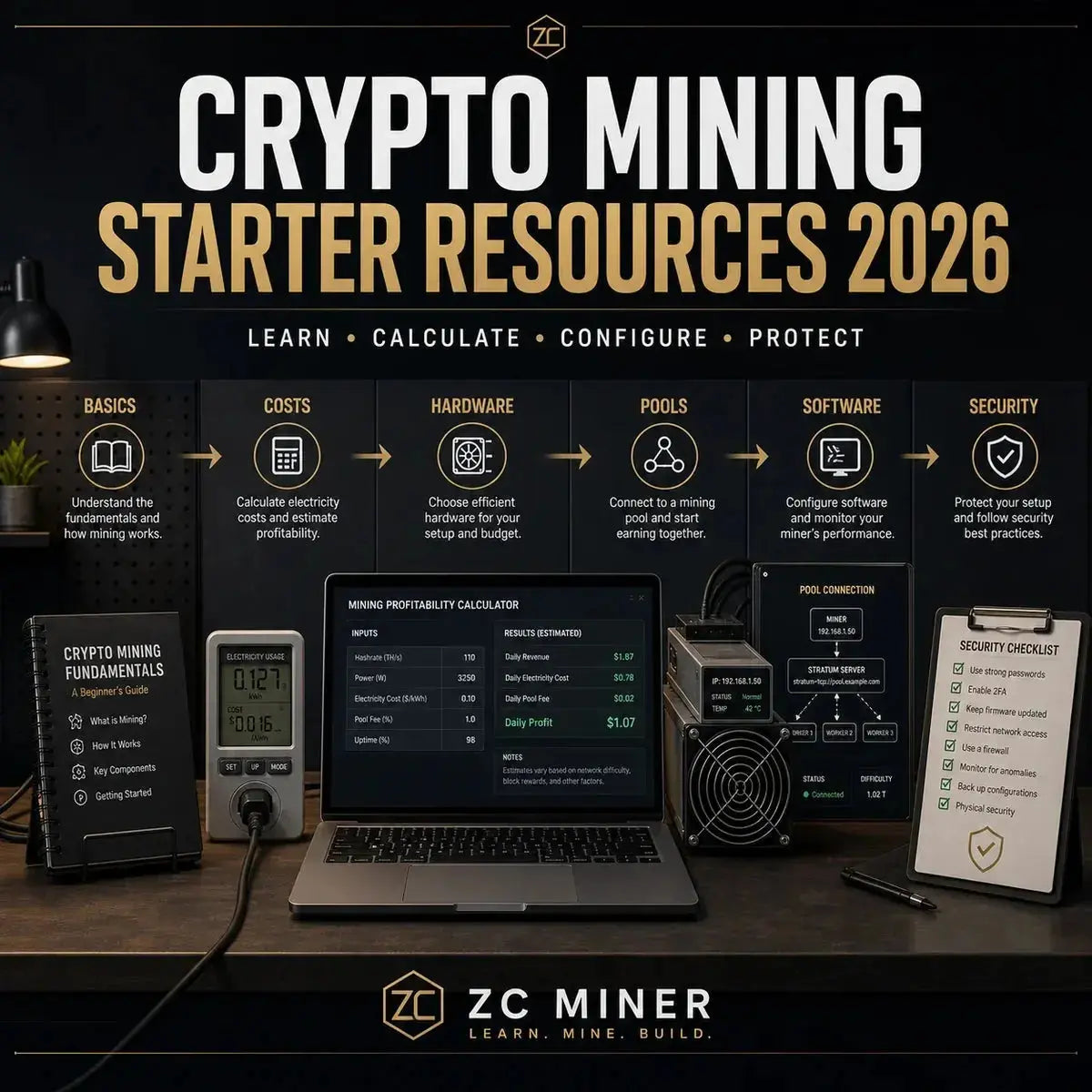
The best beginner mining resource is not a list of machines. It is a sequence that prevents expensive mistakes: understand proof of work, identify the algorithm, measure electricity cost and circuit capacity, model revenue conservatively, verify hardware specifications, select a transparent pool, install official software, and monitor accepted work after deployment.
The earlier version of this page mixed 2025 hardware models, wallets, mining programs, pools, calculators, and power cables without explaining when each tool should be used. Some recommendations also implied that software could increase hashrate while reducing power by itself, or that mining was a way to profit without investing. Neither is a safe assumption. Mining requires capital, electricity, cooling, network access, maintenance, and exposure to changing difficulty and coin prices.
Do not buy hardware because a calculator shows today's positive number. First run a low-price, higher-difficulty, lower-uptime scenario and confirm that your electrical and cooling setup can operate the device safely.
2Best Resources for Learning Mining Basics
Begin with material that explains blocks, proof of work, difficulty, rewards, shares, pools, and wallets without promising income. Our cryptocurrency mining beginner guide provides a plain-language foundation. For Bitcoin's technical workflow, the Bitcoin Developer Guide explains how solo and pooled mining construct work and how shares represent contributed hashing effort.
Bitcoin Developer Guide
Use it to understand blocks, targets, solo mining, pooled mining, GetBlockTemplate, and Stratum. It is technical reference material, not a profitability promise.
Official Project Documentation
Read the network's own algorithm, wallet, node, emission, and pool documentation before using third-party tutorials. Protocol rules change faster than generic list articles.
ZC Miner Mining Guides
Use coin- and hardware-specific guides for voltage, noise, cooling, firmware, pool endpoints, and deployment checks after learning the core concepts.
Bitcoin Stack Exchange
Search existing evidence-based answers before asking. Prefer reproducible logs, exact software versions, and official documentation over anonymous chat advice.
3Mining Calculators: Useful Inputs, Not Forecasts
WhatToMine, NiceHash's profitability calculator, and Minerstat can help compare algorithms and estimate revenue. Their result is only as good as the inputs and assumptions. Enter measured wall power rather than a marketing specification whenever possible, include pool fees and downtime, and separate revenue from profit.
Daily electricity cost = power in kW × 24 × electricity rate. A 3.2 kW miner at $0.10/kWh costs $7.68 per day before cooling, ventilation, networking, maintenance, and financing. Our crypto mining profitability guide explains the full calculation.
| Resource | Best Use | Required Input | Main Limitation |
|---|---|---|---|
| WhatToMine | Compare GPU and multi-algorithm opportunities | Hashrate, watts, electricity rate | Defaults and exchange assumptions may not match your hardware or liquidity |
| NiceHash Calculator | Estimate earnings when selling hashrate through NiceHash | Recognized hardware or manual performance | Marketplace earnings are not identical to directly mining a coin |
| Minerstat Calculator | Compare coins, pools, and hardware profiles | Hashrate, consumption, costs, fees | Modeled values change with network and market data |
| Your Spreadsheet | Build low, base, and high scenarios | Purchase cost, measured power, uptime, fees, repairs | Requires disciplined updates and realistic assumptions |
4Hardware Research Resources
Match the miner to the algorithm before comparing hashrate. SHA-256 hardware cannot be redirected to Scrypt, KHeavyHash, Equihash, Blake3, or Aleo proving work. For each candidate, verify the model on the manufacturer's product or support page, then cross-check independent pool-side results and the seller's exact included components.
- Specification sheet: algorithm, nominal hashrate, power, efficiency, input voltage, dimensions, weight, temperature limits, and cooling type.
- Electrical plan: wall voltage, plug, PDU, breaker capacity, continuous-load headroom, cable rating, and local electrical requirements.
- Environmental fit: sound level, heat output, airflow direction, dust, humidity, water requirements for hydro units, and exhaust path.
- Commercial checks: condition, warranty, PSU inclusion, shipping terms, duties, repair access, firmware support, and return policy.
A beginner usually learns more from one stable, measurable unit than from buying the highest-hashrate machine available. Home deployments should prioritize electrical compatibility, noise, and heat before raw output.
5How to Research a Mining Pool
Pooled mining reduces payout variance by sharing rewards in proportion to contributed work. Pool names and market share change, so this guide does not declare one permanent winner. Use official pool documentation and compare payout method, fee, minimum payout, supported algorithm, server regions, Stratum details, security, status history, and support quality.
Braiins Academy provides unusually clear documentation for Bitcoin pool setup, rewards, payouts, and firmware. F2Pool publishes coin-specific setup pages across multiple proof-of-work networks. These are useful examples of what transparent documentation should look like, not endorsements or guarantees. For pool economics and centralization tradeoffs, read our Bitcoin mining pool comparison and solo mining versus pool mining guide.
Copy pool URLs from the pool's official setup page. Confirm the coin, region, port, payout address, worker format, and TLS support where available. A convincing message in Telegram or Discord is not an authoritative endpoint.
6Mining Software and Monitoring Resources
Many modern ASICs include a manufacturer web interface and do not need a beginner to install CGMiner manually. CGMiner remains important historically and technically, but unofficial binaries and old forks create risk. Use the device manufacturer's current firmware, signed releases, or a reputable third-party firmware that explicitly supports the exact model and offers a recovery path.
Farm-management platforms such as Minerstat, Hiveon OS, and Braiins tools can centralize alerts, configuration, and performance data. They do not remove the need to verify pool-side accepted work. Our updated Bitcoin mining software guide separates firmware, pool software, monitoring, operating systems, and solo-mining tools.
- Track both sides: compare the miner dashboard with pool hashrate and accepted/rejected work.
- Alert on operations: temperature, fan or pump status, zero hashrate, rejected shares, power loss, and network loss.
- Record versions: firmware, pool endpoint, settings, and change date make troubleshooting reproducible.
- Back up safely: save configurations without exposing wallet secrets, passwords, or remote-access credentials.
7Security, Firmware, Wallet, and Electrical Safety
Mining equipment is an always-on networked appliance connected to valuable payout infrastructure and a high continuous electrical load. Change default passwords, isolate miners from personal devices, restrict remote administration, update through verified sources, and avoid exposing management pages directly to the internet. Never send a seed phrase or private key to a pool, firmware vendor, support agent, or calculator.
Use a payout address you control and verify the full address after any firmware or configuration change. For electrical work, use a qualified electrician and equipment rated for the actual continuous load. A surge-protected extension cable is not a substitute for correct circuit, breaker, receptacle, cable, grounding, and PDU design.
Do not install mining software from sponsored download ads, random file mirrors, chat attachments, or videos that hide the destination URL. Avoid cloud-mining contracts and “AI profit switching” offers that guarantee returns or demand crypto deposits before showing verifiable infrastructure and contract terms.
8Community Resources Without the Noise
Community help is valuable when it is evidence-based. Start with official documentation, issue trackers, release notes, pool status pages, and searchable technical forums. Bitcoin Stack Exchange is useful for protocol and node questions; GitHub issues can reveal known software problems; manufacturer and pool support channels can confirm model-specific steps.
When asking for help, share the model, firmware version, algorithm, pool region, error message, temperatures, rejected-share rate, and steps already tried. Remove wallet addresses, IP addresses, serial numbers, order details, and credentials. Never grant remote access to an unknown helper.
9A Safe Beginner Mining Workflow
- Read a proof-of-work and pool-mining overview.
- Choose one coin or algorithm and confirm compatible hardware.
- Measure electricity price and confirm the circuit and cooling plan.
- Build low, base, and high scenarios with current calculator data.
- Verify specifications, included accessories, condition, warranty, and seller terms.
- Create a secure wallet or payout address appropriate for the coin.
- Select a documented pool and copy its official endpoint.
- Install only verified firmware, change credentials, and isolate the device network.
- Run a 24- to 72-hour stability test and compare local data with pool results.
- Record daily electricity, accepted work, downtime, fees, and actual payouts before scaling.
10Beginner Mining Resources FAQ
What is the first tool a beginner miner needs?
A measured electricity rate and a realistic profitability spreadsheet are more useful than buying hardware first. They reveal whether the project can work at your location.
Which mining calculator is most accurate?
No calculator predicts future profit accurately. Compare more than one tool, replace defaults with measured hashrate and watts, include every cost, and test adverse scenarios.
Do ASIC miners need separate mining software?
Most current ASICs include firmware and a web interface. You generally configure a pool, wallet or worker, network, and operating settings rather than installing desktop mining software.
Should a beginner use solo mining or a pool?
A pool usually provides lower payout variance. Solo mining may have extremely long and unpredictable intervals between rewards, especially when a miner controls a tiny share of network hashrate.
Are cloud-mining platforms beginner friendly?
They may look simple but add counterparty, contract, fee, custody, and fraud risk. Beginners should not treat promised cloud-mining returns as equivalent to operating verifiable hardware.
11Reviewed Resources
These established or primary resources were reviewed before inclusion. External links open in a new tab and are marked nofollow.
- Bitcoin Developer Guide: MiningTechnical explanation of solo mining, pooled mining, shares, GetBlockTemplate, and Stratum.
- Braiins AcademyCurrent Bitcoin mining documentation covering pool setup, rewards, payouts, firmware, and farm management.
- F2Pool Mining SupportCoin-specific pool configuration and operational documentation.
- WhatToMine CalculatorMulti-algorithm calculator for comparing hashrate, power, electricity, and modeled revenue.
- NiceHash Profitability CalculatorHardware and hashrate-marketplace earnings estimates.
- Minerstat Mining CalculatorMining calculator with hardware, coin, pool, and cost comparisons.
- CGMiner Official RepositoryPrimary source repository and documentation for the established open-source mining program.
- Bitcoin Stack ExchangeSearchable technical question-and-answer community recommended by Bitcoin developer documentation.
Final Recommendation
A beginner needs a verified workflow, not the longest resource list. Learn the protocol, calculate with measured inputs, match hardware to the algorithm and electrical site, use official pool and firmware documentation, then monitor accepted work and actual cost.
Resources should help you test assumptions. They should never replace due diligence or turn a changing network into a fixed profit promise. Start with one controlled deployment, record results, and scale only after the data matches the plan.




Leave a comment
This site is protected by hCaptcha and the hCaptcha Privacy Policy and Terms of Service apply.