
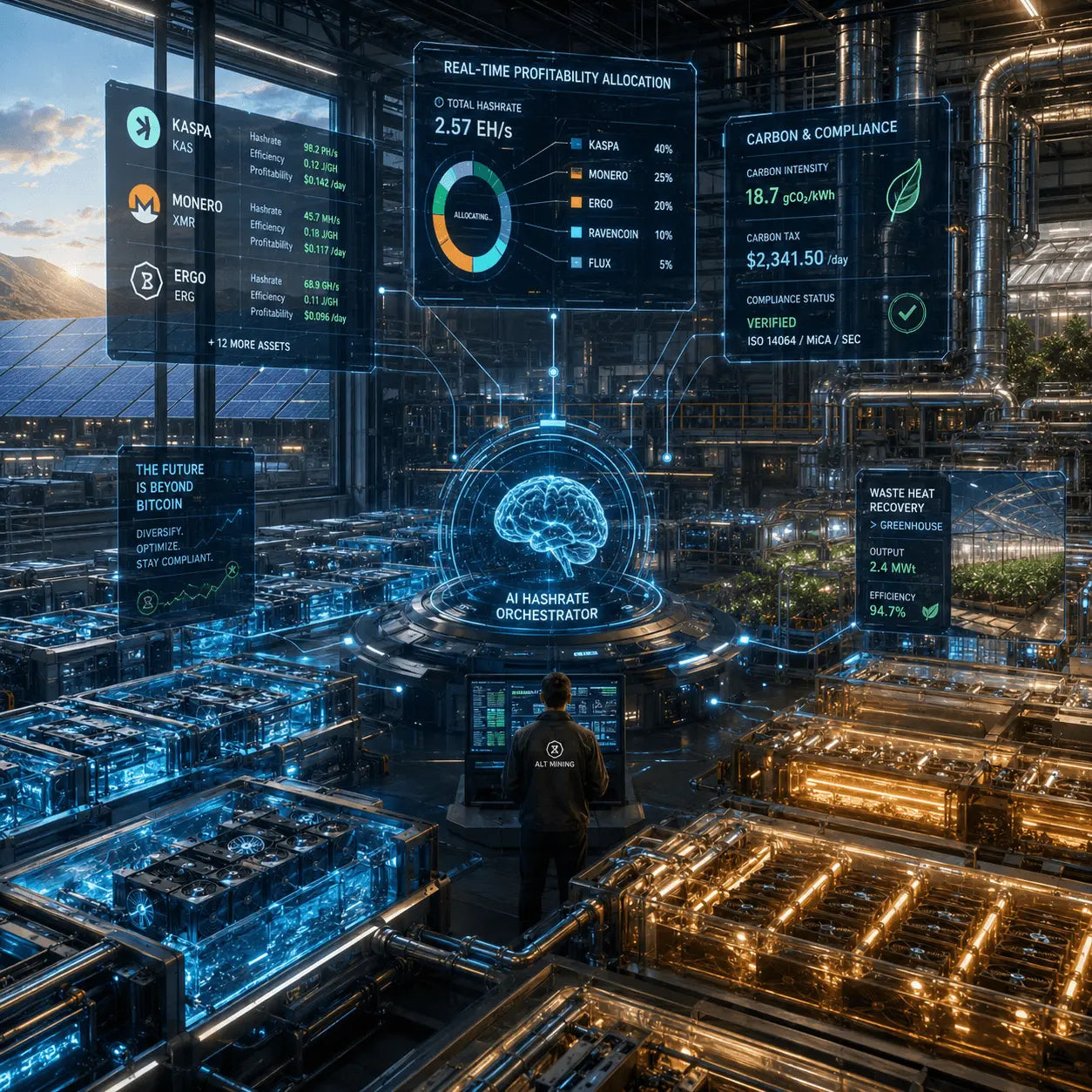
In 2026, why should miners seriously consider altcoins instead of sticking with Bitcoin?
Core conclusion: Because the marginal returns of Bitcoin mining have dropped to historic lows, while the altcoin ecosystem offers a triple strategic value of diversified revenue, network governance rights, and compliant operations.
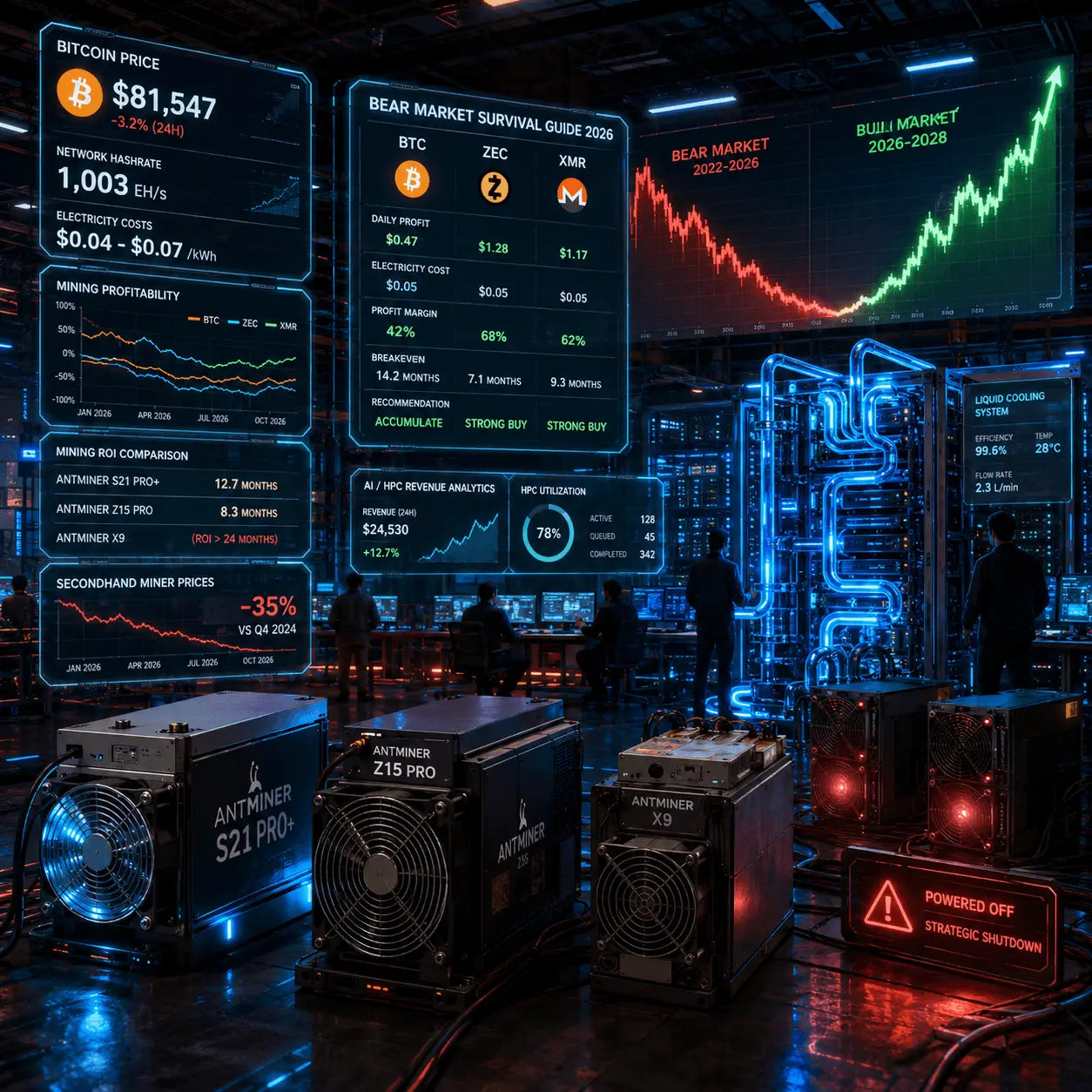
In early 2026, Bitcoin's network hashrate surpassed 1 ZH/s (Zettahash per second), yet the block reward remains at 3.125 BTC following the fourth halving in 2024. This has pushed the breakeven production cost to approximately $80,000/BTC. In contrast, altcoin mining has evolved into a highly segmented, technology-driven industry fully integrated with global compliance frameworks. Three specific advantages stand out. First, the hardware ecosystem has reached extreme maturity, with specialized ASICs and high-performance GPUs forming a complementary defense matrix. Second, global regulatory environments are increasingly clear; projects like Ergo (ERG) and Kaspa (KAS) have established robust compliance frameworks, providing legal safe harbors for commercial operations. Third, the function of mining itself has fundamentally transformed—hashrate now directly translates into network governance power, allowing miners to participate in protocol upgrades, fee structures, and development funding decisions.
What are the mainstream altcoin mining algorithms in 2026, and how should miners choose corresponding hardware?
Core conclusion: The 2026 algorithm ecosystem is highly differentiated; miners must precisely match their electricity costs and compliance capabilities to core algorithms such as RandomX, GHOSTDAG, and Autolykos v3.
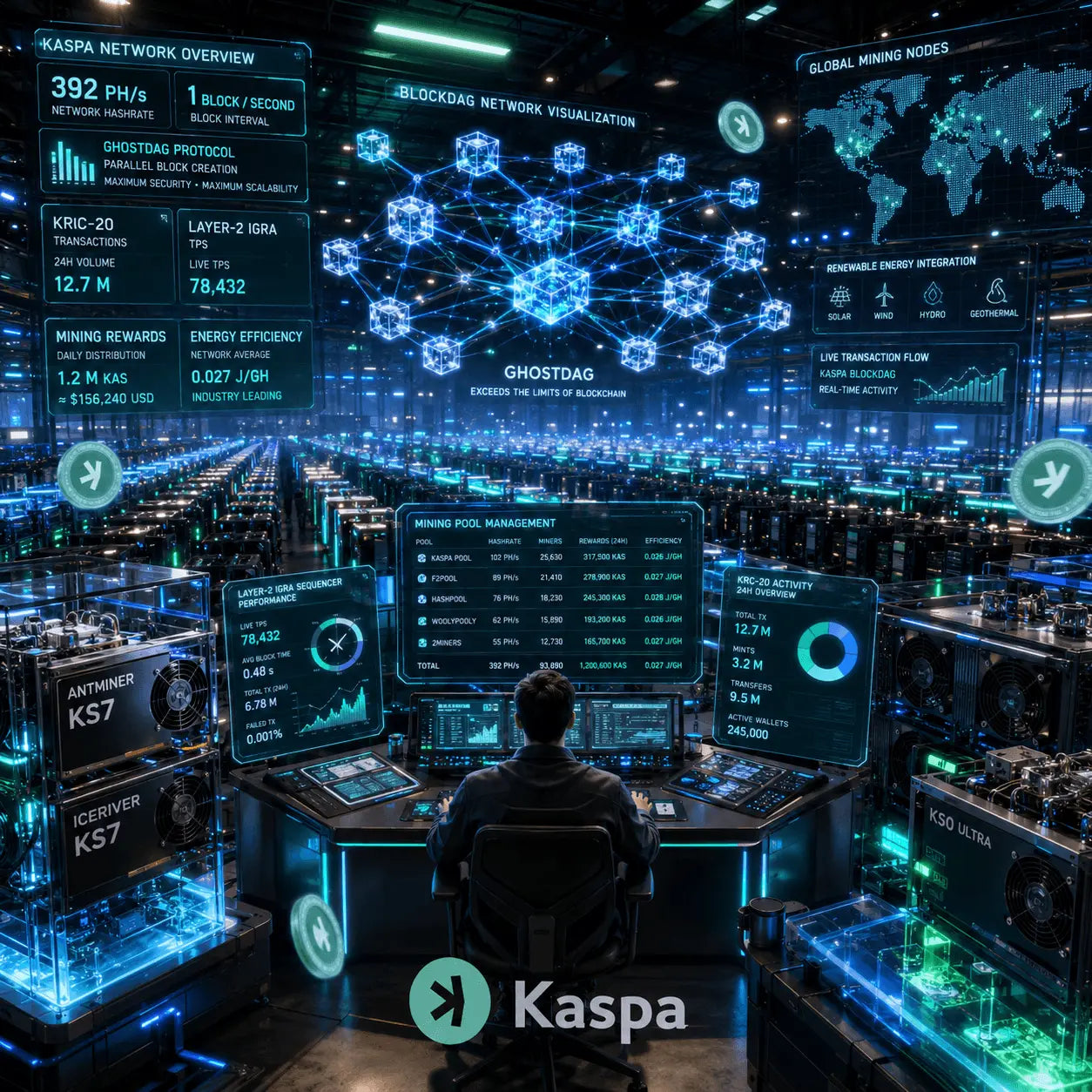
RandomX v2.0 (Monero) has been optimized for DDR5 memory bandwidth and Zen5 architecture processor vector instructions, incorporating quantum-resistant variants. It is best suited for high-performance desktop CPUs such as the AMD Ryzen 9 9950X. GHOSTDAG (Kaspa) uses a revolutionary blockDAG protocol to achieve 10 blocks per second (10 BPS) throughput, eliminating the wasted orphan blocks of traditional linear chains. It requires dedicated ASICs like the Antminer KS5 Pro (21 TH/s, 3150W) for optimal efficiency. Autolykos v3 (Ergo) maintains GPU-friendliness while significantly improving energy efficiency. The RTX 5090, with its 32GB GDDR7 memory and approximately 1.8 TB/s memory bandwidth, dominates this algorithm as well as other memory-hard algorithms. For operations balancing flexibility and stability, a "three-layer pyramid" hybrid strategy has proven most effective: 60% dedicated ASICs for high-liquidity coins to provide cash flow, 30% high-performance GPU arrays for switching to emerging algorithms amid market volatility, and 10% R&D equipment (such as FPGAs) to track projects still in testnet phases.
What is the real profitability model for altcoin mining in 2026? How do electricity costs and compliance costs factor in?
Core conclusion: Simple "hashrate calculators" are completely obsolete. In 2026, miners must build comprehensive financial models that incorporate energy costs, carbon taxes, equipment depreciation, and hashrate derivatives.
Electricity cost remains the first red line, but the real difference lies in the introduction of the "carbon footprint tax." In the EU and parts of North America, miners must submit energy reports based on CO₂ emissions per megawatt-hour. Even if a region appears to offer attractive power at $0.08/kWh from coal, potential Carbon Border Adjustment Mechanism (CBAM) costs can push the actual operating cost above $0.12/kWh.The 2026 profit function can be expressed as: Profit = Σ(Hashrate × Pool efficiency factor × Token value) − (Power draw × Time × Electricity price) − Carbon compliance cost − Hardware depreciation and maintenance. Taking Kaspa as an example, its network difficulty adjusts every 10 seconds. If the hashrate growth rate exceeds the token price increase by 30%, equipment depreciation accelerates exponentially. Top miners therefore establish a "mandatory shutdown point"—when the hashprice (USD revenue per unit of hashrate) falls below a critical threshold, they cut power or migrate to other coins rather than waiting blindly for a rebound.
How do cooling technology and hardware depreciation affect return on investment cycles in 2026?
Core conclusion: In 2026, medium and large mining farms have completely phased out traditional air cooling. Immersion cooling not only reduces cooling energy consumption by 90–95% but also extends equipment lifespan to more than seven years.
Real-world data shows immersion cooling allows ASIC miners to safely overclock by 15–30% while maintaining core temperatures below 40°C. Although the initial construction cost is approximately 700 per kW, the return on investment cycle is typically only 12–18 months when accounting for reduced failure rates, extended equipment life, and the ability to sell waste heat for greenhouse heating or district heating—turning residual heat into a sellable asset. In contrast, traditional air cooling has an ROI cycle of 24–36 months and an average equipment lifespan of only 3.5 years. One important caution: due to geopolitical factors in 2026, core chip supplies (such as TSMC 2nm/3nm) may experience shortages. Miners should not only pursue the latest models but also stock sufficient consumable parts (cooling pumps, high-voltage power modules) and learn basic ASIC repair skills.
How has the mining pool ecosystem changed in 2026, and what value-added services do pools offer?
Core conclusion: Mining pools in 2026 are no longer simple accounting intermediaries. They have transformed into full-service mining financial centers offering tax compliance, automatic coin conversion, and hashrate derivatives.
Due to increased AML and tax transparency requirements, top-tier pools like Foundry USA, Ethermine, and SupportXMR now offer built-in "compliance filters." Miners can export asset movement reports that comply with local financial standards with one click, have estimated taxes automatically deducted, or directly convert mined altcoins into regulated stablecoins (such as USDC) to hedge against market volatility. This "auto-conversion" feature protects at least 15% of net profits on average in the volatile 2026 market. Additionally, specialized platforms like Luxor have widely promoted hashrate derivative contracts. Miners can sell hashrate forward contracts to lock in future earnings before token prices peak, thereby transforming themselves from "gamblers" into "risk managers."
Which regions are most suitable for altcoin mining in 2026, and what are the compliance requirements?
Core conclusion: The UAE, with its inexpensive natural gas and solar power combined with a highly open regulatory sandbox, has become the world's fastest-growing region for hashrate, while the US and EU have incorporated mining into strict compliance frameworks through the GENIUS Act and MiCA respectively.
In the US, the GENIUS Act of 2025 clarifies that qualifying PoW assets are not securities, attracting substantial institutional capital to domestic mining farms. However, miners must connect to regulated utility grids and submit quarterly energy reports. The EU's MiCA framework enters full enforcement in July 2026; all mining farms operating within the EU must hold a CASP (Crypto Asset Service Provider) license and publicly disclose their carbon neutrality roadmap. Electricity costs in the EU average $0.18/kWh, making compliance the most stringent globally. The UAE (particularly Dubai) offers low electricity costs at $0.05/kWh and free zone licensing, making it a top choice for commercial mining farms. Other regions such as Canada ($0.07/kWh, focused on heat recovery and ecological footprint) and Kazakhstan ($0.09/kWh, strict quota system) each have their own characteristics.
However, all require miners to first verify “energy access permits” and local registration requirements before investing in hardware.
How does one start altcoin mining in 2026? Is there a clear practical roadmap?
Core conclusion: A systematic four-phase deployment strategy—compliance first, hybrid hardware, modern software, and utility focus—is the key to success for 2026 miners.
Phase 1: Compliance first and site selection. Before purchasing any hardware, verify local regulatory requirements and "energy access permits." Many power grids no longer accept new cryptocurrency mining connections unless miners can prove 100% of their energy comes from off-grid surplus sources (such as methane capture or remote small-scale hydroelectric power). Phase 2: Hybrid hardware strategy, specifically the "60% ASIC + 30% GPU + 10% R&D equipment" pyramid structure described earlier. Phase 3: Modern management software. 2026-era management systems (such as HiveOS 2026 or SimpleMining Pro) deeply integrate "compliance filters." They can automatically balance mining frequencies based on real-time spot prices, difficulty predictions, local time-of-use electricity rates, and daily carbon allowance quotas. If electricity prices spike at 2:00 PM due to peak demand, the system automatically enters "eco mode," reducing power draw to 40% to protect profits from being consumed by electricity costs. Phase 4: Focus on real utility and network governance. Prioritize coins with proven real-world applications—Kaspa's enterprise adoption for supply chain tracking determines its long-term transaction fee revenue, Ergo's DeFi TVL influences hashrate flows, and Monero's privacy features hold scarcity value in an increasingly transparent regulatory world.
What are the biggest "hidden killers" in altcoin mining, and how can risk management be implemented?
Core conclusion: Altcoin mining in 2026 faces three hidden killers—extreme pressure from dynamic difficulty, fragmentation of hardware supply chains, and infrastructure mismatches when shifting from mining to AI compute rentals.
First, for networks with extremely fast difficulty adjustment like Kaspa, if hashrate growth exceeds token price growth by 30%, equipment depreciation accelerates exponentially. Miners must establish and strictly enforce a "mandatory shutdown point." Second, due to geopolitical factors in 2026, core chip supplies may see shortages. Miners should not only stock sufficient consumable parts (cooling pumps, power modules) but also learn basic ASIC repair skills to cope with long hardware return-to-factory lead times. Third, although shifting hashrate from mining to AI inference (HPC) appears to be a safe transition, AI computing has much higher demands for network bandwidth, latency, and VRAM stability than mining. Many farms that failed to transition in 2026 did so precisely because their underlying network infrastructure could not meet AI clients' SLA requirements, leaving hardware idle for extended periods. Before considering such a transition, miners must first assess whether their network bandwidth and latency meet the required standards.
What is the future direction of altcoin mining beyond 2026?
Core conclusion: Altcoin mining will accelerate in four directions—regulatory standardization, AI-optimized scheduling, quantum-resistant protocols, and cross-chain mining.
First, regulatory integration: standardized compliance frameworks across major jurisdictions will reduce cross-border operating costs for miners. Second, AI-optimized mining: machine learning algorithms will predict optimal coin selection in real time based on market conditions, regulatory changes, and energy prices, enabling automatic strategy switching. Third, widespread adoption of quantum-resistant protocols: RandomX v2.0 has already taken the first step, and next-generation altcoins will generally integrate post-quantum cryptography to counter potential quantum computing threats. Fourth, cross-chain mining protocols: allowing miners to contribute hashrate to multiple blockchain networks simultaneously, further improving utilization efficiency. Kaspa's GHOSTDAG protocol has already achieved enterprise adoption in supply chain management, while Ergo's DeFi ecosystem now processes over $2 billion in monthly transactions—both demonstrating that altcoin mining is not speculative but a value-creating activity deeply integrated into the real global economy.




Leave a comment
This site is protected by hCaptcha and the hCaptcha Privacy Policy and Terms of Service apply.