
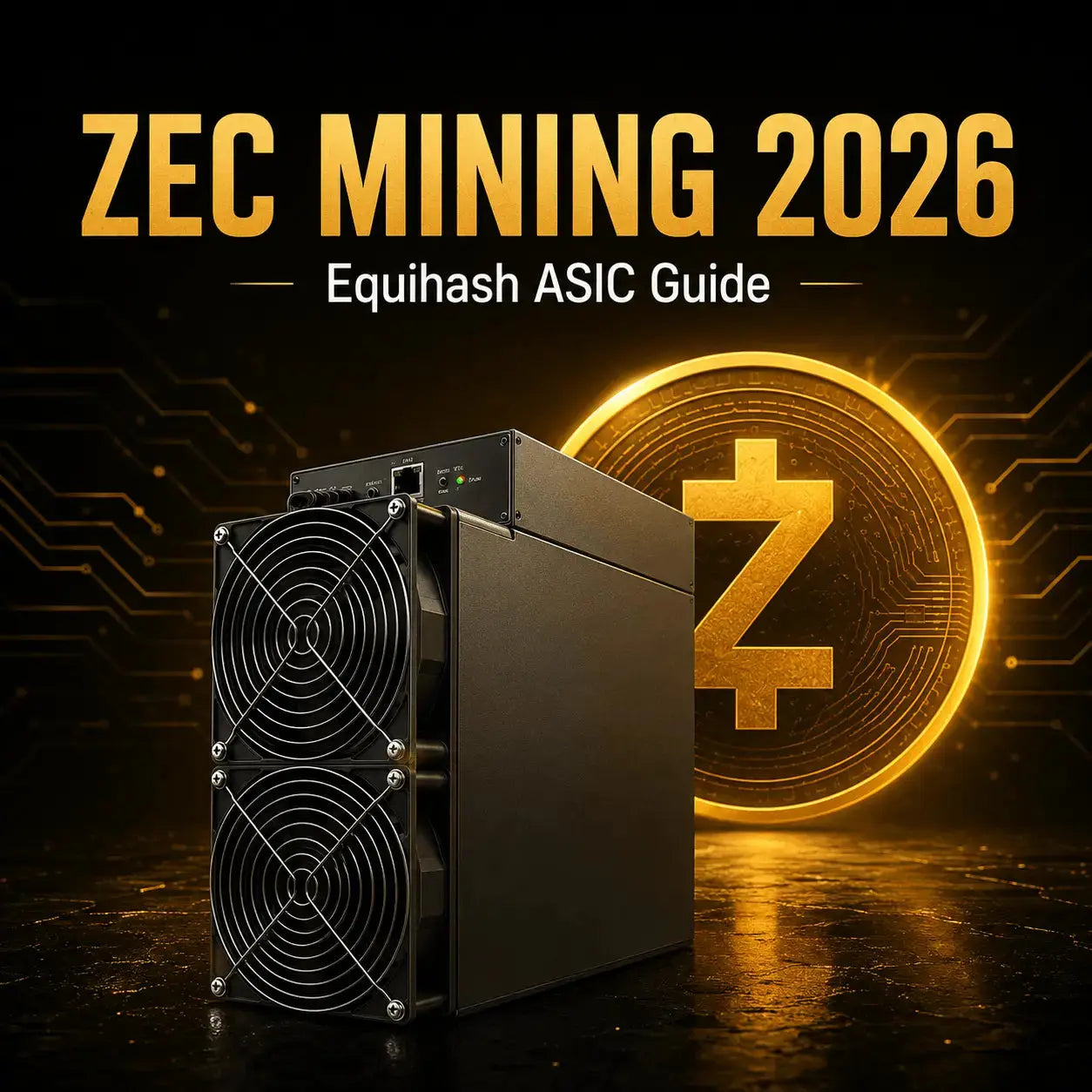
ZEC Mining in 2026:
When Equihash ASICs Make Sense
Zcash mining economics · Equihash ASIC comparison · Electricity cost framework · Halving-aware ROI planning
1ZEC Mining in 2026: The Core Decision
Zcash (ZEC) remains one of the most recognizable Proof-of-Work privacy coins. It was built from Bitcoin's codebase, but added optional shielded transactions so users can protect financial information when privacy matters. For miners, the practical question is not whether Zcash is interesting; it is whether ZEC mining still offers a rational operating window in 2026.
The answer depends on four inputs: electricity rate, hardware efficiency, infrastructure readiness, and ZEC market conditions. Zcash uses Equihash (200,9), produces blocks roughly every 75 seconds, and currently operates after the November 2024 halving, when the block reward fell from 3.125 ZEC to 1.5625 ZEC. That gives miners a defined planning window before the next expected reward cut around 2028.
After the 2024 halving, miners still receive the largest share of each block reward. This keeps hashrate incentives meaningful, but it also means ROI models must account for ZEC price, network difficulty, and the remaining time before the next halving.
2How ZEC Mining Economics Work
ZEC mining revenue is shaped by block rewards, network difficulty, pool performance, hardware efficiency, and coin price. The miner's controllable side is narrower: power cost, uptime, cooling, pool selection, and hardware purchase price. A profitable setup usually starts with cheap electricity, but it survives because the operator keeps downtime and heat under control.
This is why a ZEC mining plan should be built around net profit, not daily gross revenue. Gross output can look attractive while real margins shrink after electricity, fees, rejects, cooling overhead, repair risk, and market slippage.
3Why Equihash ASICs Replaced GPU Mining
Zcash originally used Equihash as a memory-hard algorithm that was intended to be more GPU-friendly than many older mining algorithms. Over time, dedicated Equihash ASICs became the dominant hardware class. In practical 2026 mining terms, GPUs are no longer the competitive path for ZEC mining at scale.
The important point for buyers is algorithm stability. The Zcash community previously considered ASIC resistance and did not move the network away from ASICs. That reduces one major hardware risk: buying an Equihash ASIC is less likely to be invalidated by a sudden algorithm fork than in ecosystems that frequently change mining algorithms.
Representative Equihash ASICs
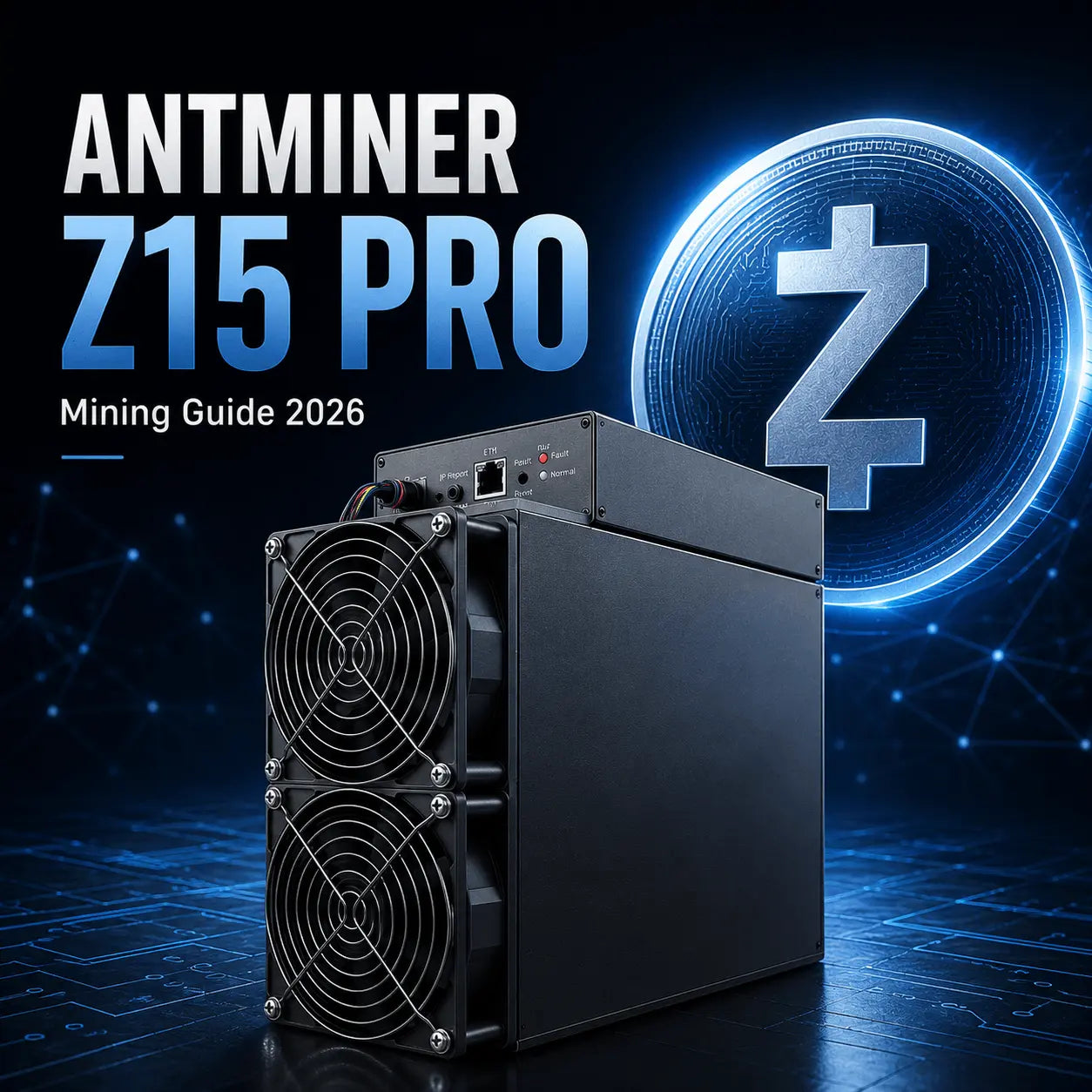
The Antminer Z15 and Z15 Pro are useful benchmarks for understanding the current Equihash ASIC landscape. This comparison is included to support mining planning, while the main focus remains the broader ZEC mining decision.
| Specification | Antminer Z15 | Antminer Z15 Pro |
|---|---|---|
| Algorithm | Equihash (200,9) | Equihash (200,9) |
| Maximum Hashrate | 420 kSol/s | 840 kSol/s |
| Power Consumption | About 1,510 W | About 2,780 W |
| Energy Efficiency | About 3.60 J/kSol | About 3.31 J/kSol |
| Chip Node | 7nm class | 7nm class |
| Noise Profile | About 70 dB | About 72-75 dB |
| Cooling | Dual fan | Dual fan push-pull airflow |
| Typical Use Case | Lower-entry-cost Equihash mining | Higher-output ZEC mining operation |
| Mineable Assets | ZEC, ZEN, and other Equihash coins | ZEC, ZEN, and other Equihash coins |
The Z15 Pro doubles the hashrate of the Z15 while improving efficiency per kSol. For operators with adequate power and cooling, that makes the Pro the cleaner choice for serious ZEC mining. For budget-sensitive buyers, the standard Z15 only makes sense if the purchase price is low enough to offset weaker output.
4Electricity Cost and Profitability Scenarios
Electricity rate is the first number to test before buying any Equihash ASIC. A Z15 Pro drawing about 2,780W uses roughly 66.72 kWh per day. That means a small difference in power price can change daily net profit materially.
| Electricity Rate | Daily Power Cost | Illustrative Gross Revenue | Illustrative Net Profit | Operating View |
|---|---|---|---|---|
| $0.05/kWh | $3.34 | About $39.88 | About $36.54 | Excellent |
| $0.07/kWh | $4.67 | About $39.88 | About $35.21 | Strong |
| $0.10/kWh | $6.67 | About $39.88 | About $33.21 | Viable |
| $0.15/kWh | $10.01 | About $39.88 | About $29.87 | Monitor |
| $0.20/kWh | $13.34 | About $39.88 | About $26.54 | Higher Risk |
Figures are scenario examples based on the source article's June 2026 assumptions. Always replace them with live calculator data before purchasing hardware.
Net Profit Formula for ZEC ASIC Buyers
- Gross revenue/day = ZEC mined/day x ZEC market price
- Power cost/day = miner kW x 24 x electricity rate
- Net/day = gross revenue - electricity - pool fees - downtime - maintenance overhead
- Payback window = total landed hardware cost / net daily profit
Do not buy based on one calculator screenshot. Re-run the model with current ZEC price, current network difficulty, your real electricity contract, pool fee, hosting cost, taxes, shipping, and expected downtime.
5The Zcash Halving Timeline and 2028 Planning Window
Zcash has already completed two major halvings. The second occurred on November 23, 2024 at block 2,726,400, reducing the block reward from 3.125 ZEC to 1.5625 ZEC. The next expected halving around 2028 will reduce issuance again.
This matters because miners entering in 2026 are buying into a limited reward window. If your projected ROI is less than a year under conservative assumptions, the timing may be workable. If your payback model stretches close to the next halving, risk increases sharply.
| Event | Date | Block Height | Reward After Event |
|---|---|---|---|
| Launch | October 2016 | Genesis | 12.5 ZEC |
| Blossom Upgrade | December 2019 | 653,600 | 6.25 ZEC equivalent cadence |
| First Halving | November 18, 2020 | 1,046,400 | 3.125 ZEC |
| Second Halving | November 23, 2024 | 2,726,400 | 1.5625 ZEC |
| Third Halving | Expected around 2028 | About 4,406,400 | 0.78125 ZEC |
6Operator Fit: Who Should Mine ZEC in 2026?
ZEC mining can be attractive, but it is not casual home mining. The Z15 Pro uses nearly three kilowatts, produces meaningful heat, and runs at industrial noise levels. The strongest buyers are operators who already understand power, airflow, uptime, and mining risk.
A Z15 Pro is not a small plug-and-forget device. At about 2,780W and 72-75 dB, it needs suitable circuit capacity, ventilation, heat management, and a location where continuous fan noise is acceptable.
7Pool Mining vs Solo Mining for ZEC
For most individual miners, pool mining is the practical choice. Solo mining can avoid pool fees, but payout variance is too high unless an operator controls substantial hashrate. Pool mining smooths that variance into more predictable payouts.
When comparing ZEC pools, focus on payout model, pool fee, server location, minimum payout threshold, reliability, and historical hashrate share. The best pool for one miner is not always the best pool for another if latency or payout policy differs.
| Factor | Solo Mining | Pool Mining |
|---|---|---|
| Income Consistency | Highly variable and block-dependent | Smoother daily or periodic payouts |
| Fees | No pool fee | Usually a small percentage fee |
| Minimum Viable Hashrate | Best for large multi-machine operations | Practical even for a single ASIC |
| Setup Complexity | Higher; node and solo setup required | Lower; configure stratum URL and wallet |
| Best Fit | Large farms with variance tolerance | Most individual and small-scale miners |
8Risk Checklist Before Buying Hardware
A good ZEC mining plan should survive weaker assumptions. Before buying hardware, stress-test the model against price drops, difficulty increases, delivery delays, higher heat loads, and less-than-perfect uptime.
- ZEC price risk: revenue can fall quickly if coin price weakens.
- Difficulty risk: more network hashrate reduces coins mined per machine.
- Infrastructure risk: insufficient airflow, circuit capacity, or sound control can make operation impractical.
- Hardware price risk: overpaying extends payback and reduces flexibility.
- Pool and uptime risk: rejected shares, unstable connections, and downtime reduce real income.
- Halving risk: the 2028 reward cut should be part of every payback model.
If the model only looks good with optimistic ZEC price, perfect uptime, and low difficulty growth, the setup is probably too fragile. A healthier plan still works under conservative assumptions.
9FAQ: ZEC Mining, Equihash ASICs, and ROI
Is ZEC mining profitable in 2026?
ZEC mining can be profitable for miners with efficient Equihash ASICs, low electricity rates, and suitable infrastructure. Profitability changes with ZEC price, difficulty, fees, and uptime.
What is the best ZEC miner in 2026?
The Antminer Z15 Pro is a leading Equihash ASIC option because it offers 840 kSol/s and better efficiency than the standard Z15.
Can I mine ZEC with GPUs?
GPU mining is generally not competitive for ZEC in 2026 because dedicated Equihash ASICs dominate hashrate and efficiency.
How much electricity does a Z15 Pro use?
A Z15 Pro uses about 2,780W, or roughly 66.72 kWh per day if it runs continuously for 24 hours.
Should I solo mine ZEC or join a pool?
Most miners should join a pool because pool mining reduces payout variance and is easier to operate than solo mining.
When is the next Zcash halving?
The next Zcash halving is expected around 2028, when the block reward is projected to drop from 1.5625 ZEC to 0.78125 ZEC.
Is Z15 Pro suitable for home mining?
It can be used in a prepared home or garage setup, but it is not suitable for normal living spaces because of high power draw, heat, and 72-75 dB noise levels.
Decision Framework
ZEC mining in 2026 can make sense when three conditions line up: electricity is affordable, infrastructure is ready for high-power ASIC operation, and the payback model remains reasonable before the expected 2028 halving. The hardware choice matters, but it is only one part of the decision.
The best candidates are miners with low-cost power, proper cooling, sound control, and a habit of updating profitability assumptions with live market data. Casual home miners, high-tariff regions, and buyers relying on best-case ROI numbers should be more cautious.
Treat ZEC mining as an operating business with variable returns, not as a fixed-payback product. Recalculate often, protect uptime, and size the hardware purchase so a weaker market does not break the plan.


Leave a comment
This site is protected by hCaptcha and the hCaptcha Privacy Policy and Terms of Service apply.