
Zcash Mining Security in 2026:
Orchard Fix and Risk Guide
Equihash mining · Orchard vulnerability · NU6.2 remediation · node compatibility · operational security
1Zcash Mining in 2026: Start With the System
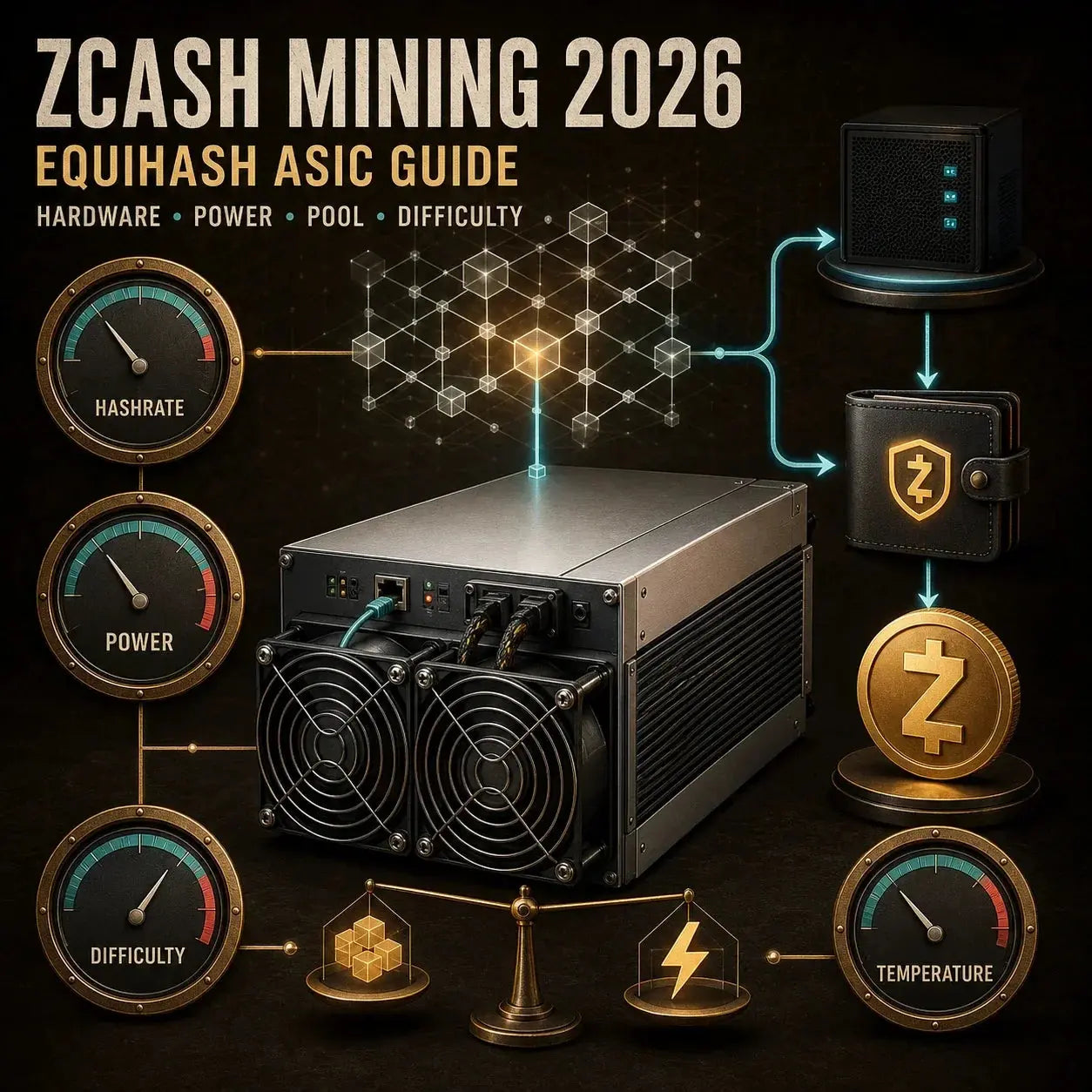
Zcash remains a Proof-of-Work network secured by Equihash miners. Specialized ASIC hardware performs the hashing work, pools aggregate shares, full nodes validate blocks, and wallets receive payouts. A profitable operation therefore depends on more than hashrate. Electricity, uptime, pool reliability, wallet security, software compatibility, network difficulty, and the market value of ZEC all sit in the same operating chain.
This matters because the 2026 Orchard incident did not damage an ASIC or change how an Equihash chip computes work. It exposed a flaw in a shielded transaction circuit. Yet the response still affected miners: node and pool operators had to coordinate software upgrades, outdated infrastructure risked producing rejected blocks, and market confidence influenced the value of mined rewards.
Hardware risk and protocol risk are different. A miner can be electrically healthy and hashing normally while its pool, payout path, validating node, or reward value is exposed to a network-level event.
2The Zcash Mining Risk Stack
Miners often focus on machine specifications because they are easy to compare. That is necessary, but incomplete. A better assessment separates risks by layer and gives each one an owner, a monitoring signal, and a response plan.
3What Happened to Orchard?
On May 29, 2026, security researcher Taylor Hornby reported a soundness vulnerability in the Orchard Action circuit during an AI-assisted security audit commissioned by Shielded Labs. Orchard is a Zcash shielded protocol: it lets users prove that a private transaction follows the rules without revealing its sender, recipient, or amount.
The flaw was in the circuit implementation, not in Equihash mining hardware. In simplified terms, a missing relationship inside a scalar-multiplication gadget could allow a malicious prover to create an apparently valid proof for an invalid hidden balance change. A successful exploit could therefore have permitted unauthorized value creation inside the Orchard pool.
The vulnerability was real and exploitable in a controlled environment, but that is not evidence that ASIC miners were hacked. Zcash Foundation reporting states that the turnstile accounting mechanism found no evidence of unauthorized value creation and that user privacy and total supply remained intact.
| Question | Accurate answer | Mining relevance |
|---|---|---|
| Was the ASIC firmware vulnerable? | No evidence connects the Orchard circuit flaw to ASIC firmware. | Keep hardware security checks separate from protocol updates. |
| Could invalid value be created? | The flaw could have allowed balance violation within Orchard. | Supply confidence can affect ZEC price and reward value. |
| Was exploitation proven? | No known exploitation or unauthorized supply was found. | Avoid decisions based on sensational claims. |
| Did nodes need updates? | Yes. Emergency and NU6.2-compatible releases were required. | Pools and validating nodes had to remain on the accepted chain. |
4How the Network Responded
The response used two coordinated steps. First, an emergency soft fork temporarily disabled Orchard actions while developers completed and reviewed the corrected circuit. The mitigation activated on mainnet at block height 3,363,426 on June 2. During this temporary period, Sapling and transparent transactions continued to operate.
Second, NU6.2 activated at mainnet block height 3,364,600 on June 3. It restored Orchard using a corrected circuit and a new verifying key, while also enforcing a canonical proof length. The official releases supporting the upgrade were zcashd 6.20.0 and Zebra 5.0.0, or later compatible versions.
This response is a useful mining lesson. Consensus changes are not ordinary app updates. A pool or node that misses an urgent activation can produce work the upgraded network rejects, lose connectivity, or experience elevated orphan rates. A miner connected to that infrastructure may continue displaying hashrate while earning less than expected.
5What the Orchard Event Means for ZEC Miners
For a miner who connects an ASIC to a third-party pool, the most important question is whether the pool upgraded and remained on the accepted chain. The miner itself does not validate every protocol rule. It submits shares to the pool, and the pool's node builds or validates candidate blocks. That makes pool software discipline part of the miner's counterparty risk.
Operators running their own full node or pool carry a larger responsibility. They must monitor official releases, verify binaries and release notes, stage upgrades, preserve configuration backups, and confirm post-upgrade peer count, chain height, block templates, and payout processing. During an emergency upgrade, waiting for a routine maintenance window may be too slow.
Wallet users also need to distinguish address and software support from miner operation. A payout wallet that cannot properly follow a network upgrade can delay access to rewards even though the pool has paid correctly. Use currently supported wallet software, protect recovery material offline, and test a small payout after major wallet or protocol changes.
6Practical Security Checklist
| Control | What to verify | Recommended action |
|---|---|---|
| ASIC firmware | Vendor source, checksum or signature, version, and unexpected configuration changes | Download only from the manufacturer; disable exposed remote administration. |
| Pool status | Official upgrade notice, block acceptance, payout queue, and stale-share rate | Maintain at least one tested failover pool endpoint. |
| Full node | Supported release, synchronized height, peer health, disk space, and error logs | Subscribe to Zcash and implementation release alerts. |
| Wallet | Supported network version, recovery backup, address compatibility, and test receipt | Keep keys offline and confirm a small transfer before changing payout destinations. |
| Network access | Default credentials, open ports, VPN access, and account permissions | Segment miners from business devices and allow administration only from trusted paths. |
| Incident record | Timeline, affected systems, version changes, pool notices, and payout reconciliation | Document actions so revenue loss and root cause can be reviewed later. |
Do not stop at “the dashboard is online.” Confirm accepted shares, pool-side hashrate, chain height, rejected-block or stale-share changes, and successful wallet payouts.
7Calculate Profitability Without Fixed Promises
Zcash revenue changes with network difficulty, block issuance, pool luck, fees, uptime, and ZEC price. A profitability estimate should therefore be treated as a snapshot, not a guarantee. Avoid annualizing one unusually favorable day or assuming that current network conditions remain unchanged.
Daily electricity cost = power in kW × 24 × electricity rate. Net operating cash flow is then gross mining revenue minus electricity, pool fees, hosting, cooling, maintenance, downtime, and any conversion costs. Hardware depreciation and taxes belong in the full investment model as well.
Run at least three scenarios: a base case, a downside case with lower ZEC price and higher difficulty, and a disruption case with lower uptime or a temporary pool issue. Protocol security events belong in that final scenario because they can affect liquidity, price, software availability, and payouts even when the ASIC keeps hashing.
8A Better Go/No-Go Framework
- Proceed when electricity remains competitive under a downside scenario, cooling and circuit capacity are verified, and the pool has a credible upgrade record.
- Reduce exposure when most projected margin depends on a single ZEC price assumption, one pool, one payout wallet, or uninterrupted uptime.
- Pause expansion when node or pool compatibility is unclear during an active network incident, or when you cannot reconcile accepted shares and payouts.
- Exit or redeploy when sustained operating margin no longer covers electricity, maintenance, and hardware depreciation under realistic conditions.
The key principle is simple: a mining plan should survive more than one type of failure. Efficient hardware helps, but disciplined software updates, secure payout custody, pool redundancy, and conservative economics decide whether the operation remains resilient.
9FAQ
Did the Orchard vulnerability infect Zcash ASIC miners?
No. It was a soundness flaw in the Orchard zero-knowledge circuit implementation. The direct operational requirement for miners concerned compatible pool and node software, not a hardware infection.
Was counterfeit ZEC created?
The flaw could have enabled unauthorized value creation in Orchard, but official reporting found no evidence that the total ZEC supply was affected.
Why did miners need to care about NU6.2?
Pools and validating nodes needed compatible releases to follow the upgraded consensus rules. Outdated infrastructure could lose connectivity or produce blocks rejected by the upgraded network.
Can Zcash mining profitability be predicted for a full year?
Only as a scenario, not a promise. ZEC price, difficulty, pool performance, uptime, fees, and electricity costs can all change materially.
What should a miner monitor after a network upgrade?
Check accepted shares, pool-side hashrate, stale or rejected shares, node chain height, peer health, official pool notices, and successful wallet payouts.
10References
- ZIP 257: Orchard Mitigation and NU6.2 DeploymentOfficial consensus record for the temporary Orchard mitigation, corrected circuit, activation heights, and compatible protocol versions.
- Zcash Releases: zcashd 6.12.5 and 6.20.0Official release notes covering the emergency soft fork, Orchard remediation, and NU6.2 activation.
- Zcash Foundation: Zebra Emergency Soft Fork and NU6.2Foundation account of discovery, response, node upgrades, supply checks, and Orchard restoration.
- Shielded Labs: The Orchard Counterfeiting VulnerabilityPrimary disclosure background on the commissioned audit, AI-assisted research, exploit validation, and responsible response.
- Zcash Documentation: Mining GuideOfficial mining overview covering Proof of Work, Equihash ASICs, pools, wallets, setup, and profitability assumptions.
Final Verdict
The Orchard incident is not evidence that Zcash ASIC hardware was compromised. It is evidence that mining returns depend on the wider protocol, node, pool, wallet, and market stack. The flaw was responsibly disclosed, temporarily contained, and corrected through NU6.2, with official reporting finding no unauthorized supply creation.
ZEC miners should treat urgent network upgrades as operational events: verify pool readiness, update owned nodes, test payouts, preserve failover options, and recalculate profitability under a disruption scenario. Security discipline belongs inside the mining model, not beside it.




Leave a comment
This site is protected by hCaptcha and the hCaptcha Privacy Policy and Terms of Service apply.