
Coins vs Crypto Tokens:
What Is the Difference?
native assets · token contracts · network fees · stablecoins · wrapped assets · transfer safety
On This Page
1Coins and Tokens: The Quick Answer
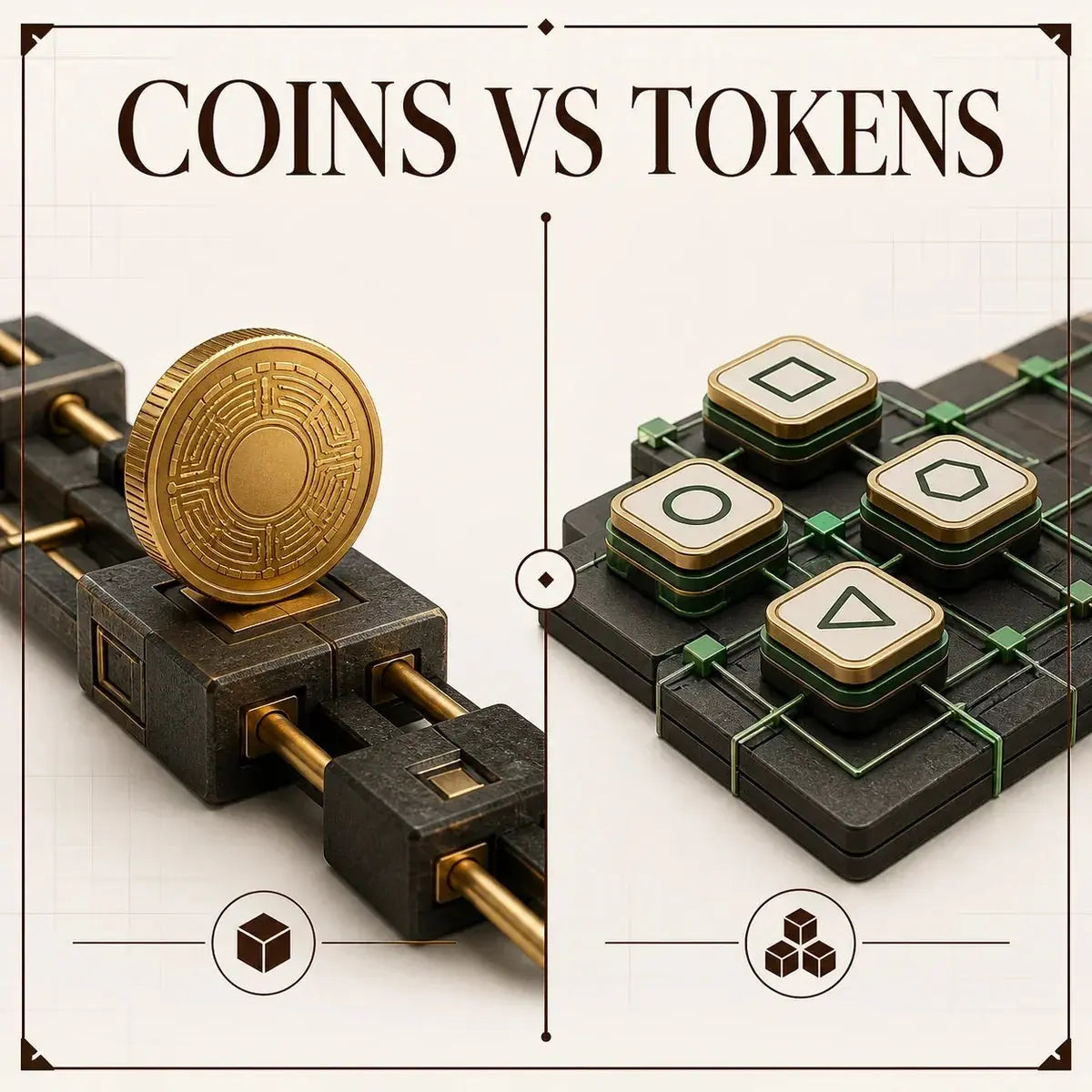
A crypto coin is the native asset of its own blockchain or base network. A crypto token is an asset issued and managed on a host network. Bitcoin is the native asset of the Bitcoin network. Ether is native to Ethereum, SOL is native to Solana, and ada is native to Cardano. By contrast, an ERC-20 asset such as LINK is represented by a smart contract on Ethereum, while USDC is issued on multiple supported networks.
The distinction is architectural, not a quality ranking. A native coin is not automatically safer or more valuable, and a token is not automatically speculative. Evaluate each asset through its protocol or issuer, supply controls, permissions, network security, and intended function.
Ask what asset pays the base network fee. If a transfer on Ethereum requires ETH for gas, the asset being moved may be an Ethereum token. If the asset itself pays the base fee and secures or operates the network, it is usually the native coin.
2How Native Crypto Coins Work
A coin is recorded directly by the rules of its base network. The protocol defines how balances change, how new units are issued, and how transaction fees are paid. Bitcoin nodes enforce BTC ownership and supply rules without relying on a token contract. Ethereum similarly treats ETH as its native cryptocurrency, even though Ethereum also hosts thousands of separate token contracts.
Native coins commonly perform several network-level jobs. They may pay transaction fees, reward miners or validators, serve as staking collateral, and provide the settlement asset used by applications. These functions vary by chain. Bitcoin uses proof of work and issues BTC through block subsidies and fees. Ethereum issues ETH through its proof-of-stake protocol and uses ETH for gas and staking. Solana uses SOL for fees and staking, while Cardano uses ada for fees, deposits, and rewards.
People often use “coin” for every fungible crypto asset, but that shortcut hides network dependency. The precise question is whether the asset is native to the ledger or issued on top of it.
3How Crypto Tokens Work
A token is created within an existing blockchain environment. On Ethereum, a fungible token often follows the ERC-20 standard, which defines common functions for balances, transfers, approvals, and total supply. The token contract records who owns how many units and which addresses are allowed to spend them. The Ethereum network executes those rules and charges transaction fees in ETH.
Other networks have their own token systems. Solana uses token programs and token accounts. Cardano supports native tokens through its ledger rather than requiring every asset to use an Ethereum-style smart contract. The implementation differs, but the central distinction remains: these assets depend on a host network and are not that network's principal fee asset.
Tokens can represent stablecoins, governance rights, application utility, wrapped assets, game items, off-chain claims, or NFTs. The label explains how an asset is hosted; it does not establish its legal status, redemption rights, or risk.
4Accurate Coin and Token Examples
| Asset | Best Classification | Host or Base Network | Practical Reason |
|---|---|---|---|
| Bitcoin (BTC) | Native coin | Bitcoin | BTC is created and transferred by Bitcoin's base protocol and pays network fees |
| Ether (ETH) | Native coin | Ethereum | ETH pays gas and secures Ethereum; native ETH is not an ERC-20 token |
| Solana (SOL) | Native coin | Solana | SOL is the network's native currency for fees and staking |
| Cardano (ADA) | Native coin | Cardano | Ada is Cardano's principal currency for fees, deposits, and rewards |
| USDC | Token or issued asset | Multiple networks | Circle issues USDC on supported chains; the correct network and contract must be verified |
| Chainlink (LINK) | Token | Ethereum and supported environments | LINK is represented through token contracts rather than being Ethereum's native fee asset |
| Wrapped Bitcoin (WBTC) | Wrapped token | Ethereum and compatible networks | WBTC represents BTC in a token format; it is not native BTC on the Bitcoin network |
| Polygon (POL) | Native gas and staking asset on Polygon PoS; ERC-20 on Ethereum | Polygon PoS and Ethereum | Classification depends on the network context; POL replaced MATIC in Polygon's migration |
The same brand can appear in different technical forms. Check the chain, asset standard, and verified contract address before sending funds.
5Important Edge Cases That Cause Confusion
Native ETH and Wrapped ETH Are Different Forms
ETH is Ethereum's native cryptocurrency. WETH is an ERC-20 token backed by ETH so applications designed for the ERC-20 interface can use an ETH-linked asset. Wrapping does not create a second Ethereum network; it changes how the asset is represented and introduces contract interaction.
One Stablecoin Can Exist on Several Networks
USDC is available on multiple blockchains. A USDC balance on Ethereum is not automatically the same transferable object as USDC on Solana. Exchanges and wallets must support the exact network selected. Sending an asset over an unsupported network can delay recovery or permanently lose access.
A Token Can Become a Network's Native Asset
Assets can change roles after migrations or network launches. Polygon's POL is a useful example: it is the native gas and staking asset on Polygon PoS, while its representation on Ethereum follows an ERC-20 implementation. Context matters more than a permanent one-word label.
Native Tokens Do Not Always Use Smart Contracts
Cardano supports ledger-level native tokens. They are not ada, so they are not Cardano's native coin, but they also do not require the same custom smart-contract pattern used by Ethereum ERC-20 tokens. “Token” is a broad category across different blockchain architectures.
6Why the Coin-Token Difference Matters
A native coin depends heavily on base-layer consensus and monetary rules. A token adds issuer, contract, bridge, custody, and application dependencies. Both layers matter when evaluating risk.
7How to Identify Whether an Asset Is a Coin or Token
Use this five-question process instead of relying on an exchange label:
- What network is being used? Read the wallet or withdrawal screen and identify the exact blockchain, not only the ticker.
- What pays the network fee? If another asset is required for gas, the asset being sent is usually a token on that network.
- Does the project publish a contract or mint address? A verified address normally identifies a token instance on a specific chain.
- Is the asset defined by the base protocol? Native issuance, staking, mining, or fee rules point toward a coin.
- Is there a bridge, wrapper, or issuer? Wrapped and bridged assets add dependencies that native coins do not have in their home network.
Use official documentation and the project's verified explorer links. Search results, wallet suggestions, and ticker symbols are not enough because fraudulent tokens can copy a legitimate name. Test a new route with a small amount before sending a large balance.
8What Coins and Tokens Mean for Crypto Mining
Proof-of-work mining normally produces the native coin of the network being secured. Bitcoin miners perform SHA-256 work and receive BTC-denominated block rewards and transaction fees. A miner cannot point the same machine at an arbitrary ERC-20 token, because an Ethereum token contract is not a separate proof-of-work network.
Tokens can affect mining economics indirectly by creating application or settlement demand, but that does not make them mineable coins. Before buying hardware, identify the consensus network, algorithm, pool support, and payout asset.
Our guide to how cryptocurrency mining works explains proof of work, block rewards, mining pools, and hardware. For a network-level comparison between two native coins that share SHA-256 hardware, see Bitcoin vs Bitcoin Cash.
9Transfer, Contract, and Classification Risks
- Wrong network: the sending and receiving platforms support different versions of the asset.
- Fake contract: a fraudulent token copies a real name and ticker but uses a different contract address.
- Approval exposure: an ERC-20 approval can authorize a contract to spend tokens from a wallet.
- Bridge dependency: a bridged token can depend on validators, custody, smart contracts, or message verification outside the destination chain.
- Issuer control: some tokens allow minting, freezing, pausing, blacklisting, or upgrades under defined administrative rules.
- Outdated classification: migrations such as MATIC to POL can make old articles, wallet labels, and exchange instructions inaccurate.
Confirm the full asset name, network, verified contract or mint address, destination support, and required gas asset. A matching ticker does not prove that two balances use the same blockchain or contract.
10Coins vs Tokens FAQ
Is Bitcoin a coin or a token?
Bitcoin is a native coin. BTC is issued and transferred by the Bitcoin network's base protocol rather than by a token contract on another blockchain.
Is ETH a coin or an ERC-20 token?
Native ETH is Ethereum's coin and pays gas. Wrapped ETH, or WETH, is an ERC-20 token representation of ETH used by applications that require the ERC-20 interface.
Are USDT and USDC coins?
They are issuer-backed stablecoins that exist as tokens or issued assets on supported host networks. Users must verify the exact blockchain and contract before transferring them.
Are SOL and ADA tokens?
SOL is Solana's native currency, and ada is Cardano's native currency. Both networks can also host separate tokens.
Can crypto tokens be mined with an ASIC?
Generally no. ASIC mining secures a compatible proof-of-work network and earns that network's reward asset. A token contract on a host chain is not independently mineable unless a separate protocol specifically defines such a mechanism.
11References
These official and primary sources were reviewed before inclusion. External links open in a new tab and are marked nofollow.
- Bitcoin: A Peer-to-Peer Electronic Cash SystemThe original Bitcoin paper and primary background for BTC as the asset of the Bitcoin network.
- Ethereum.org: What Is Ether?Official explanation of ETH as Ethereum's native cryptocurrency and the distinction between ETH and WETH.
- Ethereum.org: ERC-20 Token StandardOfficial developer documentation for fungible tokens implemented through Ethereum smart contracts.
- Solana: Introduction to Solana TokensOfficial distinction between native SOL and other digital assets created on Solana.
- Cardano Docs: Cryptocurrency and Native TokensOfficial documentation identifying ada as Cardano's native currency and explaining Cardano native tokens.
- Circle Docs: USDC Contract AddressesOfficial network and contract references for native USDC deployments across supported blockchains.
- Polygon Docs: Migrate from MATIC to POLOfficial migration guidance and current explanation of POL as Polygon PoS's native gas and staking token.
Final Explanation
Coins belong to their base networks; tokens are issued within host-network asset systems. BTC, ETH, SOL, and ada are native coins. Assets such as LINK, WETH, and network-specific versions of USDC are tokens.
The label is only the first layer of research. Before sending, storing, or evaluating an asset, verify its network, contract or mint address, fee currency, issuer or bridge dependencies, and destination support. That process prevents more mistakes than relying on a familiar ticker.





Leave a comment
This site is protected by hCaptcha and the hCaptcha Privacy Policy and Terms of Service apply.