
What Is Bitcoin? How It Works, Mining, Wallets, and Risks
peer-to-peer money · private keys · independent nodes · Proof of Work · limited supply
On This Page
1What Is Bitcoin? A Quick Definition
Bitcoin is a decentralized peer-to-peer monetary network, and BTC is the digital asset used on that network. It allows people to transfer value without asking a bank or payment processor to maintain the master ledger. Instead, thousands of independently operated computers validate the same public transaction history under a shared set of rules.
Bitcoin does not mean that every participant trusts every other participant. The design combines digital signatures, a public ledger, economic incentives, and Proof of Work so that strangers can agree on ownership and transaction order without appointing one central operator.
Bitcoin usually means the network and protocol. BTC is the unit recorded and transferred by that network. People often use the words interchangeably, but the distinction helps when learning how the system works.
2The Bitcoin System at a Glance
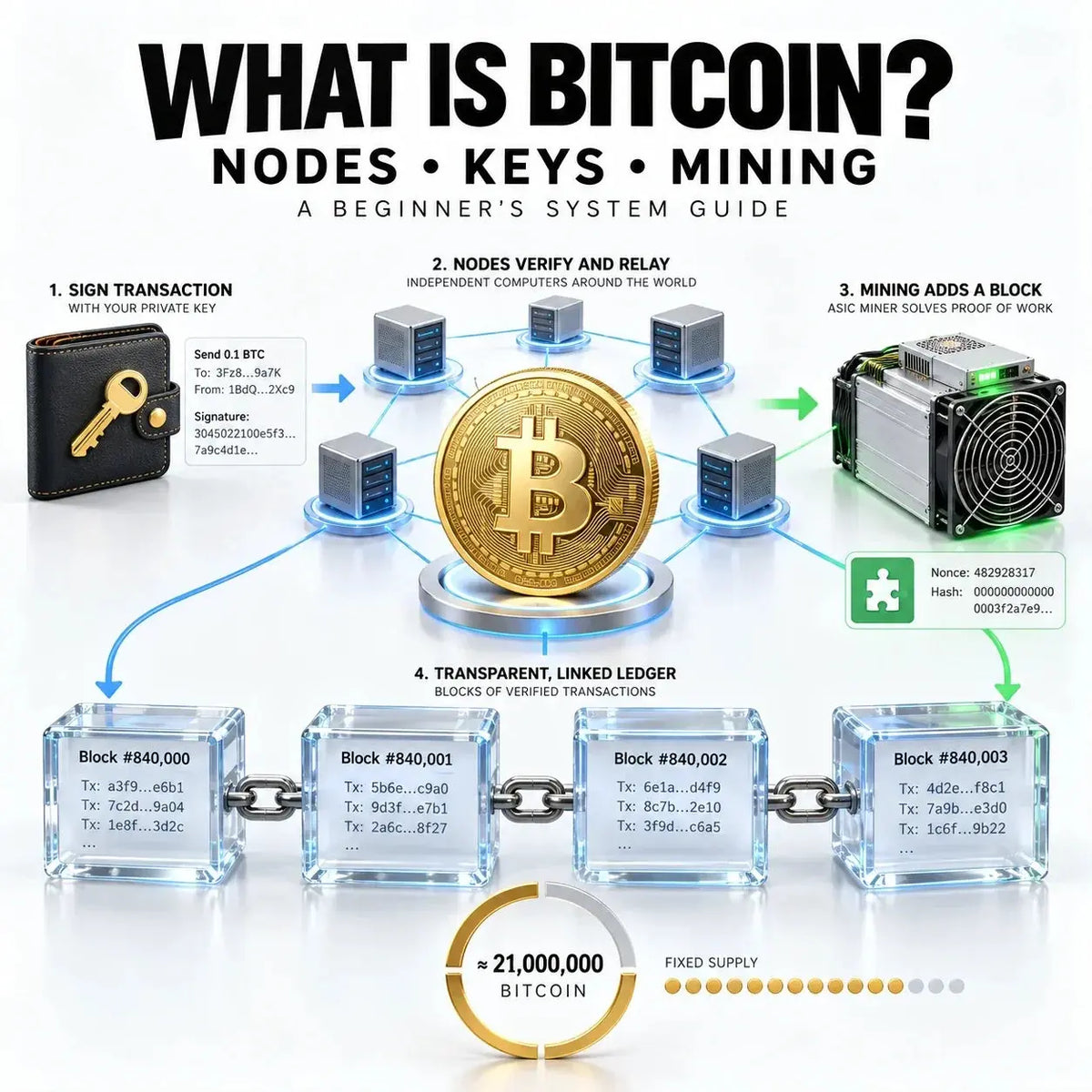
- A wallet constructs a transaction that spends one or more existing UTXOs.
- The owner signs the transaction with the necessary private key.
- Nodes verify the signature, amounts, scripts, and other consensus rules.
- Miners may include the valid transaction in a candidate block.
- After a miner finds valid Proof of Work, nodes independently validate the block.
- More valid blocks can build on it, increasing settlement confidence.
No single company performs every step. Wallet developers, node operators, miners, pools, exchanges, merchants, and users have different roles. That separation is one reason Bitcoin can continue operating even when a particular business or server goes offline.
3What Problem Does Bitcoin Solve?
Digital information is easy to copy, so a digital money system must prevent the same value from being spent twice. Traditional systems solve that problem with a trusted central ledger. Bitcoin replaces that central bookkeeper with a public transaction history that network participants can verify for themselves.
The original Bitcoin whitepaper described a peer-to-peer electronic cash system in which transactions are ordered through an ongoing Proof-of-Work chain. The system does not eliminate trust from every human activity. Users still make choices about wallet software, exchanges, merchants, and custody providers. What Bitcoin changes is the need for one institution to approve and maintain the base ledger.
Bitcoin is decentralized because its rules and ledger can be independently verified by many participants. The number of apps or companies displaying a BTC balance does not determine the network's rules.
4How Does a Bitcoin Transaction Work?
A Bitcoin balance is not a row inside a personal account. The ledger contains transaction outputs that have not yet been spent. A wallet selects suitable UTXOs as inputs, creates new outputs for the recipient, and usually sends any remainder back to a change address controlled by the sender.
Suppose a wallet controls a 0.010 BTC UTXO and needs to pay 0.006 BTC. It might create one 0.006 BTC recipient output and one smaller change output, minus the miner fee. The original 0.010 BTC output is consumed completely; Bitcoin does not shave part of an output in place.
| Transaction Part | Purpose | Beginner Note |
|---|---|---|
| Input | References an existing spendable output | It proves which value is being spent. |
| Signature / witness | Satisfies the spending conditions | Usually produced by a wallet using a private key. |
| Recipient output | Assigns value to new spending conditions | An address helps the wallet construct this output. |
| Change output | Returns unused value to the sender | It can look like a second payment in a block explorer. |
| Fee | Difference between total inputs and outputs | It is influenced more by transaction size and demand than by the BTC amount sent. |
Once broadcast, the transaction may enter node mempools. Inclusion is not guaranteed merely because a wallet displays “sent.” Miners choose transactions under their own policies, often prioritizing fee rate, while nodes still reject anything that violates consensus rules.
5Private Keys, Addresses, and Wallets
A common shortcut says that a wallet “stores Bitcoin.” More precisely, wallet software manages keys, creates addresses, constructs transactions, and signs spending requests. The spendable outputs remain recorded on the shared ledger.
| Term | What It Does | Main Risk |
|---|---|---|
| Private key | Provides the secret needed to authorize spending | Loss can make funds permanently inaccessible; exposure can allow theft. |
| Public key / address | Helps define where value can be received and later spent | Address reuse can reduce privacy; wrong-network transfers can fail. |
| Seed phrase | Backs up a deterministic set of wallet keys | Anyone who obtains it may control the wallet; fake recovery sites are common. |
| Custodial account | A provider controls keys and credits the user internally | Withdrawals depend on the provider's security, solvency, and policies. |
| Self-custody wallet | The user controls the keys directly | The user becomes responsible for backup, device security, and recovery. |
Never share a seed phrase or private key with “support,” a giveaway, a recovery service, or a website reached through an unsolicited message. A legitimate recipient only needs a receiving address, not the secret that controls your wallet.
Hardware wallets can reduce exposure to an internet-connected computer, but they do not remove every risk. Verify the destination and amount on the trusted display, protect the backup, understand the recovery process, and test with a small transaction before moving a large amount.
6Nodes, Blocks, and the Blockchain
A full node downloads and validates the information needed to enforce Bitcoin's rules. It checks whether inputs exist and remain unspent, signatures satisfy the required scripts, coin creation follows the schedule, block size and weight limits are respected, and Proof of Work meets the required target.
Blocks group transactions and reference the previous block, creating a chronological chain. However, “the longest chain” is an imprecise shortcut. Nodes follow the valid chain with the most cumulative Proof of Work, not simply the chain with the greatest number of blocks.
Miners cannot make a properly configured full node accept an invalid reward or an unauthorized spend. A miner can choose which valid transactions to include and can attempt to reorganize recent transaction order, but changing consensus rules requires the receiving nodes to run software that accepts those rules.
Bitcoin's ledger is publicly auditable. Addresses are pseudonymous rather than automatically anonymous, and transaction patterns can sometimes be connected to real-world identities through exchanges, merchants, reuse, or other data.
7Bitcoin Mining and Proof of Work
Bitcoin miners repeatedly hash candidate block headers using SHA-256 twice, commonly called SHA-256d. A valid result must be below the network target. Because each hash is unpredictable, miners vary a nonce and other block data while performing an enormous number of trials.
Finding a valid block is probabilistic. A miner or pool with a larger share of total hashrate has a greater chance of finding the next block, but there is no guaranteed schedule for one machine. The network adjusts mining difficulty every 2,016 blocks to keep the average block interval near ten minutes over time.
For a deeper explanation of miners, pools, hashes, and difficulty, see What Is Cryptocurrency Mining? and How Bitcoin Miners Solve Mathematical Puzzles.
8Bitcoin Supply, Halvings, and Transaction Fees
New BTC enters circulation through the block subsidy. In 2026, the subsidy is 3.125 BTC per block, plus the transaction fees included in that block. The subsidy halves every 210,000 blocks, approximately once every four years, causing new issuance to decline over time.
Bitcoin's programmed issuance approaches a maximum of about 21 million BTC. This limit does not mean that all coins are liquid or available for sale. Some are lost, held long term, locked temporarily, or economically uneconomical to move.
As the subsidy declines, transaction fees are expected to become a larger share of miner revenue. That transition is economically important because miners secure the network only when their expected revenue justifies equipment, electricity, maintenance, and operating risk. Our guide to the last one million bitcoins examines the late-stage issuance schedule in more detail.
9Confirmations, Fees, and Faster Payments
A transaction receives its first confirmation when it is included in a valid block. Each additional block built on top increases the cumulative work behind that history. There is no universal confirmation count for every payment: a small retail purchase and a large irreversible settlement have different risk tolerances.
Base-layer fees change with demand for limited block space. A higher fee rate can improve the chance of timely inclusion, but wallets should estimate current conditions rather than use a permanent fixed fee. Replace-by-fee and child-pays-for-parent are mechanisms that may help when a compatible transaction is delayed.
The Lightning Network moves many small payments through payment channels and later settles results to Bitcoin. It can provide faster and less expensive payments, but users still need to consider liquidity, channel management, routing, backups, and whether a wallet is custodial or self-custodial.
“Instant” can describe a wallet notification, zero-confirmation acceptance, a custodial database update, or a Lightning payment. These are not identical to final settlement in a confirmed Bitcoin block.
10What Bitcoin Can Do, and What It Cannot Guarantee
| Potential Use | Why Bitcoin May Help | Important Limitation |
|---|---|---|
| Self-custodied savings | Ownership can be controlled through keys without a bank account | Price volatility and key-management failure can produce major losses. |
| Cross-border settlement | The network operates globally and continuously | Local law, exchange access, fees, and confirmation time still matter. |
| Merchant payments | Payments can be verified without card chargeback rules | Refunds, accounting, tax, volatility, and customer support require planning. |
| Public auditability | Supply and transaction history can be independently checked | Public records reduce privacy and do not prove off-chain claims. |
| Mining revenue | Miners can earn subsidy and fees for valid Proof of Work | Profit is not guaranteed and depends on power, difficulty, price, uptime, and hardware. |
Bitcoin does not guarantee profit, stable purchasing power, privacy, cheap fees, instant confirmation, or protection from user error. Transactions are generally difficult to reverse, and scammers exploit that feature. It is also possible to buy a claim to BTC from a provider without controlling the keys yourself.
Bitcoin is the first cryptocurrency, but it is not a template that every other network follows. Different assets use different consensus models, issuance rules, security assumptions, governance, and use cases. See our guide to Bitcoin and other cryptocurrencies before comparing them by price alone.
Beginner Safety Checklist
- Learn the difference between a custodial account and a self-custody wallet before depositing funds.
- Download wallet software only from a verified source and confirm important release information.
- Write down the recovery method offline; never store an unencrypted seed phrase in cloud notes or chat.
- Verify the network, address, and amount before signing; use a small test transaction when practical.
- Do not treat screenshots, social posts, or displayed balances as proof that a payment has settled.
- Understand fees, confirmation policy, withdrawal limits, and local tax or reporting obligations.
- Ignore guaranteed-return offers and anyone asking for a seed phrase, remote access, or an advance “unlock” fee.
11Bitcoin FAQ
Who controls Bitcoin?
No single person or company controls every part of Bitcoin. Developers publish software, miners propose blocks, businesses provide services, and users choose what software and rules to accept. Full nodes independently enforce consensus rules.
Does a Bitcoin wallet contain coins?
Not literally. A wallet manages keys and transaction data. Spendable BTC is represented by UTXOs recorded on the distributed ledger.
Can Bitcoin transactions be reversed?
There is no central chargeback operator. A recipient may voluntarily return funds, and a recent unconfirmed or low-confidence transaction can face replacement or reorganization risk, but a sender cannot simply cancel a deeply confirmed payment.
How are new bitcoins created?
Valid blocks may include a coinbase transaction that pays the permitted block subsidy plus transaction fees. In 2026, the subsidy is 3.125 BTC per block.
Is Bitcoin anonymous?
Bitcoin is better described as pseudonymous. Transactions are public, and addresses can sometimes be linked to identities through external data and usage patterns.
Is Bitcoin the same as Bitcoin Cash?
No. They share early history but follow separate networks and rules. The Bitcoin versus Bitcoin Cash comparison explains the differences.
12References and Further Reading
- Bitcoin: A Peer-to-Peer Electronic Cash SystemSatoshi Nakamoto's original description of transactions, timestamps, Proof of Work, and the peer-to-peer network.
- Bitcoin Developer Guide: Block ChainTechnical overview of block headers, proof of work, and chain selection.
- Bitcoin Developer Guide: TransactionsUTXOs, inputs, outputs, scripts, signatures, and transaction structure.
- Bitcoin Developer Guide: WalletsHow wallet software creates keys and addresses and controls spending.
- Bitcoin Developer Guide: MiningMining, candidate blocks, coinbase transactions, pools, and block proposals.
- Bitcoin.org: Securing Your WalletPractical backup, encryption, online-service, and cold-storage considerations.
- U.S. FTC: What to Know About Cryptocurrency ScamsCommon payment, investment, impersonation, and recovery scam patterns.
Bitcoin in One Sentence
Bitcoin is an open peer-to-peer monetary network in which private keys authorize spending, nodes independently enforce shared rules, and miners use Proof of Work to order valid transactions into a public ledger.
Understanding those separate roles is more useful than treating Bitcoin as only a price chart, a mining machine, or a wallet balance.




Leave a comment
This site is protected by hCaptcha and the hCaptcha Privacy Policy and Terms of Service apply.