
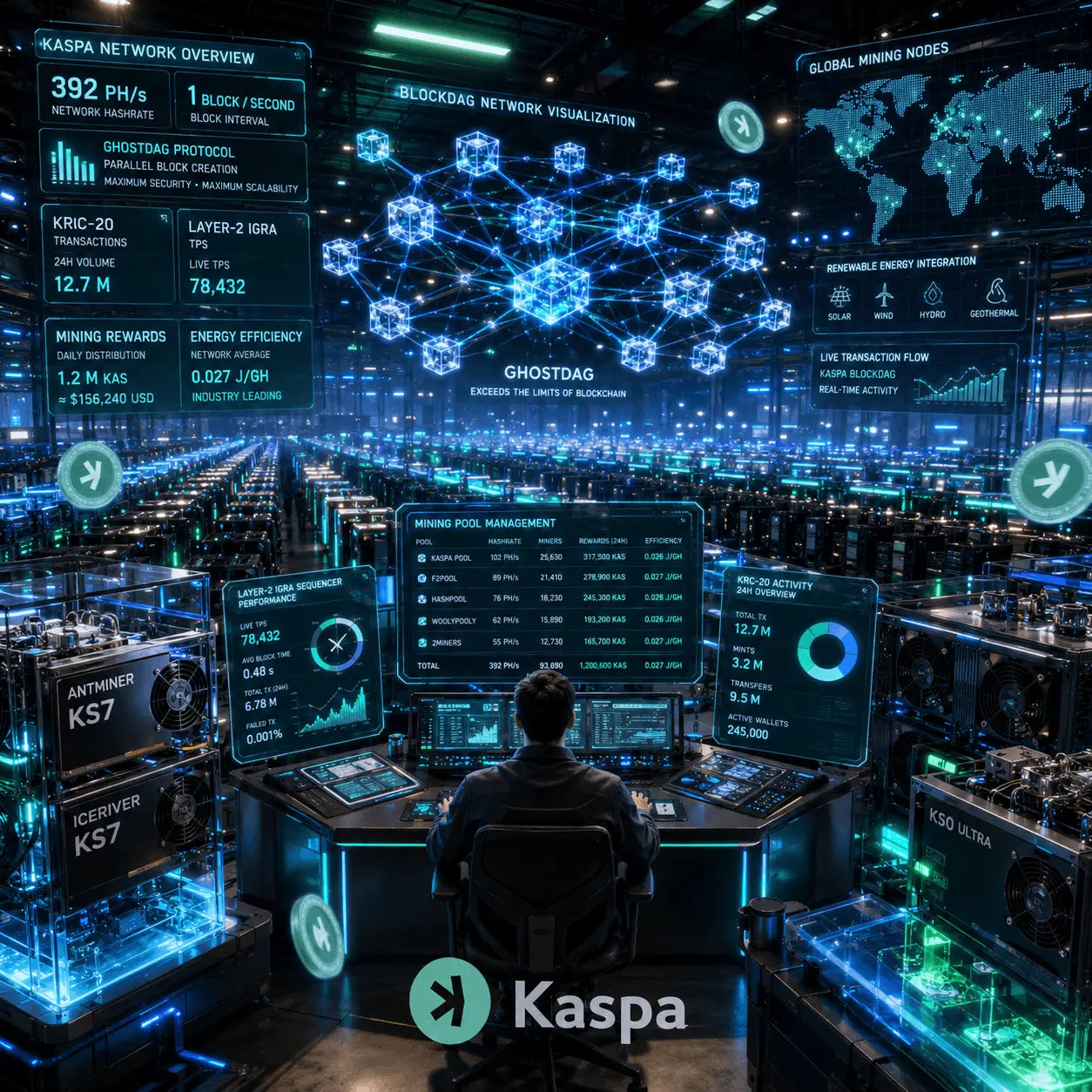
Why Choose to Mine Kaspa in 2026?
Core Conclusion: Thanks to its unique BlockDAG architecture, fair-launch with zero pre-mine, and ongoing evolution into a programmable Layer-1 network, Kaspa remains one of the most technologically vibrant and miner-friendly Proof-of-Work projects in 2026.
As of May 2026, Kaspa has grown from an early experimental network into one of the world's most significant proof-of-work settlement layers. It is not a traditional blockchain but a BlockDAG (Directed Acyclic Graph) based on the GHOSTDAG protocol. Unlike Bitcoin, which processes one block per second and discards orphan blocks entirely, Kaspa allows multiple blocks to be created in parallel and coexist on the network. This means virtually no mining power is wasted, and the network maintains a steady block rate of one block per second. Cumulative transaction volume surpassed 21 billion in May 2026.
More importantly, Kaspa launched in November 2021 with no pre-mine, no pre-sale, and no insider allocations. In an industry where most projects hide pre-distributed tokens, this "clean launch" is extremely rare. Its total supply is 28.7 billion KAS, released through a smooth monthly reduction mechanism with no Bitcoin-style halving jumps. For miners, Kaspa offers a transparent, low-barrier, and technologically advanced path to participation.
How Does Kaspa Mining Actually Work?
Core Conclusion: Kaspa uses the kHeavyHash algorithm and GHOSTDAG consensus, requiring miners to validate transactions and secure the network through a computational race, while allowing parallel blocks to coexist – making mining rewards more stable and predictable than traditional PoW.
Kaspa is a Layer-1 public blockchain that uses Proof-of-Work (PoW). When you run mining hardware, you are essentially performing complex mathematical calculations to verify network transactions and package them into blocks. In return, the network pays you KAS tokens.
Unlike Bitcoin, where only one miner wins per block and everyone else's hashrate is "wasted," Kaspa's GHOSTDAG protocol allows parallel blocks to coexist. The system produces very few orphaned blocks, making the entire network's hashrate far more efficient. The direct benefit to miners is that your reward variance is greatly smoothed – you no longer rely entirely on "lottery ticket" luck.
The underlying kHeavyHash algorithm has the following characteristics:
-
Based on matrix multiplication and two Keccak hash functions.
-
Designed to be core-dominant, rewarding raw processing power.
-
Initially GPU and FPGA-friendly, now deeply optimized for ASICs.
-
Considerably more energy-efficient than many other PoW algorithms.
What Hardware Do You Need to Mine Kaspa in 2026?
Core Conclusion: ASIC miners have completely dominated Kaspa mining by 2026. GPUs have largely lost profitability due to vast efficiency gaps. Depending on your electricity cost, space, and budget, options range from silent home units like the KS0 Ultra to industrial-grade machines like the Antminer KS7.
As of May 2026, the network hashrate is stable at over 392 PH/s, with more than 200 active miner clusters. At this scale, even top-tier GPUs like the RTX 4090 (about 2 GH/s) operate at a severe loss at electricity costs above $0.08/kWh. Therefore, this guide focuses exclusively on ASICs.
Here is a comparison of mainstream KAS ASIC miners in 2026 (data prioritized from the third document):
| Miner Model | Hashrate | Power | Efficiency | Best For |
|---|---|---|---|---|
| Bitmain Antminer KS7 | 40 TH/s | 3080W | 77 J/TH | Large-scale farms |
| IceRiver KAS KS7 | 30 TH/s | 3500W | 116.67 J/TH | Mid-large operations |
| Bitmain Antminer KS5 Pro | 21 TH/s | 3150W | 150 J/TH | Professional mining |
| IceRiver KS7 Lite | 4.2 TH/s | 500W | 119 J/TH | Budget/beginner |
| Goldshell KA Box Pro | 1.6 TH/s | 600W | 375 J/TH | Quiet home mining |
| IceRiver KS0 Ultra | 400 GH/s | 100W | 250 J/TH | Desktop entry-level |
How to Choose?
-
Beginner or home use: IceRiver KS0 Ultra (nearly silent, 10dB) or KS7 Lite.
-
Dedicated space, serious mining: Antminer KS5 Pro.
-
Industrial-scale farm: Antminer KS7 (current efficiency champion).
-
Extreme quiet requirement: Goldshell KA Box Pro.
Infrastructure Warning: Industrial miners above 3000W require 220V-240V circuits with dedicated outlets (e.g., L6-30) and professional PDU. Standard residential 110V lines cannot handle the load. Ensure 30cm of clearance around the miner for airflow. Noise levels can reach ~75dB.
How Do You Safely Set Up a Kaspa Wallet?
Core Conclusion: Before mining a single KAS, you must generate a self-custodial wallet address starting with the "kaspa:" prefix and securely back up the 12 or 24-word seed phrase. Never send pool payouts directly to an exchange address.
All Kaspa addresses should include the kaspa: prefix (e.g., kaspa:qq...). This ensures recognition by the vast majority of mining pools.
Recommended wallet types in 2026:
-
Official Web/Desktop Wallet (wallet.kaspa.org) : Simplest option, ready in 2 minutes. Great for beginners.
-
Hardware Wallet (Ledger, OneKey Pro) : Best for large holdings – private keys stay offline.
-
Kaspium Mobile App : Community-endorsed, fast sync speeds. Ideal for daily earnings monitoring.
-
Exchange Wallet (temporary only) : e.g., UEX, KuCoin, Gate.io – never for long-term storage or direct mining payouts.
Key setup steps (official web wallet):
-
Go to
wallet.kaspa.organd click "Create New Wallet." -
Write down the 12 or 24-word seed phrase on paper – no screenshots, no cloud storage, no sharing.
-
Confirm the seed phrase when prompted.
-
Copy your receiving address starting with
kaspa:.
Security Rule: Your seed phrase is your wallet. Anyone with those words can steal all your funds. Exchanges have historically suspended KAS deposits/withdrawals due to sudden high-volume requests. Always mine to a self-custodial wallet first, then transfer to exchanges in batches.
How to Choose and Configure a Mining Pool?
Core Conclusion: For the vast majority of miners, joining a PPLNS pool is the best choice for stable, low-fee earnings. In 2026, Nanopool's 0% fee and F2Pool's high stability each offer distinct advantages.
With network hashrate in the hundreds of PH/s, the chance of a solo individual finding a block is nearly zero. Pools combine the hashrate of many miners and distribute rewards according to contribution.
Top Kaspa Mining Pools (May 2026):
| Pool | Fee | Payout Model | Notable Feature |
|---|---|---|---|
| Nanopool | 0.0% | PPLNS | Zero fee, highly attractive |
| F2Pool | 1.0% | PPLNS | World-class stability |
| HumPool | 0.75% | PPLNS | Low latency for Asia |
| 2Miners | 1.0% | PPLNS | Beginner-friendly, good docs |
| ViaBTC | 2% | PPS+ | Stable payouts, no variance |
Payout Models Explained:
-
PPLNS (Pay Per Last N Shares) : Rewards based on actual blocks found by the pool. Because Kaspa produces blocks very quickly (1 per second), luck variance is minimal. PPLNS is the first choice for long-term miners due to lower fees.
-
PPS+ (Pay Per Share Plus) : The pool pays you a theoretical reward regardless of whether a block is found. Eliminates variance, but fees are higher (2-4%).
Configuration Steps (Antminer KS7 as example):
-
Connect miner to router via Ethernet cable and power on.
-
Use an IP scanner (e.g., Advanced IP Scanner) to find the miner's local IP address.
-
Enter that IP into a browser. Log in with default credentials (admin/admin or root/root).
-
Navigate to "Pool Settings" and enter:
-
URL: e.g.,
stratum+tcp://kas.f2pool.com:5200 -
Username/Worker:
Your_Kaspa_Wallet_Address.Worker_Name(e.g.,kaspa:qq123.Miner01) -
Password:
x
-
-
Save and restart. Within 5-10 minutes, you can view hashrate and earnings on the pool's website using your wallet address.
How Much Can You Realistically Earn Mining Kaspa in 2026?
Core Conclusion: Under current high network hashrate and monthly emission reductions, net profit margins after electricity have compressed to below 20% for efficient industrial miners. Home micro-miners cannot profit in fiat terms. ROI timelines are extremely long, and profitability heavily depends on KAS price appreciation or on-chain fee income.
The core profitability formula is:
Daily Profit = (Your Hashrate / Network Hashrate) × Daily Block Rewards × KAS Price – (Power × 24 / 1000 × Electricity Rate)
Example Calculation (Electricity at 0.035):
-
Antminer KS7 (40 TH/s) : ~4.43 daily electricity = ~$1.17 net profit per day.
-
IceRiver KS0 Ultra (400 GH/s) : ~0.14 daily electricity = ~$0.09 net loss per day.
Key Insights:
-
Home micro-miners are not profitable in fiat terms by May 2026. Their value lies in using minimal electricity to acquire non-KYC "clean" coins for potential future appreciation.
-
A flagship industrial miner at 0.08/kWh, it edges toward loss.
-
Static ROI: A 1.17 per day would take over 2,200 days to break even. This means that without a 5-10x rise in KAS price or substantial fee income from the Toccata hard fork, mining alone will not pay back the hardware cost.
Therefore, before entering in 2026, you must use real-time calculators (minerstat.com, whattomine.com) and repeatedly evaluate your electricity rate and KAS price expectations.
How to Maximize Mining Profit and Extend Hardware Life?
Core Conclusion: By using custom firmware for efficiency tuning, enforcing rigorous cooling and dust control, configuring backup pools, and 24/7 monitoring, you can increase net profits by 10-15% and reduce hardware failure rates by over 80% in this thin-margin era.
-
Reduce Electricity Cost: This is the top priority. Aim for industrial rates below $0.05/kWh, or utilize curtailed renewable energy and time-of-use pricing.
-
Use Third-party Firmware: Tools like LuxOS or VNish can auto-tune voltage, further optimizing KS7 efficiency to below 70 J/TH. They also offer "low-power safety mode" for extreme heat.
-
Physical Maintenance:
-
Clean dust from fans and heatsinks every 2-3 weeks with an anti-static brush and blower. Dust buildup can raise chip temperatures by over 10°C, causing throttling.
-
For large farms, immersion cooling is proven to reduce ASIC failure rates by 85% compared to air cooling.
-
-
Configure Backup Pools: Enter 2-3 pool addresses in your miner's settings. If the primary pool fails, the miner automatically switches to keep hashrate running.
-
Real-time Monitoring: Set up email or Telegram alerts on your pool dashboard for hashrate drops, high temperature, or offline workers.
How Will Kaspa Mining Evolve After 2026?
Core Conclusion: The Toccata hard fork and the Igra Layer-2 network will transform miners from simple "block subsidy collectors" into "on-chain sequencer service providers," with transaction fees potentially becoming the main pillar of future mining income.
Between June 5 and June 20, 2026, the Kaspa mainnet will activate the Toccata hard fork. It introduces native KRC-20 tokens, smart contract programmability (covenants), and zero-knowledge proof verification. This means KAS will evolve from a simple payment coin into the gas currency for complex DeFi and applications. Explosive growth in on-chain activity will generate substantial transaction fees, partially offsetting the monthly reduction in block subsidies.
Simultaneously, the Igra network – the first EVM execution layer (Layer 2) built on Kaspa BlockDAG – uses a "Based Rollup" architecture: transaction sequencing rights are fully delegated to underlying Kaspa miners. While processing base-layer blocks, miners can earn extra fee income by sequencing Igra's Layer-2 transactions. Igra handles over 3,000 transactions per second and maintains consistently high activity.
For miners, the core survival strategy after 2026 is clear: evolve from a pure hashrate provider into a service provider for the network's ecosystem.




Leave a comment
This site is protected by hCaptcha and the hCaptcha Privacy Policy and Terms of Service apply.