
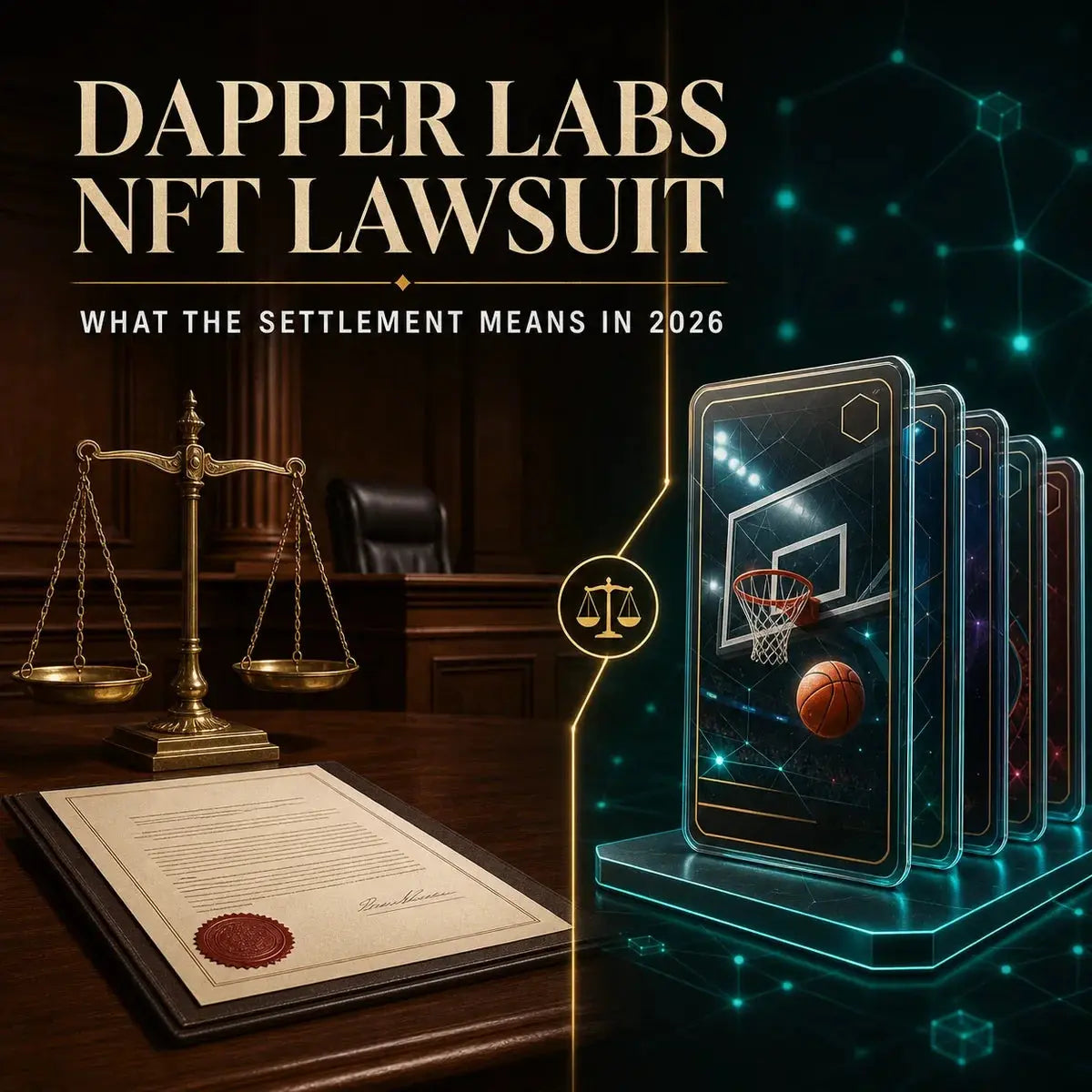
Dapper Labs NFT Lawsuit:
What the Settlement Means in 2026
NBA Top Shot Moments · the Howey test · final settlement · updated SEC digital-collectible guidance
On This Page
The Dapper Labs NFT lawsuit did not end with a court declaring that NBA Top Shot Moments, or NFTs generally, are securities. The case ended through a class-action settlement that received final approval in October 2024. The claims were dismissed with prejudice, and the final judgment expressly prevented the settlement from being treated as an admission of fault or liability.
That distinction matters even more in 2026. A new SEC interpretation now states that a digital collectible, as defined by the agency, is not itself a security because it lacks the economic characteristics of a security. Yet the way a crypto asset is offered, sold, fractionalized, or tied to a promoter's essential managerial efforts can still create an investment-contract issue. The Dapper case therefore remains useful as a fact-specific warning, not a universal NFT rule.
The 2023 decision only held that the plaintiffs had plausibly alleged a securities claim and could continue the lawsuit. The 2024 settlement ended the case without a trial judgment on whether Moments were securities. In 2026, projects should evaluate the complete transaction and promises around an NFT, while collectors should not assume that every NFT carries securities-law rights.
1Current Status of the Dapper Labs Lawsuit
Friel v. Dapper Labs, Inc. was filed in 2021 in the Southern District of New York. Plaintiffs alleged that Dapper Labs offered NBA Top Shot Moments as unregistered securities. The defendants denied liability and moved to dismiss the amended complaint.
On February 22, 2023, Judge Victor Marrero denied that motion. On June 3, 2024, the parties entered into a settlement stipulation. After notice and a fairness hearing, the court entered an order and final judgment on October 28, 2024, finally approving the settlement and dismissing the action and released claims with prejudice.
The settlement was widely described as providing a roughly $4 million fund. The judgment says it is not evidence or an admission of liability. There was no merits trial establishing a broad NFT precedent.
2Case Background: NBA Top Shot and Flow
NBA Top Shot is a digital-collectible platform built on the Flow blockchain. A Moment is an NFT associated with a licensed professional-basketball highlight. Dapper Labs sold packs containing Moments and operated a secondary marketplace where users could buy and sell individual collectibles.
The complaint focused on the full economic arrangement rather than the video clip alone. Plaintiffs emphasized Dapper Labs' role in the Flow blockchain, minting, marketplace, fees, wallet infrastructure, and trading ecosystem.
This dependence theory separated the dispute from a simple claim that every trading card becomes a security whenever it is resold. The court examined whether the alleged scheme linked purchasers' economic expectations to Dapper Labs' continuing work and control.
3The Howey Test and NFTs
U.S. courts use the Supreme Court's SEC v. W.J. Howey Co. framework to determine whether a transaction is an “investment contract,” one category within the statutory definition of a security. The analysis looks to economic reality rather than the name placed on an asset.
| Howey element | Question in an NFT transaction | Dapper allegations considered in 2023 |
|---|---|---|
| Investment of money | Did purchasers provide value to obtain the asset? | Purchasers paid for packs or Moments. |
| Common enterprise | Were purchaser fortunes linked to a shared venture? | Sales allegedly supported an ecosystem controlled by Dapper Labs. |
| Expectation of profits | Did the offer encourage a financial-return expectation? | Marketplace activity and promotional context were considered. |
| Efforts of others | Were expected profits substantially dependent on essential managerial work? | The complaint tied value and tradability to Flow and Dapper's marketplace. |
No single feature answers the question. A resale market, scarcity, royalty, licensed content, or blockchain record can exist without creating a security. The transaction, promises, rights, and economic dependence must be considered together.
4What the 2023 Court Ruling Actually Said
The court was deciding a motion to dismiss, not conducting a trial. At that stage, it generally accepted well-pleaded allegations as true and asked whether the complaint stated a plausible claim. It concluded that the plaintiffs had plausibly alleged the Howey elements and allowed the case to proceed.
The opinion emphasized the alleged relationship among Moments, Flow, and Dapper Labs' marketplace. It considered ecosystem control, dependence, transfer restrictions, and the promoter's role in establishing the market.
“Motion to dismiss denied” means the complaint was legally sufficient to continue. It does not mean the plaintiffs proved their facts, won at trial, or established that all Moments transactions were securities transactions.
5What the 2024 Settlement Changed
The settlement closed the class action and avoided the cost and uncertainty of further litigation. Final approval bound the settlement class, released covered claims, and dismissed the case with prejudice. Dismissal with prejudice generally means those released claims cannot be filed again by the same class members.
Public descriptions also noted commitments concerning decentralization and separation from aspects of the Flow ecosystem. Those changes do not create a universal checklist guaranteeing non-security status.
For readers following crypto regulation, the practical value of the settlement is modest but real: centralized control, closed trading infrastructure, profit-oriented promotion, and continuing dependence on a promoter can invite scrutiny. The legal result, however, was a negotiated resolution rather than a judicial classification of Moments after a developed evidentiary record.
6What the Case Did and Did Not Decide
7The SEC's 2026 Digital-Collectible Interpretation
Effective March 23, 2026, the SEC and CFTC issued a new interpretation addressing several crypto-asset categories. It describes a digital collectible as an asset designed to be collected or used, such as artwork, music, video, trading cards, in-game items, or similar cultural content, without rights to passive yield, future income, business profits, or business assets.
Under that definition, the SEC states that a digital collectible itself is not a security. Its value can reflect subject matter, popularity, scarcity, and ordinary supply and demand, much like a physical collectible. The interpretation also says that an automated creator royalty does not by itself turn the collectible into a security because the holder does not receive the creator's royalty stream.
The boundary is not absolute. The SEC explains that fractionalized interests in a collectible may be securities when purchasers depend on essential managerial efforts for profit. A non-security crypto asset can also be offered as part of an investment contract depending on the surrounding promises and arrangement. Howey remains binding precedent.
The 2023 Dapper opinion should therefore be read as a pleading-stage analysis of one alleged scheme, not as the current SEC position that ordinary digital collectibles are securities.
8Related NFT Enforcement Actions
In 2023, the SEC settled administrative proceedings involving Impact Theory's Founder's Keys and Stoner Cats NFTs. The agency focused on promotion that encouraged purchasers to expect value growth from issuer efforts. Both respondents settled without admitting or denying the findings.
Those orders remain part of the enforcement record, but they were not federal-court trials establishing that all NFTs are securities. SEC Commissioners Hester Peirce and Mark Uyeda publicly dissented from aspects of both actions, arguing that the agency should provide clearer rules and protect ordinary creative activity.
The 2026 interpretation now supplies a more defined category for digital collectibles and supersedes earlier SEC or staff statements on the topics it covers. Readers comparing jurisdictions should also consult our global crypto regulation guide, because securities, consumer, tax, sanctions, intellectual-property, and privacy rules differ across markets.
9Risk Factors NFT Projects Should Review
NFT teams should review the full user proposition whenever utility or marketing changes. A collectible image does not neutralize promises of business growth, while resale value or scarcity alone does not create an investment contract.
- Rights: identify whether holders receive revenue, yield, profit shares, claims on assets, or fractional interests.
- Marketing: separate collectible or functional use from promises of appreciation, returns, liquidity, or issuer-led price growth.
- Managerial dependence: assess whether the project's future work is essential to the economic return purchasers are led to expect.
- Market structure: document transfer rules, marketplace control, custody, fees, withdrawal limits, and what happens if services stop.
- Disclosure: describe intellectual-property licenses, technical dependencies, conflicts, supply controls, and material risks accurately.
- Other laws: consider consumer protection, advertising, privacy, AML, sanctions, tax, gaming, and local licensing requirements.
Legal review should cover both the token and the surrounding transaction. A project can alter its risk profile after launch by adding financial rights, new promises, pooled management, fractionalization, or a different distribution model.
10What NFT Buyers and Users Should Know
Buying an NFT does not automatically make the buyer a shareholder or give the protections associated with registered securities. Ownership may cover only the token and a limited license; it may not transfer copyright, commercial rights, rights to the underlying media, or a claim against the issuer.
Before purchasing, users should read terms covering custody, transfers, withdrawals, intellectual property, shutdowns, fees, and disputes. They should distinguish collectible demand from a contractual right to income.
The Dapper settlement also illustrates why platform dependence matters commercially even when legal classification remains unresolved. If a collection depends on a controlled wallet, marketplace, chain bridge, or account system, operational restrictions can affect liquidity and access. Those risks deserve attention apart from the securities question.
11Frequently Asked Questions
Did Dapper Labs admit that NBA Top Shot Moments were securities?
No. The final judgment states that the settlement is not evidence or an admission of fault, liability, or wrongdoing.
Did the court rule that all NFTs are securities?
No. The 2023 court decision addressed whether specific allegations were plausible at the motion-to-dismiss stage. The case settled before a merits trial.
Are digital collectibles securities under the SEC's 2026 interpretation?
A digital collectible fitting the interpretation's definition is not itself a security. Fractionalization or an accompanying investment-contract arrangement can produce a different analysis.
Does a secondary marketplace make an NFT a security?
Not by itself. Market control and promotion may be relevant facts, but the complete transaction and economic reality must be examined.
Does a creator royalty make an NFT a security?
The 2026 SEC interpretation says an automated royalty paid to the creator does not itself change a digital collectible into a security when the holder has no right to that royalty.
12Official References
- U.S. District Court: February 2023 Decision and OrderFull motion-to-dismiss opinion in Friel v. Dapper Labs.
- U.S. District Court: October 2024 Order and Final JudgmentFinal approval, releases, dismissal with prejudice, and non-admission language.
- U.S. Supreme Court: SEC v. W.J. Howey Co.The controlling investment-contract framework.
- SEC and CFTC: 2026 Crypto Asset InterpretationCurrent agency interpretation covering digital collectibles and investment-contract arrangements.
- SEC: Impact Theory NFT Order AnnouncementOfficial summary of the 2023 administrative settlement.
- SEC: Stoner Cats NFT Order AnnouncementOfficial summary of the 2023 administrative settlement and findings.
Final Takeaway
The Dapper Labs lawsuit remains an important example of how platform control, promotion, and continuing managerial dependence can shape an investment-contract allegation. Its final outcome was a settlement, not a ruling that Moments or NFTs generally are securities.
For 2026, the more accurate rule is narrower: a qualifying digital collectible is not itself a security under the SEC's current interpretation, while the surrounding transaction can still fall under securities law. Projects and buyers should evaluate rights and economic promises rather than relying on labels.




Leave a comment
This site is protected by hCaptcha and the hCaptcha Privacy Policy and Terms of Service apply.