
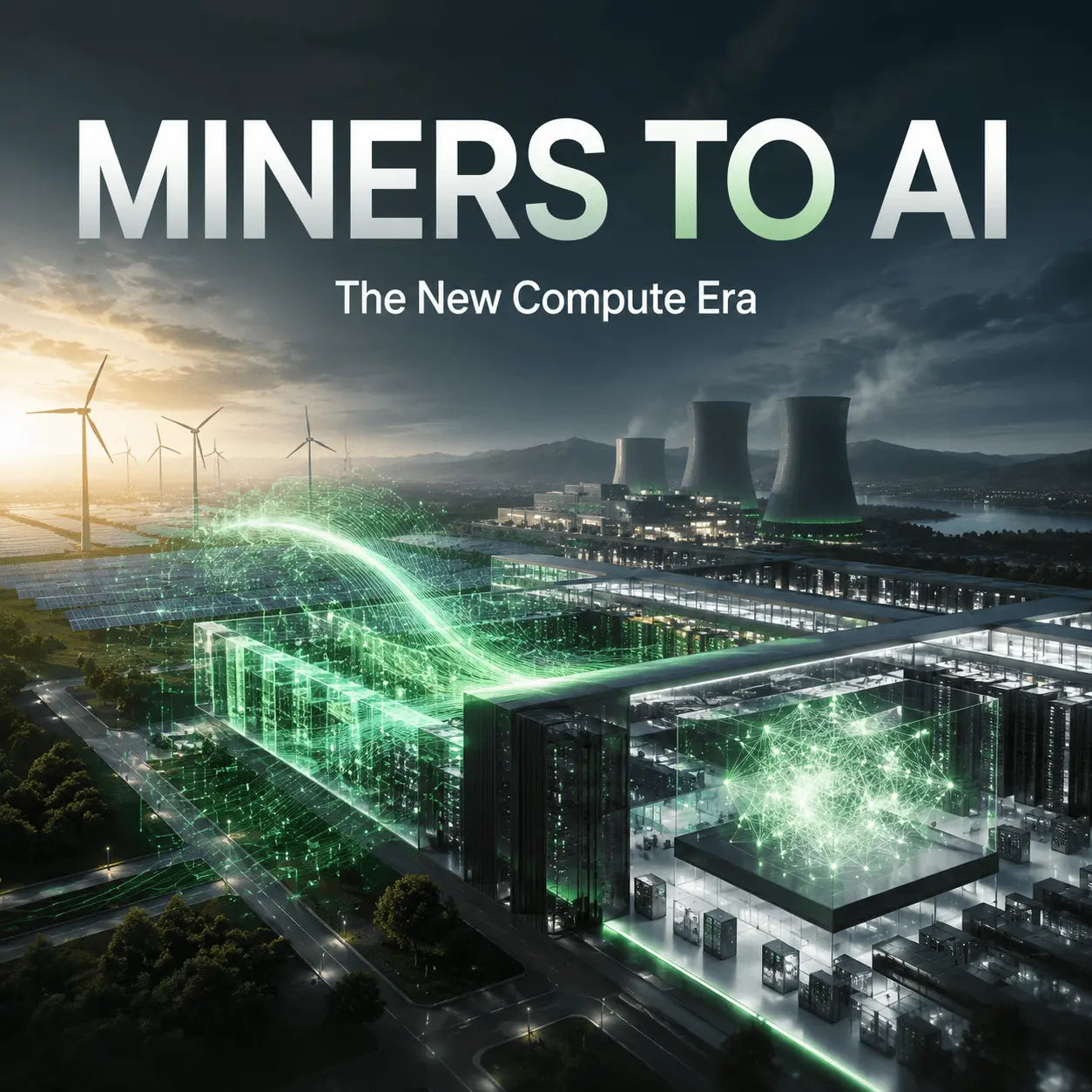
Why Bitcoin Miners Are Turning Power
Into AI Compute
Power monetization · AI/HPC contracts · Critical IT capacity · Conversion risk · Hybrid infrastructure strategy
On This Page
1Quick Answer: Miners Are Monetizing Power, Not Reusing ASICs
Bitcoin miners are moving into AI and high-performance computing because some of them control something AI developers urgently need: large blocks of power, land, substations, transmission access, construction teams, and operating experience with continuous high-density loads. The commercial opportunity is to turn those assets into data-center capacity sold under hosting, colocation, cloud-service, or long-term lease agreements.
This does not mean an AI computer can competitively mine Bitcoin, or that a Bitcoin ASIC can be converted into a GPU. SHA-256 ASICs remain purpose-built mining machines. AI clusters use GPUs or other accelerators, different networks, different cooling systems, and stricter service levels. What may transfer is selected site infrastructure, not the compute hardware.
ID201 explains the commercial strategy: why miners are reallocating megawatts and signing AI/HPC contracts. For the engineering question of whether a mining site can physically support AI workloads, read the separate Bitcoin mining data-center conversion guide.
2Why the Pure Mining Model Faces More Pressure
Bitcoin mining revenue depends on Bitcoin price, network difficulty, transaction fees, machine efficiency, uptime, and electricity cost. The April 2024 halving reduced the block subsidy from 6.25 BTC to 3.125 BTC, while site rent, labor, transformers, financing, and most power costs did not fall with it. New ASIC deployments also continue to raise network competition.
That pressure does not make mining obsolete. Efficient operators with low-cost power can still create value, and mining remains unusually flexible as an electrical load. But it forces management teams to ask a more demanding capital-allocation question: is the next available megawatt worth more in SHA-256 mining, AI hosting, a long-term power lease, or a hybrid campus?
The answer changes by site. A remote, interruptible location with inexpensive electricity may remain excellent for Bitcoin mining and unattractive to AI tenants. A site near fiber routes, population centers, skilled labor, and firm grid capacity may support a higher-value data-center project. The business shift is therefore selective, not universal.
3Bitcoin Mining and AI Hosting Sell Different Products
A mining company earns probabilistic network rewards. An AI infrastructure operator sells a contracted service: critical IT capacity, racks, cooling, connectivity, security, operations, and availability. Those models can share a power campus while producing very different cash-flow patterns and risk.
| Commercial Layer | Bitcoin Mining | AI/HPC Hosting |
|---|---|---|
| What is sold | SHA-256 work that earns BTC rewards and fees | Data-center capacity, colocation, or compute service |
| Revenue driver | BTC price, fees, network difficulty, uptime | Contracted MW, utilization, service scope, customer credit |
| Hardware | Bitcoin ASIC fleet | GPU or accelerator platform plus storage and networking |
| Load behavior | Can curtail when economics or grid conditions require it | Usually tied to stricter availability and maintenance obligations |
| Capital intensity | ASICs plus mining electrical and cooling infrastructure | Purpose-built shells, liquid cooling, fiber, redundancy, controls, security |
| Main downside | Commodity-like revenue volatility and hardware obsolescence | Construction, financing, customer, SLA, and technology-refresh risk |
Long-term AI contracts can improve revenue visibility, but visibility is not certainty. Rent often begins only after a hall passes delivery and acceptance milestones. Delays in substations, cooling equipment, fiber, permits, financing, or customer deployment can postpone revenue while interest and construction costs continue.
4Which Mining Assets Transfer to AI, and Which Do Not?
The strongest transferable asset is usually deliverable electrical capacity: land and interconnection rights that can support a real construction schedule. Grid queues can be long, and energized capacity may shorten the path to market. Site ownership, substations, utility relationships, permitting experience, and operating teams can also reduce development friction.
The ASIC fleet does not transfer. A basic air-cooled mining hall may also have limited reuse if the AI design requires much denser racks, direct liquid cooling, new busway, redundant fiber, stricter fire protection, backup systems, and customer-specific security. Even gross megawatts can mislead: an AI contract is usually discussed in critical IT megawatts, which excludes part of the facility power consumed by cooling and support systems.
5What 2026 Company Evidence Shows
By 2026, the shift was no longer only an investor presentation. Public filings and company disclosures showed actual leases, construction, energized capacity, and a strategic reallocation of capital. The examples below demonstrate the opportunity, but they also reveal the scale of the commitment.
| Operator | Published Development | What It Demonstrates |
|---|---|---|
| Riot Platforms | Signed a 15-year triple-net powered-land lease covering 910 MW of critical IT capacity at Corsicana, with approximately $28 billion of initial-term contract value | A miner can monetize land, interconnection, and electrical infrastructure without supplying or operating the tenant's AI compute hardware |
| TeraWulf | Reported 102 MW of revenue-generating critical IT capacity online at Lake Mariner in July 2026 and a 20-year Anthropic lease for roughly 401 MW at a separate purpose-built campus | Mining infrastructure can seed a broader platform, but major AI growth uses long-duration leases and purpose-built development |
| Cipher Digital | Described a transition from pure-play mining toward a vertically integrated data-center platform, with existing mining sites being retrofitted and new campuses built for HPC tenants | Power origination and site development can become the core business while mining remains an interim or complementary use |
| IREN | Announced a large AI cloud agreement tied to a staged deployment at its Childress power campus | The deliverable includes GPUs, liquid-cooled data centers, operations, and a deployment schedule, not electricity alone |
TeraWulf's second-quarter 2026 filing is especially instructive: it reported that HPC leasing had become a majority of quarterly revenue while portions of legacy mining capacity were curtailed or repurposed. That is evidence of a real operating transition. It is not proof that every announced project will meet its schedule or margin target.
Riot's $28 Billion Corsicana Lease: What the Headline Actually Means
Riot Platforms added the clearest current example on November 4, 2026. The company announced a 15-year triple-net powered-land lease with a leading Frontier AI Lab for the full Corsicana campus: 910 MW of critical IT capacity on 332 acres. Riot described approximately $28 billion of total contract value and about $1.8 billion of average annual rent over the initial term, including contractual escalators. Those figures describe scheduled lease economics, not cash received on the announcement date and not guaranteed net profit.
The structure also shows why “AI lease” can mean something different from operating an AI cloud. Riot is responsible for the land, power infrastructure, powered pads, and continued ownership and maintenance of the high- and medium-voltage systems. The tenant is expected to procure, install, own, and operate the modular compute deployment and bear substantially all operating costs, including power as a pass-through. Riot therefore monetizes its power campus without converting Bitcoin ASICs into AI hardware.
| Riot Disclosure | Published Figure | How to Interpret It |
|---|---|---|
| Initial lease term | 15 years; approximately $28 billion total contract value | Long-term contracted value, not immediate revenue or profit |
| Capacity | 910 MW of critical IT load | Usable tenant compute capacity, not simply the site's gross electrical nameplate |
| Delivery schedule | 400 MW in September 2027, 200 MW in January 2028, and 310 MW in July 2028 | Rent is expected to begin by phase after powered-pad delivery, so execution timing matters |
| Estimated capital requirement | Approximately $6 million per IT MW, or $5.5 billion overall | The headline contract requires major development and financing before all rent can be earned |
| 2026 funding source | 20,264 BTC sold for approximately $1.5 billion during the first nine months | Bitcoin treasury value is being converted into data-center development capital |
Riot's third-quarter mining results reinforce the capital-allocation tension. Bitcoin production increased 16% year over year to 1,637 BTC, but Bitcoin Mining revenue fell from $160.8 million to $116.0 million because the average production value per coin was lower. Riot reported a $39,265 cost to mine one BTC before miner depreciation and $78,805 including depreciation, compared with a $70,855 production value per BTC for the quarter. This does not mean the mining fleet should be switched off solely because of a non-cash depreciation charge. It does show why management compares flexible mining cash flow with the potential value of long-duration infrastructure contracts.
The Riot agreement is evidence that powered land and grid access can command substantial value. It is not evidence that every mining site is AI-ready, that $28 billion is already earned, or that AI infrastructure is automatically more profitable than mining. Delivery, financing, tenant credit, construction, and contract performance remain decisive.
Capacity, contract value, expected delivery dates, and projected margins may depend on construction, financing, customer credit, power delivery, and acceptance tests. Use filings to understand the model, not as guaranteed outcomes.
6Why a Large Contract Headline Is Not the Same as Profit
AI infrastructure announcements often quote the total value of a 10-, 15-, or 20-year agreement. That number can be useful, but it is not current revenue and it is not net income. A disciplined review separates contract headline value from the cash and obligations required to earn it.
- Critical IT MW vs. gross MW: the customer pays for usable compute capacity, while the site also consumes energy for cooling and support systems.
- Delivery schedule: rent may start phase by phase after commissioning rather than on the announcement date.
- Construction cost: purpose-built AI capacity can require many millions of dollars per critical IT megawatt.
- Financing: debt cost, guarantees, tenant credit support, equity dilution, and completion risk affect shareholder value.
- Power treatment: contracts differ on utility pass-throughs, escalators, curtailment, and responsibility for excess costs.
- Exit rights: termination, delay remedies, acceptance criteria, and renewal options can matter as much as the headline term.
A miner evaluating its own site should model annual rent commencement, development cost, interest during construction, operating expense, tax, maintenance, equipment refresh, and downside delays. It should then compare that result with continued mining under conservative assumptions using the Bitcoin mining electricity cost framework and the broader miner profitability and market outlook.
7Four Strategies Are Emerging
The market is not moving toward one universal model. Operators are choosing among four approaches based on site quality, balance sheet, customer access, and appetite for construction risk.
| Strategy | Best Fit | Main Trade-Off |
|---|---|---|
| Pure-play mining | Low-cost, flexible, remote, or interruption-friendly power | Retains BTC upside and curtailment value but remains exposed to mining economics |
| Hybrid campus | Large sites where a premium AI phase can be separated from flexible mining load | Preserves optionality but requires careful electrical, cooling, and operating separation |
| AI/HPC redevelopment | Sites with strong fiber, firm power, customer demand, financing, and conversion economics | Can improve contracted visibility but commits capital and reduces mining flexibility |
| Power-and-land monetization | Owners with valuable sites but limited desire to build or operate AI infrastructure | Reduces execution exposure while giving up part of the development upside |
Hybrid campuses may be strategically useful because mining can operate before an AI phase is ready and can sometimes use capacity that would otherwise remain idle. But once a data hall is promised under a service-level agreement, its power cannot be casually switched back to mining. Contracted AI capacity and flexible mining capacity must be treated as different operating products.
8A Decision Framework for Miners
- Freeze the site facts: document utility rights, energized capacity, expansion milestones, tariff, curtailment rules, acreage, permits, fiber, water, and building condition.
- Define the customer product: decide whether the offer is land and power, powered shell, colocation, managed infrastructure, or cloud compute.
- Separate reusable and replacement scope: identify which substations, buildings, cooling systems, controls, and networks can meet the new design.
- Build a financeable schedule: align utility delivery, equipment lead times, construction, commissioning, customer acceptance, and rent commencement.
- Stress-test the contract: model delays, cost overruns, lower utilization, customer default, technology refresh, and higher financing cost.
- Compare all alternatives: test continued mining, hybrid operation, leasing the site, and full AI redevelopment under the same power and capital assumptions.
Do not convert a mining site because AI demand is fashionable. Proceed only when deliverable power, fiber, engineering, customer requirements, financing, and contract risk all support the same project.
9What the AI Pivot Means for Bitcoin Mining
The pivot does not mean miners are collectively abandoning Bitcoin. It means premium power sites are being repriced. Sites that can support AI may attract more capital, while low-cost interruptible sites may remain specialized mining assets. This separation can make the mining sector more disciplined: firms must justify why each megawatt belongs in a particular workload.
For smaller miners, public-company AI contracts are not a direct operating playbook. Most small sites lack the scale, fiber, financing, customer pipeline, and service organization required for hyperscale hosting. Their practical edge may still come from efficient ASICs, low electricity cost, stable uptime, curtailment programs, heat reuse, or carefully timed equipment purchases.
Energy claims also need evidence. AI infrastructure usually wants firmer service and may curtail less easily than mining. A site that changes workloads can change its grid value and environmental profile. The green-energy and flexible-load analysis explains why measured grid behavior matters more than broad labels.
10Bitcoin Miners and AI Compute FAQ
Can an AI computer mine Bitcoin?
A general AI server or GPU can technically perform calculations, but it cannot competitively replace a modern SHA-256 ASIC for Bitcoin mining. The economic link between miners and AI is usually shared power infrastructure, not shared compute hardware.
Why are Bitcoin miners turning to AI?
Some miners control large power interconnections, land, substations, and development teams that AI data-center customers need. AI hosting may also provide longer contracted revenue visibility than mining alone.
Can any Bitcoin mine become an AI data center?
No. A viable project needs firm and deliverable power, high-capacity fiber, suitable location, dense cooling, structural capacity, security, operations, financing, and a customer-compatible delivery schedule.
Is AI hosting always more profitable than Bitcoin mining?
No. AI hosting can support long-term contracts but demands much more capital and introduces construction, financing, tenant, technology, and SLA risk. Each site requires a full comparison with continued mining.
What is the difference between gross MW and critical IT MW?
Gross MW is total site power. Critical IT MW is the portion delivered to customer computing equipment after accounting for cooling and other facility loads. Contract comparisons should not treat the two figures as interchangeable.
Will AI reduce the Bitcoin network hashrate?
Some operators may redirect capital or retire mining halls, but network hashrate depends on global miner economics and new deployments. AI conversion at selected premium sites does not automatically imply a lasting hashrate decline.
11References and Data Sources
Current claims were checked against official company disclosures, regulatory filings, equipment documentation, and energy analysis. Forward-looking contract figures and schedules are identified as company expectations, not guaranteed outcomes.
- Riot Platforms: Third Quarter 2026 Results and Corsicana Lease DisclosureOfficial SEC-filed details on the 910 MW lease, contract value, delivery schedule, capital requirement, Bitcoin sales, mining revenue, production, and cost per BTC.
- TeraWulf Form 10-Q for the Quarter Ended June 30, 2026Operating transition, energized HPC capacity, mining curtailment, lease structure, and risk disclosures.
- TeraWulf: Anthropic Lease at Justified Data CampusOfficial 2026 disclosure of the long-term purpose-built AI infrastructure lease.
- Cipher Digital Form 10-Q for the Quarter Ended June 30, 2026HPC strategy, site pipeline, retrofit activity, construction dependencies, and financing risk.
- Cipher: AI/HPC Business Update Filed with the SECOfficial transaction summary showing capacity, term, schedule, and project-finance support.
- IREN Form 10-K for the Year Ended June 30, 2026Microsoft deployment status, contract structure, GPU financing, customer concentration, and delivery risk.
- NVIDIA: GB200 NVL72 Architecture GuideRack-scale AI architecture, power, networking, and liquid-cooling context.
- IEA: Powering Artificial Intelligence2026 energy-system context for reliable and sustainable AI infrastructure growth.
Final Verdict
Bitcoin miners are not turning ASICs into AI machines. The strongest operators are turning control of power, land, interconnections, and development schedules into a broader digital-infrastructure business. Long-term AI and HPC contracts can reduce reliance on daily mining economics, but only after capital is raised, facilities are delivered, customers accept them, and service levels are maintained.
The right strategy is site specific. Keep mining where flexible, low-cost power creates an advantage. Consider AI where firm power, fiber, location, engineering, financing, and a credible customer support the conversion. Use a hybrid model when it preserves optionality without confusing contracted AI capacity with interruptible mining load.



Leave a comment
This site is protected by hCaptcha and the hCaptcha Privacy Policy and Terms of Service apply.